SMB1001 vs the Essential Eight for Australian SMBs
SMB1001 and the Essential Eight solve different problems. The Essential Eight is a set of eight technical mitigation strategies from the Australian Signals Directorate, measured across maturity levels, with no certificate at the end. SMB1001 is a tiered certification scheme for small and medium businesses, published by Dynamic Standards International, that gives you something to show a customer or an insurer. If you need proof, SMB1001 provides it. If you need hardening, the Essential Eight tells you what to do.
Most Australian businesses that ask us to compare the two are really asking one of two questions. Either a customer or insurer has asked for evidence and they want to know the cheapest credible answer, or they want to know where to start technically. Those have different answers, and the rest of this article separates them.
What is the Essential Eight?
The Essential Eight is a prioritised set of eight mitigation strategies published by the Australian Signals Directorate through the Australian Cyber Security Centre. It is guidance, not a certification scheme. There is no body that issues an Essential Eight certificate, and no legal requirement for a general commercial business in Australia to implement it.
- Application control
- Patch applications
- Configure Microsoft Office macro settings
- User application hardening
- Restrict administrative privileges
- Patch operating systems
- Multi-factor authentication
- Regular backups
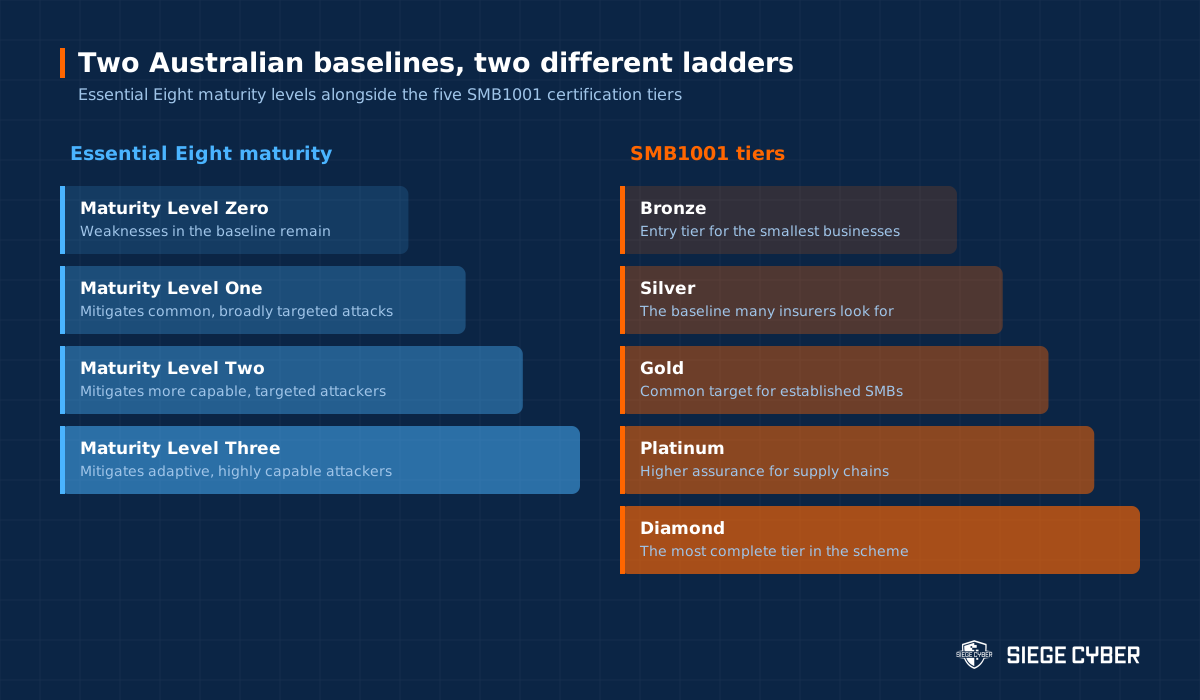
Implementation is measured against maturity levels, from Maturity Level Zero up to Maturity Level Three, where the target level is meant to be chosen according to the threat you face rather than ambition. Most small Australian businesses that genuinely reach Maturity Level One have removed a large share of their practical risk. We cover what the strategies require in the ASD Essential Eight requirements and what the next step up involves in Essential Eight Maturity Level 2.
The Essential Eight becomes mandatory only in specific contexts, most visibly for non-corporate Commonwealth entities, and it appears in government tenders and supplier requirements. Whether it applies to you is covered in is the Essential Eight mandatory in Australia.
What is SMB1001?
SMB1001 is a multi-tiered cybersecurity certification standard built specifically for small and medium businesses. It is published by Dynamic Standards International, which describes it as a dynamic standard updated annually, and the current edition is SMB1001:2026. Certification is delivered through CyberCert, which operates as the Dynamic Standard Certifier for the scheme.
The structure is five tiers, badged Bronze, Silver, Gold, Platinum and Diamond, with each tier adding controls on top of the one below. The design intent is that a micro business can start at the bottom and move up as customers demand more, rather than facing a single large jump. CyberCert states that Silver certification demonstrates the security baseline most insurers require, which is the reason a lot of Australian SMBs encounter the scheme in the first place.
The thing that distinguishes SMB1001 from the Essential Eight is simply that it produces a certificate. You can put it in a tender response, send it to a customer’s procurement team, or give it to a broker. We have covered the scheme itself in SMB1001 certification in Australia.
How do SMB1001 and the Essential Eight compare?
Comparing SMB1001 and the Essential Eight directly is slightly unfair to both, because one is a certification scheme and the other is technical guidance. The comparison is still worth making, because Australian businesses are routinely asked to choose between them as though they were equivalent.
| Essential Eight | SMB1001 | |
|---|---|---|
| Published by | Australian Signals Directorate (ACSC) | Dynamic Standards International |
| What it is | Eight prioritised technical mitigation strategies | A tiered certification standard for SMBs |
| Certificate? | No | Yes, through CyberCert as certifier |
| Structure | Maturity Level Zero to Maturity Level Three | Five tiers: Bronze, Silver, Gold, Platinum, Diamond |
| Coverage | Technical controls only | Technical controls plus people and process elements |
| Cost to access | Free to read and implement | Standard is purchased; certification is a paid service |
| Who asks for it | Government buyers, defence supply chain, larger enterprise customers | Insurers, brokers, SME supply chains, some tenders |
| Verification | Self-assessment unless an assessor is engaged | Certification through the scheme |
| Best when | You need to reduce technical risk, or a tender names it | You need to prove a baseline to a third party |
Which one does your business need?
Choosing between SMB1001 and the Essential Eight starts with who is asking and why. In practice the decision is driven almost entirely by the demand in front of you, not by which framework is better.
| Your situation | Start with |
|---|---|
| An insurer or broker has asked what security controls you have | SMB1001, because it produces evidence they recognise |
| You are bidding for Commonwealth or state government work | Essential Eight, because tenders name it and often specify a maturity level |
| You supply a larger business that sent you a security questionnaire | Essential Eight for the technical answers, SMB1001 if they want third party verification |
| You are in the defence supply chain | Essential Eight, as part of the broader DISP requirements |
| Nobody has asked, and you want to reduce real risk | Essential Eight, because it is free and it targets the attacks that actually happen |
| You are selling software to enterprise or overseas customers | Neither; ISO 27001 or SOC 2 is what those buyers ask for |
That last row matters. If your customers are enterprises or you sell internationally, neither of these frameworks is what you will be asked for. We compare the heavier options in ISO 27001 versus the Essential Eight and in SMB1001 versus ISO 27001.
Do SMB1001 and the Essential Eight overlap?
SMB1001 and the Essential Eight overlap substantially at the control level, because both are built around the same well-established basics. Multi-factor authentication, patching, backups and restricting administrative access appear in both, for the straightforward reason that these are the controls that stop the attacks Australian small businesses actually suffer.
The practical consequence is that work is not wasted. A business that has genuinely implemented Essential Eight Maturity Level One has done much of the technical work that the middle SMB1001 tiers ask for, and a business certified at a higher SMB1001 tier will have most of the Essential Eight in place. What differs is the wrapper: SMB1001 asks you to evidence and have it verified, the Essential Eight asks you to implement and measure your own maturity.
Where they genuinely differ is breadth. The Essential Eight is deliberately narrow and deliberately technical. It says nothing about staff training, supplier management, incident response planning or governance. Those gaps are real, and they are why the Essential Eight alone rarely satisfies a thorough customer security review.
What does a sensible sequence look like for a small Australian business?
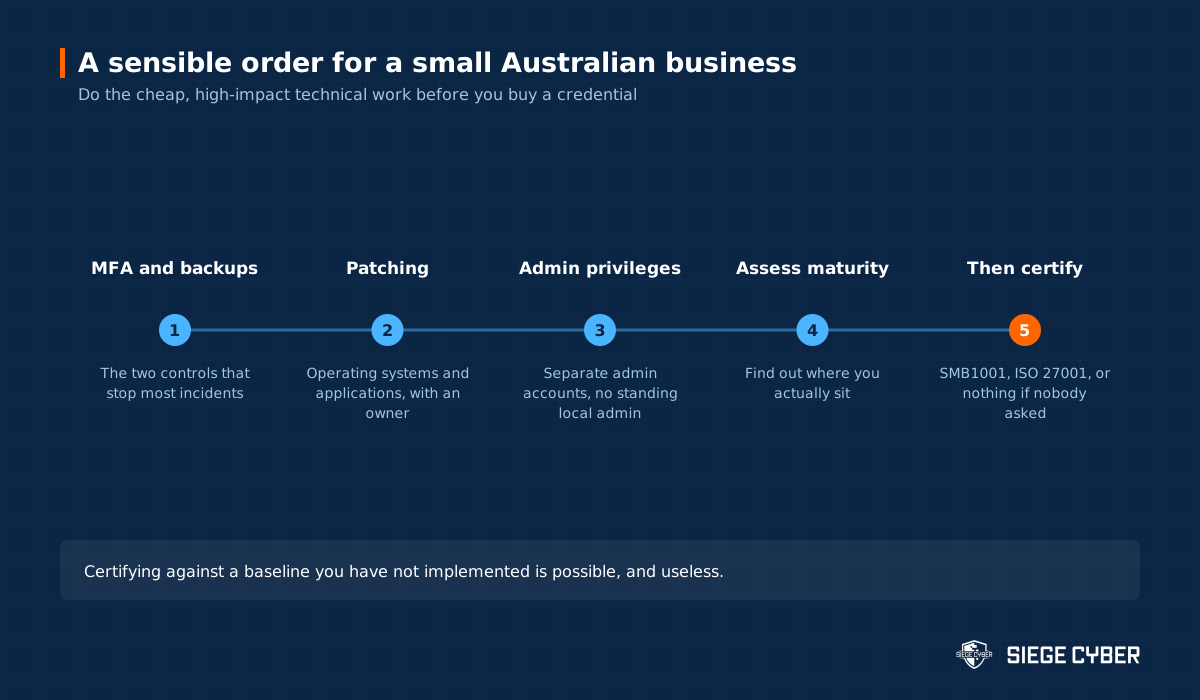
A sensible sequence for a small Australian business puts the cheap, high-impact technical work first and the credential second, unless a deadline forces the reverse. The order below works for most businesses with 2 to 100 staff.
- Fix multi-factor authentication and backups first. These two mitigate the largest share of real incidents and neither requires a framework decision.
- Get patching under control. Operating systems and applications, on a defined timeframe, with someone accountable.
- Restrict administrative privileges. Separate admin accounts from daily use accounts and remove standing local admin rights.
- Assess where you sit. A maturity assessment against the Essential Eight tells you what is left, and we describe that process in our Essential Eight maturity assessment article.
- Then pick the credential your market asks for. SMB1001 if an insurer or SME customer wants proof, ISO 27001 if you are selling to enterprise, nothing at all if nobody has asked.
The order matters because certification against a baseline you have not actually implemented is both possible and useless. The point of any of this is that the controls work on the day something goes wrong.
Common questions
What is SMB1001?
SMB1001 is a cybersecurity standard and certification scheme designed specifically for small and medium businesses, published by Dynamic Standards International. It uses five tiers, Bronze through Diamond, so a business can certify at a level that matches what its customers and insurers expect and move up over time. Certification is delivered through CyberCert, which acts as the Dynamic Standard Certifier.
What is SMB1001 certification?
SMB1001 certification is the process of being assessed against one of the five SMB1001 tiers and receiving a certificate you can show to customers, insurers and tender panels. Unlike the Essential Eight, which you implement and self-assess, SMB1001 produces third party evidence. The tier you choose should be driven by what the party asking for proof actually requires.
Who created SMB1001?
SMB1001 is published and maintained by Dynamic Standards International, which releases annual editions, the current one being SMB1001:2026. Certification against the standard is delivered by CyberCert in its role as the Dynamic Standard Certifier. The standard itself is available for purchase from Dynamic Standards International.
Is SMB1001 better than the Essential Eight?
Neither is better, because they do different jobs. The Essential Eight is free, technical and narrow, and it is excellent at reducing the risk of the attacks that most commonly hit Australian small businesses. SMB1001 costs money and produces a certificate, which is exactly what you need when a customer, a tender or an insurer wants evidence rather than assurances. Many businesses end up doing both.
Does the Essential Eight require certification?
No. The Essential Eight has no certification scheme attached to it. Organisations self-assess their maturity level, or engage an assessor to do it independently where a customer or tender requires more confidence than a self-assessment provides. An independent assessment produces a report rather than a certificate.
Where to start
If someone has asked you for proof, SMB1001 is the faster and cheaper route to something you can hand over. If you are trying to reduce the chance of a bad week, the Essential Eight is free and it targets the right things. If you are selling to enterprise customers, you will eventually be asked for neither of them and for ISO 27001 instead, so it is worth knowing that before you invest.
One last point worth making plainly. Neither of these frameworks stops an attack on its own. What stops an attack is multi-factor authentication that is actually switched on everywhere, backups that have been restored from at least once, and patches applied before the exploit is public. Both SMB1001 and the Essential Eight are structures for making sure those things happen and keep happening. The structure is useful, and it is not the point.
Our SMB1001 services and Essential Eight services pages set out how we help with each, and you are welcome to get in touch for a straight answer on which one your situation actually calls for.