SMB1001 vs ISO 27001: Which Does Your Business Need?
Choose SMB1001 if you need to show a customer, insurer or supply chain partner that you meet a defined security baseline, quickly and at modest cost. Choose ISO 27001 if a tender, an enterprise customer or an offshore buyer has named it, or if you need a certificate that is recognised outside Australia. The deciding factor is rarely which standard is better. It is who is asking, and what they will accept.
There is one difference that most comparisons skip, and it matters commercially. At SMB1001 levels one to three, which includes the Gold tier most Australian small businesses buy, the assessment is attested by a company director. Independent audit begins at level four. ISO 27001 is audited by an accredited certification body every time.
What is the difference between SMB1001 and ISO 27001?
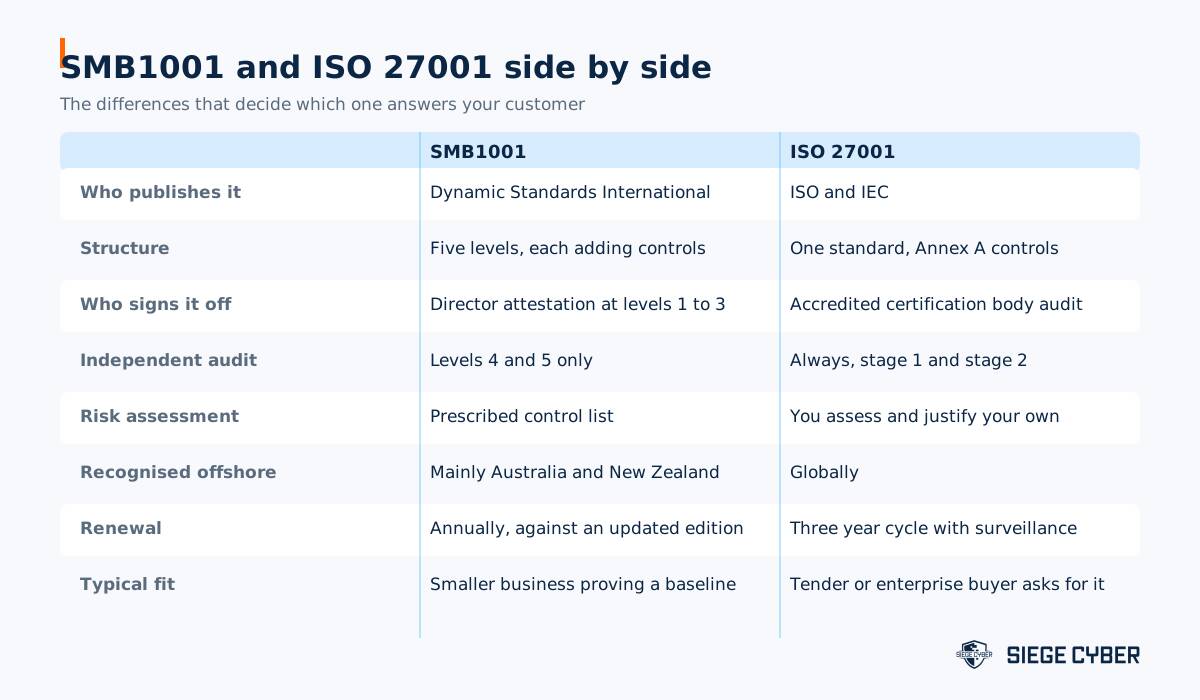
SMB1001 is an Australian originated certification standard for small and medium businesses, published by Dynamic Standards International. It sets out a tiered list of security controls across five levels, and a business certifies at the level that suits it. ISO 27001 is an international standard, published by ISO and IEC, that requires you to build an information security management system: a documented set of processes for assessing your own risks, choosing controls to treat them, and improving over time.
The practical difference is who decides what you implement. SMB1001 tells you which controls to put in place at each level. ISO 27001 asks you to work out which controls your own risks demand, and to justify that reasoning to an auditor. One is a checklist you work through. The other is a management system you run.
| SMB1001 | ISO 27001 | |
|---|---|---|
| Published by | Dynamic Standards International | ISO and IEC |
| Structure | Five levels, each building on the last | Management clauses plus Annex A controls |
| Who decides the controls | The standard prescribes them | You justify them from your own risk assessment |
| Assessment at entry levels | Director attestation | Not applicable, audit is always required |
| Independent audit | Levels four and five | Always, stage one and stage two |
| Recognition | Mainly Australia and New Zealand | Global |
| Cycle | Annual, against an updated edition | Three year certificate with annual surveillance |
| Suits | Proving a defined baseline | Answering a buyer or tender that names it |
What is SMB1001 and who publishes it?
SMB1001 is published by Dynamic Standards International, a not for profit standards body. The current edition is SMB1001:2026, published on 1 September 2025. The standard is revised annually, which is unusual and deliberate: the publisher treats it as a dynamic standard that moves with the threat environment rather than being reissued every few years.
The controls are grouped into five domains: technology management, access management, backup and recovery, policies and plans and procedures, and education and training. Certification is not issued by the publisher. It is issued by an authorised certifier, and CyberCert is currently the certifier for SMB1001 in Australia. The standard document itself is licensed rather than free, with the licence fee scaled to the size of the organisation. You can read the published detail on the publisher’s SMB1001 page.
SMB1001 is a private standard. It is not an Australian Government standard and it is not mandated by legislation. That does not make it less useful, but it does mean its value depends entirely on whether the party asking for assurance recognises it.
Who actually checks an SMB1001 certificate?
At SMB1001 levels one, two and three, the assessment is director attested. A company director signs an attestation that the controls are in place. At levels four and five, the assessment is attested and audited, with an external audit fee on top of the certification subscription. This is set out in the publisher’s own supplier categorization matrix, which lists the assessment type for each level.
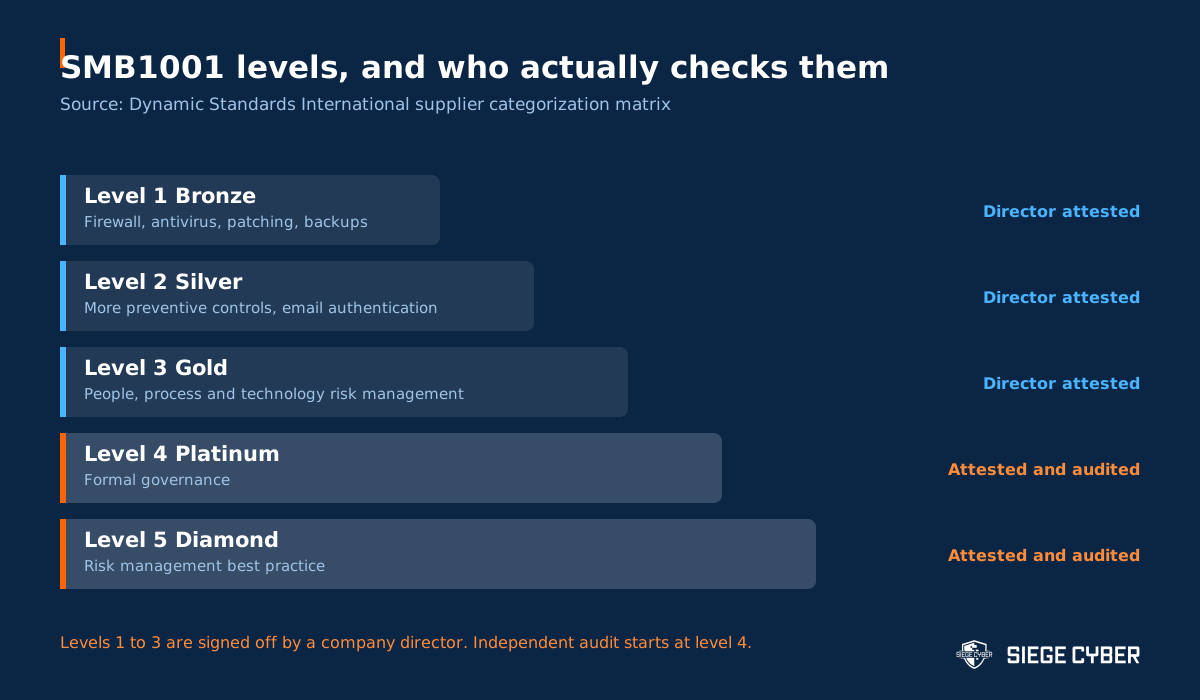
This matters in two directions. If you are buying assurance from a supplier, a Gold certificate tells you the supplier’s director has attested to a defined control set. That is meaningful, and it is not the same as an independent audit. If you are selling, know which one you hold before a sophisticated buyer asks, because answering that question wrongly in a procurement process is a worse outcome than not holding the certificate at all.
ISO 27001 removes the ambiguity. Certification requires a stage one review of your documentation and a stage two audit of your management system in operation, carried out by an external certification body, followed by annual surveillance audits. Our guide to choosing an ISO 27001 certification body covers what accreditation to look for.
When is ISO 27001 the right choice for an Australian business?
ISO 27001 is the right choice when someone has named it. That sounds flippant, but it is the single most reliable test. ISO 27001 is the standard written into Australian tender documents, enterprise vendor agreements and offshore procurement requirements. If a contract says ISO 27001, nothing else will satisfy it, however good your security actually is.
Four situations point to ISO 27001. You are bidding for government or large enterprise work where the tender names it. You sell into Europe, the United Kingdom or Asia, where SMB1001 carries little recognition. You hold or process significant volumes of customer data and need a framework that scales with that responsibility. Or you need one certificate that answers many different customers, rather than a different attestation for each.
ISO 27001 also costs more and takes longer. Expect a programme measured in months rather than weeks, external audit fees, and ongoing effort to keep the management system running between audits. Our guide to the cost of ISO 27001 certification in Australia sets out where the money goes, and our guide to defining your ISMS scope covers the decision that most affects both cost and timeline.
When is SMB1001 enough?
SMB1001 is enough when the party asking has accepted it, and when your own risk does not demand more. For a twenty person Australian services business whose largest client wants evidence of a security baseline, a certification at an appropriate SMB1001 level is proportionate, fast and demonstrably better than a spreadsheet of good intentions.
It is a sensible first step in three cases. You have been asked for assurance but not for a specific standard. You want a structured programme of improvement with a visible milestone at the end. Or you expect to pursue ISO 27001 later and want to build the underlying controls first, since the technical work overlaps substantially.
SMB1001 is not enough in three cases. A tender or contract names ISO 27001. A buyer explicitly requires an independently audited certificate and you hold a director attested level. Or you operate in a regulated space where a specific framework applies, such as APRA regulated entities or defence suppliers. Checking which framework your obligations actually point to is worth doing before you start either programme, and our overview of ISO 27001 and the Essential Eight covers the other comparison Australian businesses commonly face.
Can SMB1001 satisfy a tender that asks for ISO 27001?
No. If a tender document requires ISO 27001 certification, an SMB1001 certificate at any level does not meet that requirement. The two standards are structured differently, are assessed differently, and are not formally equivalent. Submitting one where the other was asked for usually results in a non conforming response.
What SMB1001 can do in a procurement process is demonstrate that security has been taken seriously while an ISO 27001 programme is under way, where the buyer allows that. Some Australian buyers will accept evidence of a certification in progress with a target date. Ask the question early, in writing, rather than assuming either way.
| What the buyer asked for | Does SMB1001 answer it | Does ISO 27001 answer it |
|---|---|---|
| ISO 27001 certification | No | Yes |
| Evidence of a security baseline | Yes | Yes |
| Independently audited certification | Only at levels four and five | Yes |
| Recognition outside Australia | Limited | Yes |
| A completed security questionnaire | Helps, does not replace it | Helps, does not replace it |
Common questions
What is SMB1001?
SMB1001 is a cyber security certification standard for small and medium businesses, published by Dynamic Standards International. It defines controls across five levels, from basic preventive measures such as firewalls, antivirus, patching and backups at level one, through to formal governance and risk management at levels four and five. The current edition is SMB1001:2026 and the standard is revised annually.
What is SMB1001 certification?
SMB1001 certification is a certificate issued against a chosen level of the SMB1001 standard by an authorised certifier. At levels one to three the assessment is attested by a company director. At levels four and five it is attested and independently audited, with a separate audit fee. Certification is valid for a year and renews against the updated edition of the standard.
Is SMB1001 an Australian Government standard?
No. SMB1001 is a private standard published by Dynamic Standards International, a not for profit standards body. It is not published, endorsed or mandated by the Australian Government, and no legislation requires it. Businesses pursue it because a customer, insurer or supply chain partner has asked for evidence of a security baseline, not because it is legally required.
Is ISO 27001 mandatory in Australia?
No. ISO 27001 is not mandatory for Australian businesses under general law. It becomes effectively mandatory through contracts: tenders, enterprise vendor agreements and customer requirements that name it. Specific sectors have their own obligations that may point elsewhere. Our guide on whether ISO 27001 is mandatory in Australia covers where the requirement usually comes from.
Can you do SMB1001 and ISO 27001 at the same time?
Yes, and the technical work overlaps. Access control, patching, backups, logging and awareness training appear in both. What does not transfer is the management system. ISO 27001 requires a documented risk assessment, a Statement of Applicability, internal audit and management review, none of which an SMB1001 certification produces. Treat SMB1001 as a head start on controls, not as a shortcut through ISO 27001.
Not sure which standard your customers will accept?
Siege Cyber helps Australian businesses pick the framework that answers the question their customers are actually asking, then get there without unnecessary work. See our ISO 27001 services or our SMB1001 services, read our guide to SMB1001 certification in Australia or our overview of ISO 27001 certification in Australia, or get in touch and we will tell you which one fits.