Secure SDLC: A Practical Guide for SaaS Startups
A secure software development lifecycle is the set of security controls built into how you plan, write, test, release and run software, rather than a review bolted on at the end. For an Australian SaaS startup of ten to forty people, a defensible secure SDLC is five controls: threat model the risky changes, require peer review before merge, run dependency and code scanning in the pipeline, record release approvals, and penetration test the application periodically. That is enough to satisfy ISO 27001 and SOC 2 auditors.
The reason to set it up early is not the audit. It is that retrofitting these controls onto a codebase and a team of thirty is considerably harder than starting with them at ten.
What does a secure SDLC look like for a team of ten?
A secure SDLC for a small SaaS team attaches one meaningful control to each phase of development, chosen so that the control produces evidence as a by-product of doing the work.
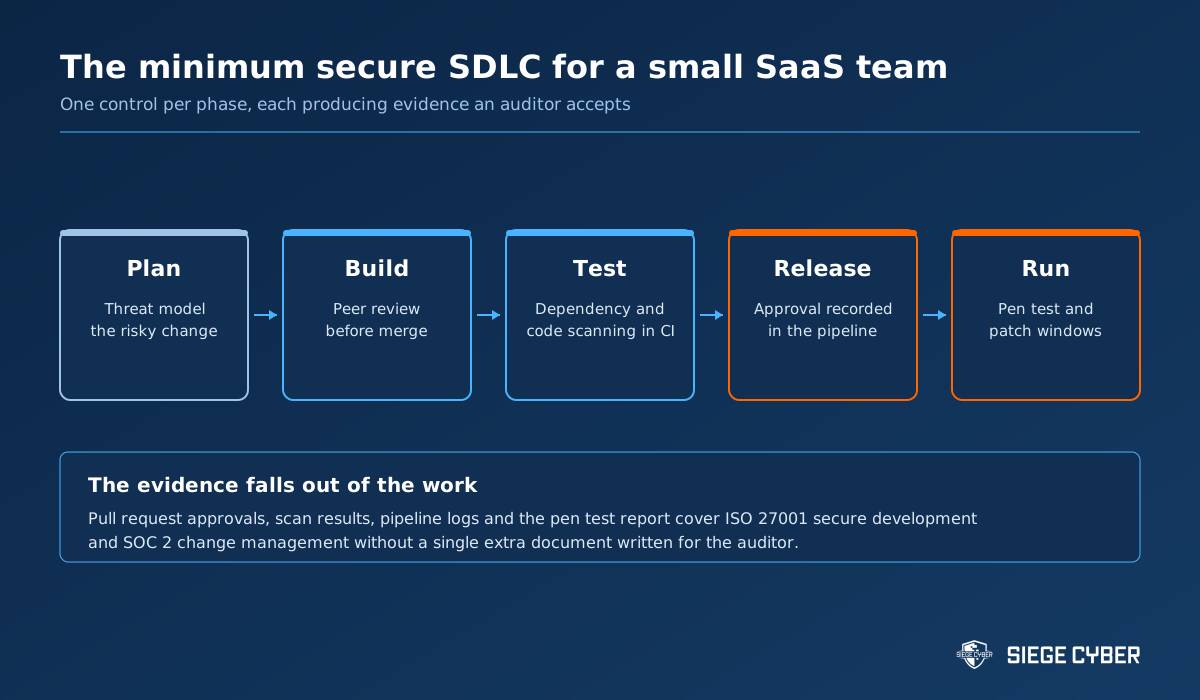
| Phase | The minimum control | The evidence it produces |
|---|---|---|
| Plan | Threat model changes that touch authentication, payments or customer data | A short written threat model in the ticket |
| Build | Peer review required before merge, enforced in the repository | Pull request approval history |
| Test | Dependency scanning and static analysis running in the pipeline | Scan results per build, with failures visible |
| Release | Approval recorded before a change reaches production | Deployment logs showing who approved what |
| Run | Penetration testing and defined patch windows | The test report and a patching record |
Notice what is absent. There is no security champion programme, no separate security testing team, no formal design review board and no manual security sign-off on every release. Those belong to larger organisations. A team of ten that tries to run them will quietly stop within two sprints, and a control that has stopped is worse than one that was never claimed.
Which secure development controls does ISO 27001 expect?
ISO/IEC 27001:2022 covers secure development through a group of Annex A controls dealing with secure development policy, secure coding, security testing in development and acceptance, separation of development and production environments, and change management.
What an ISO 27001 auditor looks for in a small SaaS company:
- A written secure development policy. Two pages is enough. It states how code is reviewed, how it is tested, how it is released and who approves changes.
- Separation of environments. Development, test and production are distinct, and production data is not copied into development without controls.
- Evidence that testing happens. Scan output, review records and test results, not a claim in a policy document.
- Change management that is followed. The process described matches the deployment history in your pipeline.
- Supplier and dependency awareness. You know what third-party components are in the product and you update them.
The control an auditor most often finds unsatisfied is separation of environments, usually because production data has been copied into a staging environment to make testing realistic. If you do that, apply the same access controls to staging as to production, or mask the data. Broader scanning and patching expectations are covered in vulnerability management for ISO 27001 and SOC 2.
What does SOC 2 expect from change management?
SOC 2 does not prescribe a development methodology. It expects you to describe your change management process and then demonstrate, across the observation period, that changes actually followed it.
In practice an auditor samples deployments from your observation window and traces each one backwards. They want to see that the change was reviewed by someone other than the author, that it was tested, that it was approved before release, and that the record of all three exists. A startup deploying several times a day cannot produce that evidence manually, which is why the controls have to live in the tooling.
The common failure is the emergency change. Teams define a careful process, then bypass it for urgent fixes and keep no record. Write the emergency path into the process, require retrospective approval within a defined window, and log it. An auditor accepts a documented emergency path; they do not accept deployments with no trace. The wider audit process is covered in the SOC 2 audit process and in SOC 2 for Australian SaaS companies.
Where should a small SaaS team start?
Start with peer review and dependency scanning, because they are enforced by configuration rather than discipline and they produce evidence automatically from the first day they are switched on.
- Turn on branch protection. Require at least one approving review before merge to the main branch, and prevent direct pushes. This is a repository setting, and it creates the approval record a SOC 2 auditor samples.
- Add dependency scanning to the pipeline. Most repository platforms include this. Configure it to fail the build on high-severity findings in direct dependencies, and to report rather than block on transitive ones, so the build stays usable.
- Add static analysis. Start with the default rule set, tune out the noise over the first month, and accept that the value is catching a class of bug consistently rather than catching everything.
- Write the two-page policy. Describe what you just configured. A policy that documents reality is quick to write and easy to defend.
- Book the penetration test. Once the pipeline controls are in place, an application test finds the logic and access control flaws that tooling does not.
- Add threat modelling last. Apply it only to changes touching authentication, authorisation, payments or customer data, and keep it to half a page.
That sequence is deliberate. The first three steps take a day of configuration and run themselves afterwards. The last three require human time, which is the scarce resource in a startup.
What does a secure SDLC produce for an audit?
A secure SDLC that is actually running produces audit evidence without anyone writing documents for the auditor, which is the main reason to build it into the tooling rather than the policy.
By the time you reach an audit, the controls above have generated pull request approvals showing separation of duties, scan results showing testing occurred on every build, pipeline logs showing who approved each release and when, a penetration test report showing independent assessment, and a dependency update history showing third-party components are maintained. Each of those maps to a control an auditor will ask about.
Compare that with a team that wrote a secure development policy and nothing else. At audit, they have a document describing a process, and no evidence any of it happened. The policy is the easy half. Readiness and evidence gaps are covered in the SOC 2 readiness assessment.
What does a secure SDLC not need to include?
A secure SDLC for a small Australian SaaS company does not need a dedicated security team, a formal gated stage-by-stage methodology, or security tooling at every layer. Adding those early buys very little and costs the engineering time you do not have.
Things that can reasonably wait:
- Dynamic application security testing in the pipeline. Useful once the application is stable, noisy and slow before then. The differences are covered in penetration testing versus vulnerability scanning.
- Software composition analysis beyond dependency scanning. Worth it when you need a software bill of materials for enterprise customers, not before.
- A formal security architecture review board. With one or two engineers making design decisions, a short threat model on risky changes covers the same ground.
- Separate security staging environments. One well-controlled staging environment is enough for most teams at this size.
The judgement to apply is whether a control would change a decision your team makes. If it would only generate a report nobody reads, it is overhead rather than security.
Common questions
What is a secure SDLC?
A secure software development lifecycle is a development process with security activities built into each phase rather than added at the end. Typical activities are threat modelling during planning, secure coding standards and peer review during development, automated scanning and security testing before release, and penetration testing and patching once the software is in production. The aim is to find and fix security defects when they are cheapest to fix.
Why is a secure SDLC important?
Because the cost of fixing a security defect rises sharply the later it is found, and because defects found after release may already have exposed customer data. For a SaaS business there is a commercial reason as well: enterprise customers, ISO 27001 auditors and SOC 2 auditors all ask how software changes are reviewed, tested and approved, and a secure SDLC is the answer that comes with evidence attached.
What is the difference between a secure SDLC and DevSecOps?
A secure SDLC describes which security activities belong in each phase of development. DevSecOps describes a way of working where security is automated into continuous integration and delivery pipelines and shared across development and operations rather than owned by a separate team. A secure SDLC is the what; DevSecOps is one way of doing it. A small team can have a perfectly adequate secure SDLC without calling anything DevSecOps.
How do you implement a secure SDLC?
Start with controls enforced by configuration: branch protection requiring peer review, and dependency and static analysis scanning in the build pipeline. Then document what you have configured in a short secure development policy, record release approvals in the deployment tooling, and add periodic penetration testing. Introduce threat modelling last and limit it to changes affecting authentication, authorisation, payments or customer data.
What are the phases of a secure SDLC?
Most models use five or six phases: planning and requirements, design, development, testing, release and deployment, and operations and maintenance. The security activity differs by phase: risk and threat analysis in planning and design, secure coding and peer review in development, automated and manual security testing before release, and monitoring, patching and periodic penetration testing in operations.
Starting where you are
If your team has branch protection turned on and dependency scanning running, you already have the foundation of a secure SDLC and the evidence it produces. The rest is writing down what you do, recording release approvals, and testing the application by hand once a year. None of that requires a security hire.
Siege Cyber works with Australian SaaS companies on application testing and the security programme that sits around it. See our cyber security advisory service or the penetration testing service, read the SaaS security checklist for Australian startups, or get in touch. For a deeper framework, NIST publishes the Secure Software Development Framework, and the OWASP Web Security Testing Guide sets out the test cases a web application assessment should cover.