SaaS Security Checklist for Australian Startups
An Australian SaaS startup needs four things before anything else: multi-factor authentication everywhere, a backup you have actually restored, same-day offboarding, and a list of where customer data sits. Add written policies and quarterly access reviews once you have paying customers, an independent penetration test and SOC 2 or ISO 27001 once enterprise deals appear. Doing these in order saves money. Buying tools first does not.
Most SaaS security checklists are written for American enterprises and list sixty controls with no sense of sequence. That is not useful when you are eleven people shipping weekly. What follows is staged by company stage, with the Australian obligations that actually apply to you.
What is SaaS security?
SaaS security is the set of controls protecting a software-as-a-service product, the customer data it holds, and the systems used to build and run it. For a startup it spans three areas: the application itself, the cloud infrastructure underneath it, and the internal accounts and laptops your team uses to reach both.
That third area is the one startups consistently underestimate. Most incidents at small SaaS companies do not begin with a clever attack on the product. They begin with a stolen credential for a developer account, a code repository or an administrative console. This is why identity controls sit at the top of the checklist and application testing sits further down, even though application testing feels more like real security work.
What should a SaaS startup do before it has paying customers?
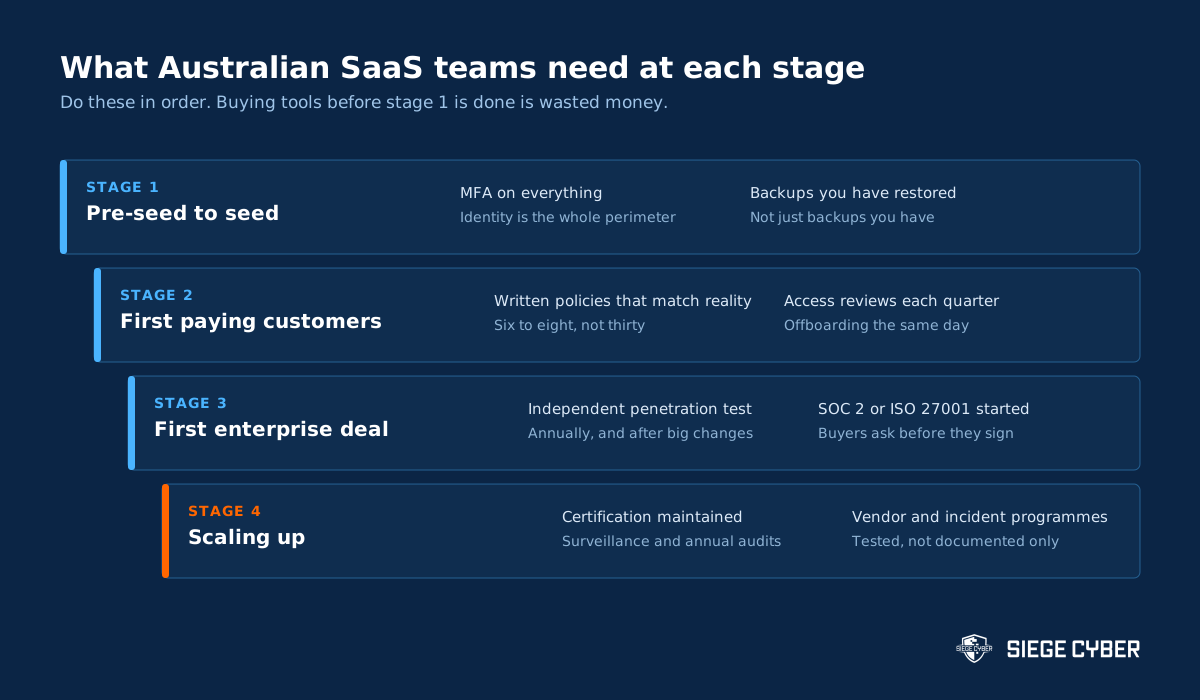
Before a SaaS startup has paying customers it should enable multi-factor authentication on every account, confirm it can restore from backup, remove access the day someone leaves, and write down what customer data it holds and where. These four take days rather than months and prevent most of what actually goes wrong at this stage.
- Multi-factor authentication on email, cloud console, code repository, CI pipeline and your production database. No exceptions for founders.
- Separate administrative accounts from daily-use accounts, so a compromised laptop does not hand over the production environment.
- A backup that is automated, encrypted and that you have restored at least once. An untested backup is an assumption, not a control.
- A written list of what personal information you hold, in which systems. One page is enough at this stage.
- An offboarding step in your leaver process that removes access the same day.
What you do not need yet is a security platform subscription, a thirty page policy set or a certification programme. Buying those before the basics are in place is the most common way early SaaS teams waste money on security.
What do Australian SaaS companies need once they have customers?
Once an Australian SaaS company has paying customers it needs written policies that match reality, quarterly access reviews, a supplier register, and a documented incident response process that accounts for the Notifiable Data Breach scheme. Customer contracts begin to reference security obligations at this point, and you need to be able to meet them.
Policies are where teams over-engineer. Six to eight short policies that describe what you actually do will serve you better than thirty downloaded templates describing a company you are not. An information security policy, access control, acceptable use, incident response, supplier management, data retention and a change process will cover most questions a customer asks.
Australian privacy obligations become real here too. If you hold personal information you are likely subject to the Privacy Act, and the Notifiable Data Breach scheme requires you to assess a suspected eligible breach within thirty days and notify affected individuals and the Commissioner if it is confirmed. A plan written during an incident is not a plan. Our guide to the Australian Privacy Principles covers the broader obligations.
What does a SaaS security assessment checklist cover for enterprise buyers?
An enterprise security review of an Australian SaaS vendor covers identity and access management, data handling and location, encryption, independent testing, incident response, business continuity, subprocessor management and certification status. The questions arrive as a questionnaire, and the speed of your answers matters almost as much as their content.
| What they ask | Minimum credible answer | What stalls the deal |
|---|---|---|
| Is MFA enforced for staff | Yes, on all accounts including admin | Partial coverage or founder exemptions |
| Where is our data stored | Named regions, with a reason | Not knowing, or a vague global answer |
| When were you last tested | An independent test within 12 months | A vulnerability scan described as a pen test |
| Do you hold ISO 27001 or SOC 2 | Certified, or a dated roadmap | Claiming alignment with no evidence |
| Who are your subprocessors | A current list with their assurance reports | No list, or one that is out of date |
| How do you handle a breach | A tested plan naming people and timeframes | A policy nobody has rehearsed |
Data location deserves particular attention in Australia, because buyers in government, health and financial services often have explicit requirements about it. Our guide to data sovereignty for Australian SaaS covers what you can and cannot commit to.
When should an Australian SaaS startup get SOC 2 or ISO 27001?
An Australian SaaS startup should begin SOC 2 or ISO 27001 when a specific deal requires it, or when security questionnaires start consuming real founder time, whichever comes first. Starting earlier rarely pays for itself. Starting after a large deal has already stalled means waiting months with the deal in limbo.
The choice between the two is usually geographic. ISO 27001 is better recognised by Australian and European buyers. SOC 2 is the default expectation in North America. Companies selling into both eventually hold both, but very few need both on day one.
Either way, the preparation work overlaps heavily with the baseline above. If you already have MFA, access reviews, a supplier register, an incident plan and an annual penetration test, you have done a meaningful share of the work. Our guides to SOC 2 for startups in Australia and SOC 2 for Australian SaaS companies cover the timing and the budget in detail.
When does a SaaS startup need a penetration test?
A SaaS startup needs an independent penetration test when it begins holding customer data that matters, which in practice means at or just before the first enterprise deal. From that point the normal cadence is annually, plus after any significant architectural change such as a new authentication system or a major platform migration.
Be clear on the distinction between a penetration test and a vulnerability scan, because enterprise buyers are. A scan is automated and finds known issues. A penetration test is human-led and finds logic flaws, broken access control between tenants, and chained weaknesses that no scanner detects. Presenting scan output as a penetration test is a credibility problem when the buyer’s security team reads it.
For a SaaS product, an authenticated web application test is almost always the right scope, because the interesting flaws live behind the login, not in front of it. Teams with a mobile client should read our mobile app penetration testing guide, and the division of responsibility with your cloud provider is covered in our guide to the SaaS shared responsibility model.
Common questions
What is SaaS security?
SaaS security covers the controls protecting a software-as-a-service application, the customer data it holds, and the cloud infrastructure and internal accounts used to build and operate it. For startups the highest-value controls are identity based, such as multi-factor authentication and prompt offboarding, because compromised staff credentials cause more incidents than application flaws do.
What goes in a SaaS security assessment checklist?
A SaaS security assessment checklist covers identity and access management, data storage location and encryption, backup and recovery, independent penetration testing, incident response and breach notification, subprocessor and vendor management, and certification status. Enterprise buyers typically send these as a questionnaire and expect evidence, not assertions, for each answer.
What is a SaaS risk assessment checklist?
A SaaS risk assessment checklist is used to evaluate the risk a SaaS product presents, either to its own customers or to a business adopting it. It identifies what data is involved, which controls protect it, what assurance exists such as SOC 2 or ISO 27001, and what residual risk remains. The output is a rating and a decision on whether to proceed.
Do Australian SaaS startups need ISO 27001 or SOC 2?
Neither is required by Australian law. Both are commercial requirements driven by procurement. ISO 27001 carries more weight with Australian and European buyers, while SOC 2 is the default expectation in North America. Start whichever one your pipeline is actually asking for, rather than certifying speculatively before a buyer has requested it.
How often should a SaaS company review its security controls?
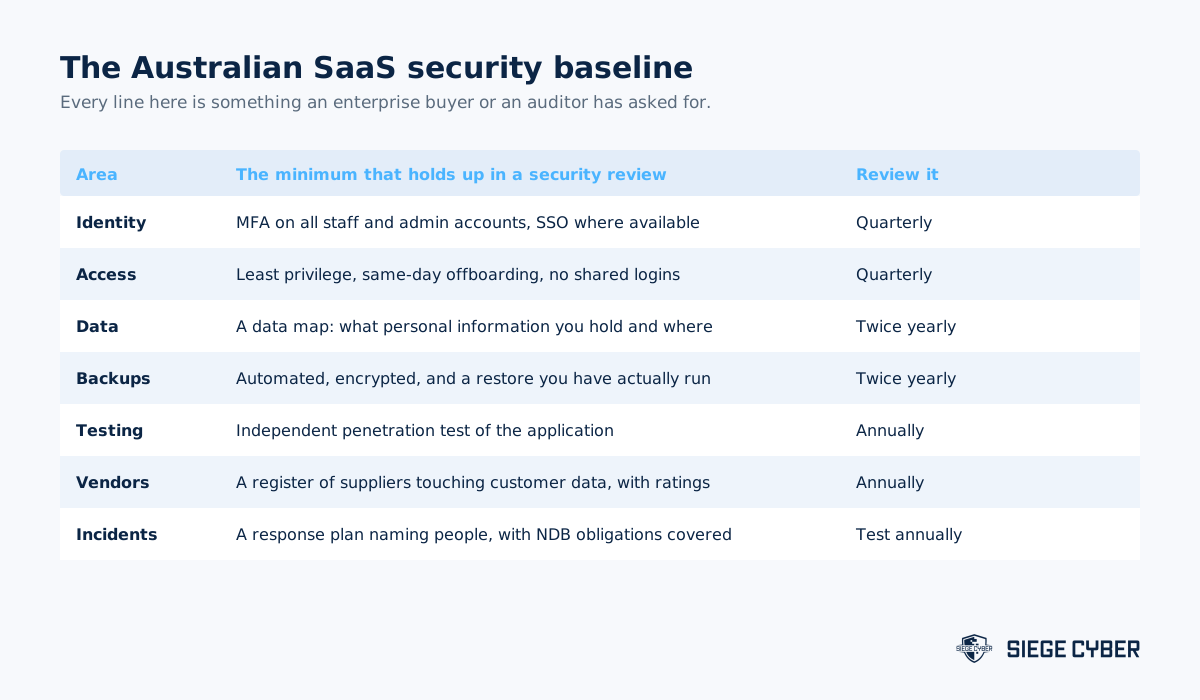
Review identity and access controls quarterly, data mapping and backup restoration twice a year, and penetration testing, vendor assessments and incident response testing annually. Significant changes, such as a new authentication provider, a cloud migration or a major feature holding new categories of personal information, should trigger a review regardless of the calendar.
Working out what you actually need
The hardest part of SaaS security for a small Australian team is not implementing controls, it is deciding which ones matter right now and which can wait another year. If you want an outside view on where you sit and what your next three moves should be, our cyber security advisory services are built for growing teams rather than large enterprises. Get in touch and we can work through it with you.