Compliance Evidence: What Auditors Ask SaaS Teams For
Compliance evidence is the record a process produced while it was running. In a SOC 2 or ISO 27001 audit you do not simply hand over a folder of screenshots. You produce a population, a complete list of every time a control ran during the period, show how that list was generated, and the auditor chooses which items to examine. You then supply evidence for those items. If one of them fails, the auditor samples more, not fewer.
That mechanic surprises most small Australian SaaS teams, because every guide online describes evidence as a shopping list of artefacts. The artefacts matter, but the populations are what determine whether your audit runs smoothly or turns into six weeks of follow up requests.
What counts as compliance evidence in a SOC 2 or ISO 27001 audit?
Compliance evidence is anything that demonstrates a control operated, as opposed to demonstrating that a control exists. A policy proves a rule was written down. An access review spreadsheet with a date, a reviewer and a decision for each account proves the rule was followed. Auditors test both, and the second is where small teams lose time.
Evidence falls into three practical groups. System generated records, such as identity provider logs, deployment histories and backup job results, which are the strongest because they are hard to construct after the fact. Workflow records, such as tickets, pull requests and approvals, which are strong when they show the full sequence. And manual records, such as meeting minutes, signed acknowledgements and completed checklists, which are acceptable but need dates and named people.
The distinction that matters most is between point in time evidence and evidence over a period. A SOC 2 Type 1 report or an ISO 27001 stage one review looks at a moment. A SOC 2 Type 2 examination looks across an observation period, which is where populations come in. Our guide to the SOC 2 observation period covers how that window is chosen.
How does an auditor sample your evidence?
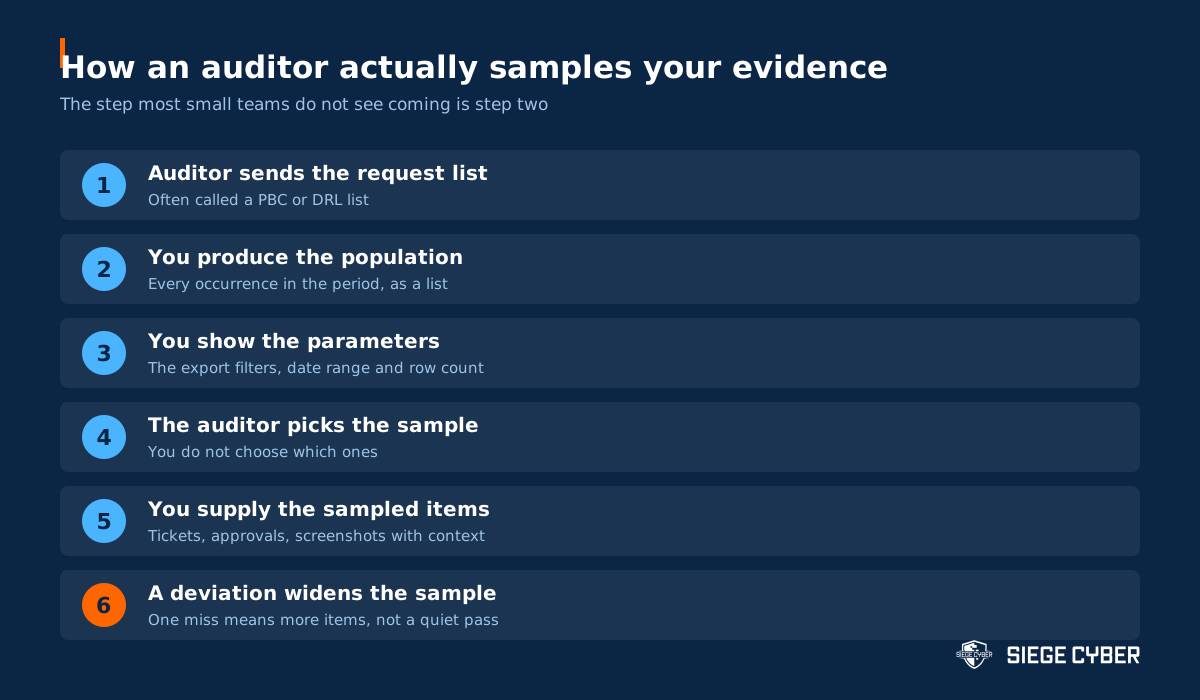
An auditor samples evidence in a defined sequence, and the step most teams do not anticipate is the second one. The auditor issues a request list. You produce a population for each control, which is a list of every occurrence in the period, not the evidence itself. You show the parameters used to generate that list, meaning the export filters, the date range and the row count. The auditor selects a sample from your population. You supply evidence only for the selected items.
Sample sizes are the auditor’s professional judgement, not a fixed number from a template. They scale with how often the control runs and how risky it is. A control that runs automatically on every deployment may need a single sample. A control that runs quarterly may need two or three. A control that runs hundreds of times a year will need considerably more.
Two practical rules follow. Populations can only be generated after the period ends, because a list produced in October cannot cover November and December. And if the auditor finds a deviation in the sample, the usual response is to expand it. One missed access review does not get waved through. It triggers more testing, which costs you time.
| Control | The population is | The sampled evidence is |
|---|---|---|
| New starter access provisioning | Every person who joined during the period | The approval and the resulting account setup for selected starters |
| Leaver access removal | Every person who left during the period | Evidence access was revoked, with timing, for selected leavers |
| Change management | Every change deployed to production | Request, review, approval and deployment record for selected changes |
| Access reviews | Every review performed in the period | The completed review, reviewer and decisions for selected reviews |
| Backup restoration | Every restore test performed | The test record and outcome for selected tests |
| Security awareness training | Every person required to complete training | Completion records for selected people |
What makes a piece of evidence acceptable or rejected?
Evidence is accepted when an independent reader can tell what system it came from, when it was captured, what it shows and that it is complete. Evidence is handed back when any of those is missing. The most common rejection is not a missing control, it is a perfectly good control documented in a way nobody else can verify.
| Rejected | Why | Accepted instead |
|---|---|---|
| A cropped screenshot of a settings page | No URL, no date, no account context | Full window capture showing the system, the account and the date |
| A policy document | Proves the rule exists, not that it ran | The record the process produced when it ran |
| A chat message saying the review is done | No decisions, no scope, not durable | The completed review with scope, decisions and reviewer |
| A list you compiled by hand | Cannot be shown to be complete | A system export with the filters and row count shown |
| A ticket marked closed | No evidence of review or approval | The ticket showing request, review, approval and deployment |
| A dashboard showing green today | Only shows the current state | A report covering the whole period |
One more trap applies to Australian teams specifically. Several tools used widely here retain logs for only thirty or ninety days by default. If your observation period is twelve months and your audit log retention is ninety days, the population for that control has a nine month hole in it that nothing can fill after the fact. Check retention settings at the start of the period, not at the end.
How long do you need to keep compliance evidence?
Neither SOC 2 nor ISO 27001 sets a single retention period for your evidence. What you must do is keep evidence available through the examination and the issue of the report, and keep it long enough to support the next cycle. Many Australian organisations settle on three years, which comfortably covers an annual report cycle and a buyer reviewing a prior year.
Two separate retention questions often get conflated. Your retention of your evidence is a business decision, informed by your own obligations. The audit firm’s retention of its working papers is governed by professional standards and is not your concern. If a customer asks how long you retain evidence, they are asking the first question.
A third period matters commercially. Buyers generally treat a SOC 2 report as current for about twelve months from the end of the observation period, which is why continuous annual cycles are the norm. Our guide to maintaining SOC 2 compliance in year two covers keeping that cycle unbroken.
Where should a small SaaS team keep its evidence?
Evidence needs to live somewhere durable, organised by control, and readable by someone who did not collect it. Beyond that, the choice is genuinely open, and a ten person team does not need what a two hundred person company needs.
Three options are common. A shared drive with a folder per control costs nothing and works until the volume beats you. A consultant can run the workspace alongside you, which suits a first audit. Or a dedicated tool sits in between: platforms such as Vanta and Drata collect evidence by integrating with your systems, while CertAssist publishes a flat list price of US$375 per month and has no integrations, so it never connects to them. Each trade off is real.
Whichever you choose, the organising principle is the same. One folder or workspace per control, named so the control is obvious. Files named with the date first, so they sort chronologically. And a note recording where each piece of evidence came from, because in nine months nobody will remember.
What does a weekly evidence routine look like for a team with no compliance hire?
A team of ten with no compliance hire can keep evidence current in roughly thirty minutes a week, plus a longer session each quarter. The failure mode is not that the work is hard. It is that nobody does it until the auditor asks, by which point the records either exist or they do not.
| Cadence | What to do | Roughly how long |
|---|---|---|
| Weekly | Capture anything that happened once: a new starter, a leaver, an incident, a vendor added | 20 to 30 minutes |
| Monthly | Export the logs that roll over, check backup job records, confirm training completions | 30 to 45 minutes |
| Quarterly | Run the access review, file it with decisions and reviewer named | 2 to 3 hours |
| Half yearly | Review risk register, review key vendors, run a restore test | Half a day |
| Annually | Review and reapprove policies, run an incident response exercise | One day |
Give the weekly slot a named owner and a recurring calendar entry. In most small companies that person is an engineering lead or an operations manager rather than a specialist. What makes it work is that it is scheduled and short, not that it is done by someone senior.
Two habits save the most time later. Capture evidence at the moment the thing happens, because reconstructing a decision from six months ago is slow and the result is usually weaker. And when you set a control’s frequency in a policy, set it to what you will actually sustain. Our guide to the SOC 2 readiness assessment covers how to test that before an auditor does.
Common questions
What is SOC 2 evidence?
SOC 2 evidence is the record that proves a control operated during the examination period. It includes system generated records such as access logs and deployment histories, workflow records such as tickets and approvals, and manual records such as completed reviews and training confirmations. A policy is not evidence that a control operated. It is evidence that a rule exists.
How does SOC 2 evidence collection work?
The auditor issues a request list. For each control you produce a population covering the whole period, together with the parameters used to generate it. The auditor selects a sample and you supply the evidence for those items. Populations must be generated after the period ends so they are complete, and a deviation found in a sample usually leads the auditor to test more items.
Can you use a spreadsheet for SOC 2 evidence collection?
Yes. Neither SOC 2 nor ISO 27001 requires a compliance platform, and many small Australian companies complete a first audit using a shared drive and a tracking spreadsheet. The constraint is effort rather than acceptability. As the number of controls and the volume of records grow, manual collection takes longer and gaps become easier to miss.
Does a compliance platform remove the need for an auditor?
No. A SOC 2 report can only be issued by an independent CPA firm, and ISO 27001 certification only by an accredited certification body. No tool changes that. The AICPA has also published guidance on the use of software tools in SOC 2 examinations, noting that information produced by a tool is itself subject to testing for completeness and accuracy.
What is the equivalent of SOC 2 in Australia?
There is no direct Australian equivalent of SOC 2. Australian companies most often pursue ISO 27001, which is a certification against an international standard rather than an attestation report, or SOC 2 itself because a customer has asked for it. Separately, the Privacy Act and the Notifiable Data Breaches scheme impose obligations that apply regardless of which framework you certify against.
Preparing for a first audit?
Siege Cyber helps Australian SaaS companies get audit ready without building a compliance function they do not need yet. See our SOC 2 services or our ISO 27001 services, read our guide to SOC 2 for Australian SaaS companies or our SaaS security checklist, or get in touch.