SOC 2 Observation Period: How Long Should It Be
The SOC 2 observation period is the window of time a Type 2 report covers, during which your auditor collects evidence that your controls operated, not just that they existed. Three months is the shortest window most auditors will examine, and twelve months is what mature buyers expect. For a first SOC 2 Type 2, three months gets you a report fastest, six months is the common compromise, and twelve months is the end state you grow into.
The choice is usually forced by a customer deadline rather than chosen calmly, which is why so many Australian companies pick the wrong window and then discover the consequences at renewal. This guide sets out what each option costs you, what buyers accept, and how to move from a short first window to an annual cycle without a coverage gap.
What is the SOC 2 observation period?
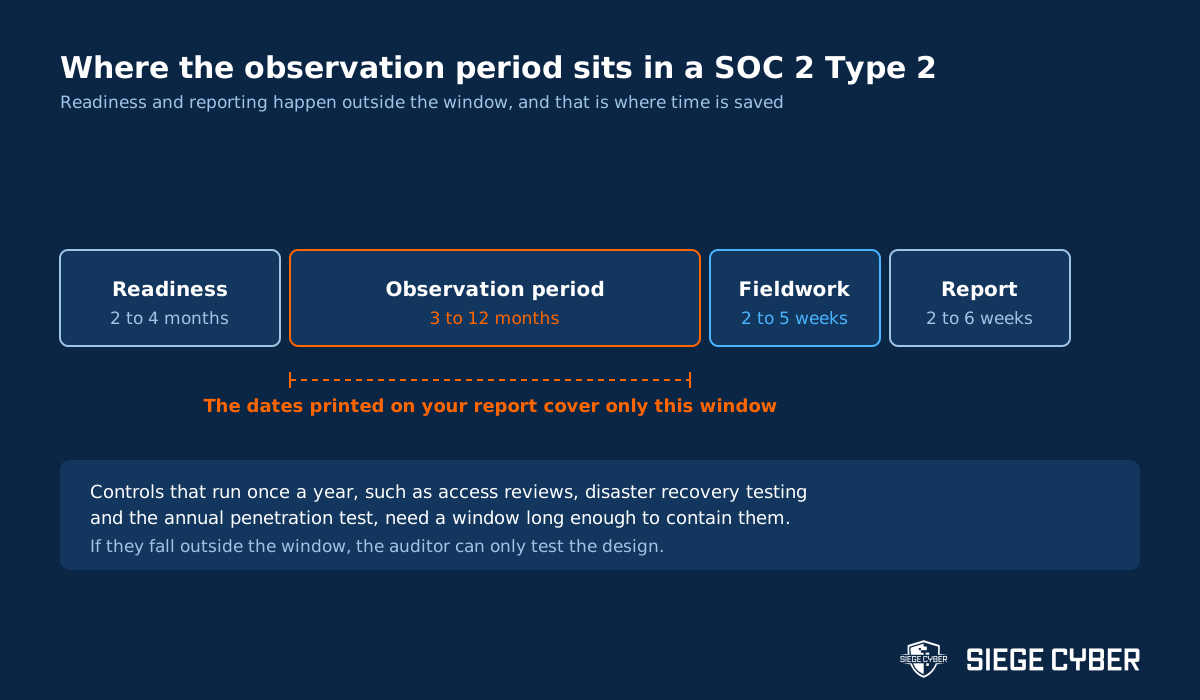
The SOC 2 observation period, sometimes called the audit window or review period, is the date range printed on the front of a SOC 2 Type 2 report. Everything the auditor tests relates to that range. If a control failed in month two, the report says so, even if it has worked perfectly since. If a control was only implemented in month five of a six month window, the auditor has very little operating evidence to test.
This is the structural difference between the two report types. A SOC 2 Type 1 assesses whether controls are suitably designed at a single point in time, so it has no observation period at all. A SOC 2 Type 2 assesses whether those controls operated effectively across a period, which is why it carries far more weight with buyers and why the window length is a real decision. Our comparison of SOC 2 Type 1 versus Type 2 covers which to start with.
Should your first observation period be three months or twelve?
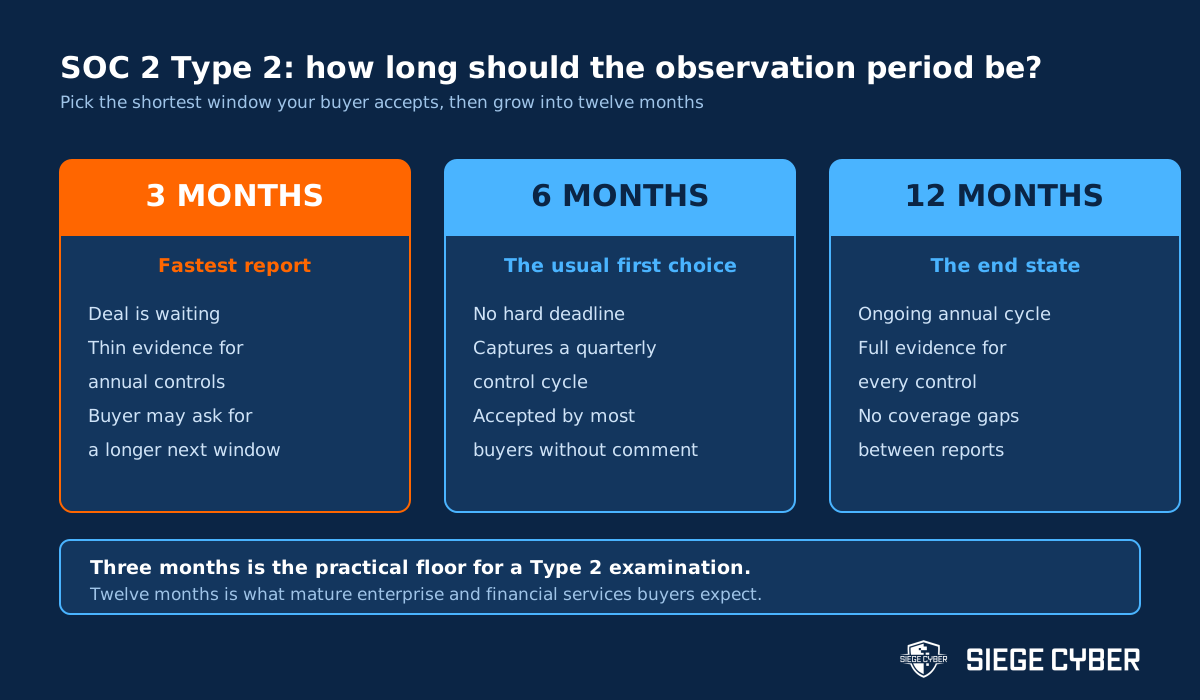
Choose a three month observation period when a signed deal is waiting on the report, and a twelve month period when you are building a compliance programme you intend to keep. Six months is the sensible middle for most Australian SaaS companies doing their first Type 2, because it is long enough to demonstrate operating effectiveness and short enough that the report arrives inside a sales cycle.
| Window | Best when | The trade off |
|---|---|---|
| Three months | A customer has made the report a condition of signing | Thin evidence for controls that run quarterly or annually, and a buyer may ask for a longer window next time |
| Six months | First Type 2 with no hard deadline, or a deadline about nine months out | Captures a quarterly cycle, and most buyers accept it without comment |
| Twelve months | Ongoing annual programme, enterprise or financial services buyers | Longest wait for the first report, but no coverage gaps afterwards |
One point that catches people out: controls that only run once or twice a year cannot show much in a three month window. Annual access reviews, the annual penetration test, disaster recovery testing and security awareness training all fall into this group. If those controls have not run inside your window, the auditor tests the design rather than the operation, and a careful reader of the report will notice.
What do you actually do during the SOC 2 observation period?
During the SOC 2 observation period you operate your controls normally and keep the evidence that proves it. That is the whole job, and it is less dramatic than teams expect. Access reviews happen on schedule and get recorded. Changes go through the change process and leave a trail. Vendors get reviewed. Incidents get logged and closed. The auditor will later sample these records, so an activity that happened without leaving a record did not happen as far as the report is concerned.
The practical question is where that evidence lives. Small teams generally choose one of four routes: a shared drive with a spreadsheet index, a consultant who maintains the register on your behalf, an enterprise platform such as Vanta or Drata that collects evidence automatically through integrations with your systems, or a self-service tool. A tool like CertAssist sits in that last group: it holds controls, evidence and read-only auditor access in one workspace at a list price of US$375 per month, and deliberately connects to no systems at all. The trade off is real in both directions, automation and deep integration on one side, simplicity and no standing access to your environment on the other.
Whichever route you pick, decide it before the window opens rather than during it. Reconstructing six months of evidence in the final fortnight is the single most common reason a first SOC 2 Type 2 slips. Our guide on how to prepare for a SOC 2 audit covers the preparation that happens before the clock starts.
Can you shorten the SOC 2 observation period?
You cannot shorten a SOC 2 observation period below what your auditor will accept, and three months is the practical floor for a Type 2 examination. What you can shorten is everything around it. Readiness work, control implementation and evidence tooling all happen before the window opens, and report writing happens after it closes. Those two phases are where first time programmes lose months.
If a customer needs something sooner than a Type 2 allows, the usual answer is a Type 1 report now and a Type 2 covering the following period. That sequence gives the buyer something real immediately and gives you a window that starts from a known, documented control set. Confirm first that the buyer will accept a Type 1, because some procurement teams will not.
What do Australian buyers accept as a first SOC 2 report?
Australian enterprise and government buyers generally accept a first SOC 2 Type 2 with a three or six month window, provided the next report covers twelve months. What they react badly to is a pattern of short windows, because a series of three month reports with gaps between them tells a reviewer that controls are being switched on for the audit. Reviewers in financial services and government are the most likely to ask for the date range before they ask anything else.
Expect a sophisticated buyer to check three things on the cover of your report: the observation period dates, whether the opinion is unqualified, and whether the scope covers the service they are actually buying. If you want to see this from the other side, our guide on reviewing a supplier’s SOC 2 report walks through what a careful reviewer looks for.
What happens when the observation period ends?
When the observation period ends the auditor completes fieldwork, resolves any exceptions and issues the report, which typically takes a further two to six weeks. The report then covers a historical window that starts ageing immediately. A report covering January to June, delivered in August, says nothing about July onwards, and customers notice that gap during security reviews.
Two things close that gap. A bridge letter, sometimes called a gap letter, is a short statement from management covering the period between the report end date and today, and our explainer on the SOC 2 bridge letter covers when one is appropriate. The other is simply scheduling the next window to start the day after the last one ended, which is what turns SOC 2 from a project into a cycle. SOC 2 year two covers what that cycle costs in effort.
Common questions
How long is a SOC 2 Type 2 report valid for?
A SOC 2 Type 2 report does not formally expire, because it is a report on a historical period rather than a certificate. In practice buyers treat a report as current for twelve months from the end of its observation period, and many security review processes enforce that. Beyond twelve months you will be asked for a newer report, and between reports you will be asked for a bridge letter.
How frequently should SOC 2 Type 2 audits be performed?
SOC 2 Type 2 audits are normally performed annually, with each observation period beginning where the previous one ended so there is no gap in coverage. Companies with a short first window sometimes run two examinations in the first eighteen months, a short one to unblock sales and then a twelve month one, before settling into the annual rhythm. More frequent examinations are rare and rarely worth the cost.
Does SOC 2 Type 2 require penetration testing?
SOC 2 does not contain a line item requiring a penetration test, because the Trust Services Criteria describe outcomes rather than specific activities. In practice most auditors expect some form of independent technical testing as evidence for the criteria covering vulnerability identification, and most Australian companies satisfy that with an annual penetration test. Our guide on whether penetration testing is required for SOC 2 sets out what auditors accept.
When is a SOC 2 Type 2 report required?
A SOC 2 Type 2 report is required when a customer makes it a condition of the contract, which in Australia usually happens as a SaaS company starts selling to enterprise, financial services or government buyers. It is not a legal requirement and no Australian regulator mandates it. The trigger is commercial: the report exists because your customers need assurance about controls they cannot inspect themselves. SOC 2 is governed by the AICPA’s SOC 2 framework.
Choosing your window
If a deal is waiting, start with the shortest window your auditor accepts and commit to twelve months next time. If nothing is waiting, six months is the window that causes the fewest questions later. Either way, decide where evidence will live before the window opens, because that one decision shapes how painful the examination feels.
Siege Cyber helps Australian companies get ready before the clock starts, so the observation period is spent operating controls rather than building them. Our SOC 2 services cover readiness assessment, control implementation and audit support. Get in touch with the date your customer needs the report and we will work backwards to tell you which window is realistic.