What We Deliver: Cloud Security Review and Testing
Siege Cyber provides expert cloud security assessments across AWS, Azure, and GCP environments. We manually review your cloud infrastructure configuration, identify security weaknesses and compliance gaps, test access controls and permissions, and deliver a prioritised remediation roadmap. You get an honest assessment from people who understand both cloud architecture and offensive security.
Here is what you get:
- Comprehensive IAM and access control review – We analyse your IAM roles, policies, and permission boundaries to identify overly permissive access, privilege escalation paths, unused or dormant accounts, lack of MFA enforcement, and opportunities to implement least-privilege access. IAM misconfigurations are the most common entry point for cloud breaches, and we find them before attackers do.
- Storage and data protection assessment – We review your S3 buckets (AWS), Blob storage (Azure), or Cloud Storage (GCP) for public exposure, weak access controls, missing encryption, lack of versioning and backup, inadequate logging, and non-compliant data handling. We identify which buckets contain sensitive data and whether they are properly protected.
- Network security and segmentation review – We assess your VPC configuration, security groups, network ACLs, subnet architecture, internet gateways and NAT configuration, and network traffic flow to identify poor segmentation, overly permissive firewall rules, exposed management interfaces, and opportunities to improve network isolation. Many cloud environments are flat networks with minimal segmentation, allowing lateral movement once an attacker gains initial access.
- Compute and serverless security testing – We review your EC2 instances, Lambda functions, containers, and Kubernetes clusters for insecure configurations, exposed secrets and credentials in environment variables, vulnerable or outdated base images, excessive permissions on compute resources, and missing security controls. Serverless functions often run with overly broad IAM roles, giving attackers more access than necessary if compromised.
- Encryption and key management assessment – We verify that data is encrypted at rest and in transit, assess your key management practices (AWS KMS, Azure Key Vault, GCP KMS), identify unencrypted volumes and databases, review key rotation policies, and ensure encryption meets compliance requirements. Many organisations enable encryption but misconfigure key management, undermining the protection.
- Logging, monitoring, and incident response review – We assess whether you have adequate visibility into your cloud environment through CloudTrail (AWS), Activity Log (Azure), or Cloud Logging (GCP), evaluate your security alerting and monitoring, review incident response procedures for cloud-specific scenarios, and identify gaps in detection capabilities. You cannot respond to what you cannot see.
- Compliance mapping to ISO 27001, SOC 2, and Essential Eight – We map your cloud security controls to the compliance frameworks you need to satisfy, identify gaps between current state and required controls, provide evidence documentation for auditors, and deliver remediation guidance aligned with your compliance timeline. If you are using Vanta or Drata, we provide the technical assessment these platforms cannot automate.
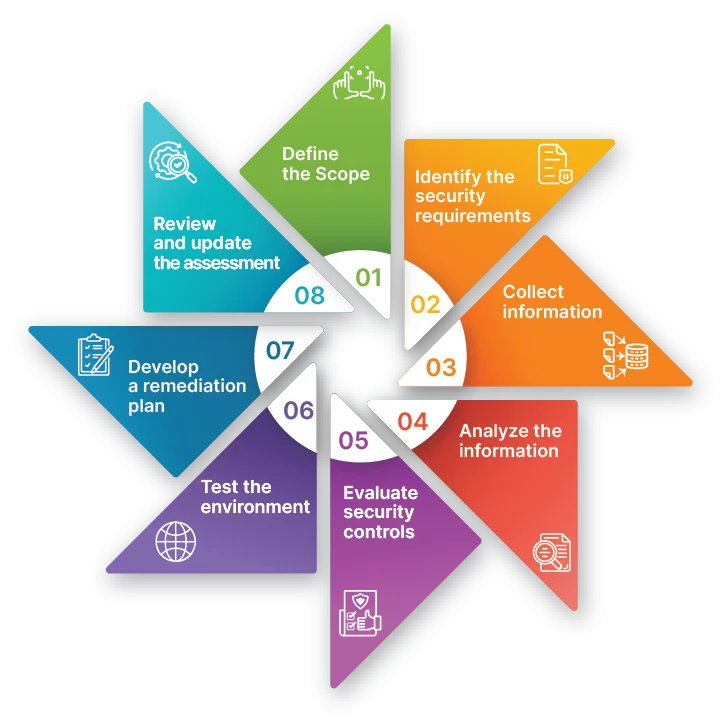
Our Cloud Security Assessment Process
We have assessed cloud environments for dozens of Australian SaaS companies and technology businesses. Here is how it works.
1. Scoping and Access Setup
We meet with your team to understand your cloud infrastructure: which providers you use (AWS, Azure, GCP, or multi-cloud), what services are in scope, what compliance requirements apply, and what concerns you have. We establish read-only access to your cloud environment using secure methods (cross-account IAM roles for AWS, service principals for Azure, service accounts for GCP). We never require write access.
2. Automated Configuration Review
We use enterprise-grade Cloud Security Posture Management (CSPM) tools to scan your entire cloud environment for misconfigurations, policy violations, and compliance deviations. This provides a baseline view of your security posture across thousands of configuration parameters, identifying quick wins and obvious issues that require immediate attention.
3. Manual Security Review and Testing
Our security team manually reviews your cloud architecture, IAM configurations, and critical services. We test access controls by attempting privilege escalation, verify whether data protection controls are effective, analyse network segmentation and traffic flow, review serverless and container security, and assess logging and monitoring coverage. This manual review identifies issues automated tools miss, including business logic flaws and architectural weaknesses.
4. Risk Assessment and Prioritisation
We analyse all findings to assess business impact, determine exploitability, identify quick wins versus strategic improvements, map issues to compliance requirements, and prioritise remediation based on actual risk. Not all misconfigurations are equal. We help you focus on what actually matters.
5. Detailed Reporting and Remediation Roadmap
We deliver a comprehensive cloud security assessment report including an executive summary for leadership, detailed technical findings with evidence, a prioritised remediation roadmap with timelines, specific configuration changes and Infrastructure as Code (IaC) updates, compliance gap analysis, and board-ready security metrics. Reports are written for both technical teams who need to fix issues and executives who need to understand business risk.
6. Remediation Support and Validation
After you implement remediation, we conduct targeted rescans and testing to validate fixes are effective, ensure no new issues were introduced, confirm compliance gaps are closed, and update documentation. We also provide ongoing advisory support to answer questions as your team works through the remediation roadmap.
Who This Is For: Cloud Security Services Australia
This service is designed for Australian SaaS companies, technology businesses, financial services firms, and any organisation that runs critical infrastructure or sensitive data in AWS, Azure, or GCP and needs to verify security is properly configured.
You are a good fit if:
- You need to satisfy ISO 27001 Annex A.14 (secure development) or SOC 2 CC6 (logical and physical access) requirements for cloud infrastructure
- You are preparing for a compliance audit and need evidence that your cloud environment is properly secured
- Your customers or prospects are asking detailed questions about your cloud security posture in vendor assessments
- You have experienced rapid cloud adoption and suspect security has not kept pace with development speed
- Your board, investors, or regulators are asking how you ensure cloud security and you need an independent assessment
- You are considering cyber insurance and insurers want evidence of cloud security controls
- You have migrated to the cloud recently and want to validate security before going live with production workloads
- You have never had a cloud security review and want to understand your current risk exposure

Why Choose Siege Cyber for Cloud Security Testing
20+ years of offensive security and cloud expertise. Our Technical Director, Peter Stewart, has spent over two decades in hands-on cybersecurity roles, including penetration testing cloud environments and exploiting the exact misconfigurations we now help clients prevent. We understand cloud security from an attacker's perspective, not just a compliance checklist perspective.
Multi-cloud expertise across AWS, Azure, and GCP. We assess security across all major cloud providers, not just one. Many organisations operate multi-cloud or hybrid environments. We understand the unique security considerations of each platform, including AWS IAM intricacies, Azure Active Directory integration, and GCP service accounts. You get expertise across your entire cloud footprint.
We understand Australian compliance requirements. ISO 27001, SOC 2, Essential Eight, APRA CPS 234 (for financial services), and the Privacy Act 1988 all have implications for cloud security. We know what Australian auditors and regulators expect, and we deliver assessments formatted for compliance. If you are in a regulated industry, we understand your specific obligations.
Focus on practical remediation, not just findings. Many cloud security assessments dump hundreds of findings on you with no context or prioritisation. We provide clear, actionable remediation guidance including specific IAM policy changes, Infrastructure as Code updates, step-by-step configuration instructions, and prioritisation based on actual risk. You get a roadmap, not just a problem list.
Official Vanta and Drata partner for compliance integration. If you are using compliance automation platforms, we provide the technical cloud security assessment these tools cannot automate. Our findings integrate with your compliance workflow, and our reports provide the evidence auditors expect. We bridge the gap between automated compliance tracking and genuine cloud security.
Frequently Asked Questions
What is the difference between a cloud security assessment and cloud penetration testing?
A cloud security assessment focuses on identifying misconfigurations, policy violations, and compliance gaps across your entire cloud infrastructure through configuration review and testing. Cloud penetration testing goes deeper by actively exploiting vulnerabilities to demonstrate real-world attack paths, privilege escalation, and lateral movement. Assessments are broader and faster (2-4 weeks). Penetration testing is deeper and more targeted (3-6 weeks). Most organisations start with an assessment to identify obvious issues, then conduct penetration testing to validate controls against realistic attacks.
Will the assessment disrupt our cloud operations or cause downtime?
No. Cloud security assessments use read-only access to review configurations, logs, and policies. We do not modify your infrastructure or deploy anything that could affect availability. Manual testing is conducted carefully to avoid service disruption. Most clients never notice the assessment is happening from an operational perspective. If we need to conduct active testing that could trigger security alerts, we coordinate timing with your team in advance.
How long does a cloud security assessment take?
For a typical single-cloud environment (AWS, Azure, or GCP) with 50-200 resources, the assessment takes 2-4 weeks from scoping to final report delivery. Larger or multi-cloud environments may take 4-6 weeks. The timeline depends on infrastructure complexity, number of accounts or subscriptions, scope of services, and availability of your team for questions. We provide a detailed timeline during the scoping phase.
Do we need a cloud security assessment if we are already using AWS Security Hub or Azure Defender?
Native cloud security tools like AWS Security Hub, Azure Defender, or GCP Security Command Centre are valuable for continuous monitoring, but they have limitations. They detect known misconfigurations based on automated rules but miss business logic issues, architectural weaknesses, and complex attack paths that require human analysis. They also do not prioritise findings based on business context or provide remediation guidance. A cloud security assessment provides the expert human review these automated tools cannot deliver.
What cloud services and resources does the assessment cover?
We assess all critical cloud services in scope including IAM (users, roles, policies, permissions), storage (S3, Blob Storage, Cloud Storage), compute (EC2, Virtual Machines, Compute Engine), serverless (Lambda, Functions, Cloud Functions), containers (ECS, EKS, AKS, GKE), databases (RDS, SQL Database, Cloud SQL), networking (VPC, VNet, firewall rules), and logging and monitoring services. We tailor scope based on what you actually use and where your highest risks lie.
How does a cloud security assessment help with ISO 27001 or SOC 2 compliance?
ISO 27001 Annex A.14 requires secure development and support processes, including cloud infrastructure security. SOC 2 Trust Service Criteria CC6.6 requires logical and physical access restrictions for systems. A cloud security assessment provides documented evidence that you have reviewed cloud security controls, identified and remediated gaps, and implemented proper access restrictions. We deliver compliance-ready reports that map findings to ISO 27001 controls or SOC 2 criteria, providing exactly what auditors expect to see.
Can you help us fix the issues you find, or just identify them?
We provide detailed remediation guidance for every finding including specific configuration changes, IAM policy updates, Infrastructure as Code modifications, and step-by-step instructions. For clients who need additional support, we offer remediation assistance where our team works alongside yours to implement fixes, validate changes, and ensure no new issues are introduced. Some clients prefer to handle remediation internally using our guidance, while others engage us for hands-on support. Both options are available.
Ready to Secure Your Cloud Infrastructure?
Cloud misconfigurations are not hypothetical risks. They are the leading cause of data breaches in cloud environments, and nearly half of all organisations have them right now without knowing it. Attackers are scanning continuously for exposed S3 buckets, overly permissive IAM roles, and weak access controls. The question is whether you find these issues first, or whether an attacker does.
Book a free 30-minute consultation with our team. We will discuss your cloud environment, explain what a security assessment covers, and give you an honest assessment of whether you need one. You will leave the call understanding exactly what risks exist in AWS, Azure, or GCP environments like yours and what a proper security review involves.