What We Deliver: Essential 8 Maturity Assessment and Compliance Services
Siege Cyber provides end-to-end Essential Eight assessment, gap analysis, and implementation support for Australian organisations. We assess your current maturity level against ASD requirements, identify specific gaps preventing you from reaching your target maturity, provide a detailed remediation roadmap with priorities and timelines, and support implementation until you achieve and can sustain your target maturity level.
Here is what you get:
- Comprehensive Essential Eight gap analysis across all eight strategies – We assess your current implementation of application control, patch applications, configure Microsoft Office macro settings, user application hardening, restrict administrative privileges, patch operating systems, multi-factor authentication, and regular backups. For each strategy, we evaluate your maturity level (0-3) based on ASD criteria, identify specific gaps preventing higher maturity, document evidence of compliance (or lack thereof), and assess whether implementation is sustainable or requires ongoing effort. You get a clear picture of where you stand today.
- Detailed maturity level determination with evidence – Essential Eight assessments require documented evidence, not claims. We review your technical controls and configurations, examine policies and procedures, validate implementation through technical testing, assess monitoring and alerting capabilities, and review incident response procedures. We document what evidence exists, what evidence is missing, and what additional documentation or technical validation is required. When you claim a maturity level, you have the evidence to support it.
- Prioritised remediation roadmap to reach target maturity – Not all gaps are equal. We prioritise remediation based on risk reduction (which gaps address the highest threats), effort required (quick wins versus major projects), compliance requirements (what is mandatory for your target maturity level), and dependencies (what must be implemented before other controls work). You get a phased implementation plan that reaches your target maturity level as efficiently as possible, not an overwhelming list of 100 tasks with no prioritisation.
- Strategy-specific implementation guidance – Each Essential Eight strategy has unique implementation challenges. We provide detailed guidance including application control whitelisting implementation, patch management processes and timelines (48 hours for critical, 2 weeks for applications), macro security settings and exceptions management, browser and email hardening configurations, privileged access management and JIT access, operating system patching automation, MFA deployment across all services, and backup testing and restoration procedures. You know exactly what to implement and how.
- Ongoing monitoring and maintenance framework – Achieving a maturity level is one thing. Sustaining it is another. We establish processes for continuous monitoring of control effectiveness, regular evidence collection for audits, quarterly or annual maturity reassessments, management of exceptions and deviations, and incident response procedures aligned with Essential Eight. Your maturity level does not drift backwards the moment you stop paying attention.
- Compliance reporting for cyber insurance, government, and board – We provide Essential Eight assessment reports formatted for your specific audience including cyber insurance compliance evidence, government tender requirements, board reporting with risk metrics, audit documentation, and annual reassessment reports. Whether you need to satisfy an insurer, win a government contract, or report to the board, you have documentation that meets expectations.
Our Essential Eight Assessment Process
We have conducted Essential Eight assessments for dozens of Australian organisations. Here is how it works.
1. Scoping and Initial Assessment
We meet with your team to understand your organisation, current security posture, target maturity level (and why), compliance drivers (cyber insurance, government contracts, board requirements), and existing controls. We conduct an initial review to identify obvious gaps and provide a preliminary assessment of your likely current maturity level. This sets realistic expectations before the detailed assessment begins.
2. Detailed Gap Analysis Across All Eight Strategies
We assess each Essential Eight strategy against ASD maturity model requirements through technical review (configuration audits, control testing), documentation review (policies, procedures, evidence), stakeholder interviews (IT, security, management), and technical validation (testing controls actually work). For each strategy, we determine your current maturity level, document specific gaps, identify missing evidence, and assess sustainability. This comprehensive analysis forms the foundation of your remediation roadmap.
3. Evidence Collection and Documentation Review
Essential Eight assessments require documented proof of compliance. We review existing documentation (security policies, procedures, runbooks, configuration standards), collect technical evidence (system configurations, patch logs, MFA enrollment data, backup test results), validate control effectiveness (testing, monitoring data, incident logs), and identify documentation gaps. We document what evidence you have, what evidence you need, and how to obtain it.
4. Remediation Roadmap and Implementation Plan
We deliver a comprehensive Essential Eight assessment report including current maturity level for each strategy (with evidence), overall organisational maturity level, specific gaps preventing target maturity achievement, prioritised remediation roadmap (phased by quarter), effort estimates and resource requirements, and compliance timeline. You know exactly what needs to be done, in what order, and how long it will realistically take.
5. Implementation Support and Technical Guidance
Achieving Essential Eight compliance is not a one-week project. We provide ongoing support as you implement remediation including technical guidance for control implementation, policy and procedure templates, assistance with vendor selection (for tools or services), validation that implementations meet ASD requirements, and progress tracking against the roadmap. Implementation timelines vary significantly based on your starting point, but most organisations require 3-6 months to move from Level 0 or 1 to Level 2, and 6-12 months to reach Level 3.
6. Final Validation and Compliance Reporting
Once remediation is complete, we conduct final validation to confirm target maturity level achievement, collect comprehensive evidence documentation, prepare compliance reports for your specific requirements, and establish ongoing monitoring processes. You receive formal documentation of Essential Eight compliance suitable for cyber insurers, government agencies, auditors, or board reporting.
Who This Is For: ASD Essential Eight Consulting
This service is designed for Australian businesses, government agencies, critical infrastructure operators, and organisations that need to demonstrate Essential Eight compliance for regulatory, contractual, or risk management purposes.
You are a good fit if:
- You need to achieve Essential Eight Maturity Level 2 or 3 to satisfy cyber insurance requirements or reduce premiums
- You are bidding on government contracts or tenders that require Essential Eight compliance as a prerequisite
- Your board or executives want independent validation of your cybersecurity posture against the ASD's Essential Eight framework
- You are in a critical infrastructure sector where Essential Eight compliance is increasingly expected or mandated
- You have been told you need Essential Eight compliance but have no idea where you currently stand or what is involved
- You attempted to assess Essential Eight internally but realised the maturity model is more complex than expected
- You need to demonstrate cyber resilience to customers, partners, or investors using a recognised Australian framework
- You want to improve your security posture systematically using the ASD's recommended baseline mitigation strategies

Why Choose Siege Cyber for Essential 8 Assessment
20+ years of hands-on cybersecurity and compliance expertise. Our Technical Director, Peter Stewart, has spent over two decades in information security roles including security assessments, penetration testing, and compliance consulting. We understand both the technical implementation and governance aspects of Essential Eight, allowing us to provide practical guidance rather than theoretical compliance advice.
Deep expertise in the Australian Essential Eight framework. We have conducted Essential Eight assessments for organisations across government, financial services, healthcare, and technology sectors. We understand the November 2023 updates to the maturity model, the ASD's expectations for evidence and implementation, and the practical challenges Australian organisations face achieving and sustaining maturity levels. You get guidance grounded in real-world Essential Eight implementation experience, not generic security consulting.
We focus on sustainable compliance, not checkbox exercises. Achieving a maturity level once is relatively straightforward. Sustaining it over time is harder. We design implementations that can be maintained with your existing resources, establish monitoring processes that detect control drift before it becomes non-compliance, and build documentation and evidence collection into your normal operations. The goal is ongoing compliance, not a one-time assessment that is outdated in six months.
Practical, risk-based approach to prioritisation. The Essential Eight maturity model is prescriptive, but implementation sequencing requires judgement. We prioritise remediation based on your risk profile, compliance deadlines, resource constraints, and existing capabilities. A financial services firm faces different priorities than a SaaS company. A government agency has different timelines than a private business. We tailor the roadmap to your actual situation.
We understand Essential Eight in the context of broader security programmes. Essential Eight is a foundational baseline, but many organisations also pursue ISO 27001, SOC 2, or other frameworks. We help you align Essential Eight implementation with other compliance efforts, leverage controls that satisfy multiple frameworks, and avoid duplication. If you are already working towards other certifications, we show you how Essential Eight fits into your overall security programme rather than treating it as an isolated project.
Frequently Asked Questions
What is the difference between Essential Eight maturity levels?
Maturity Level 1 protects against opportunistic attacks using publicly available exploits. Maturity Level 2 protects against targeted attacks where adversaries invest more time and effort. Maturity Level 3 provides resilience against advanced persistent threats and highly targeted attacks. The ASD recommends all Australian businesses target Maturity Level 3, though Level 2 is often the minimum for cyber insurance or government contracts. Each level has increasingly stringent requirements for all eight mitigation strategies.
How long does it take to achieve Essential Eight compliance?
The timeline depends entirely on your starting point and target maturity level. Initial assessment typically takes 2-4 weeks. If you are starting from Maturity Level 0 or 1, reaching Level 2 typically requires 3-6 months of implementation. Reaching Level 3 from Level 2 can take an additional 6-12 months. Organisations with mature security programmes can move faster, while those with significant gaps or technical debt require longer timelines. We provide realistic timelines during the scoping phase based on your specific situation.
Can we achieve Essential Eight compliance without external consultants?
Yes, but it is significantly more difficult. The Essential Eight maturity model is detailed and prescriptive, and correctly interpreting requirements requires familiarity with the ASD's expectations. Many organisations attempt self-assessment and either overestimate their maturity level (claiming compliance without adequate evidence) or underestimate it (implementing far more than required). External assessment provides independent validation and ensures your interpretation aligns with what auditors, insurers, and government agencies expect.
Does Essential Eight replace ISO 27001 or other security frameworks?
No. Essential Eight is a baseline set of mitigation strategies, not a comprehensive information security management system like ISO 27001. Many organisations implement Essential Eight as the technical foundation and pursue ISO 27001 for governance, risk management, and broader security controls. Essential Eight can satisfy some ISO 27001 Annex A controls, and both frameworks complement each other. We help organisations align multiple frameworks efficiently rather than treating them as separate compliance projects.
What evidence does an Essential Eight assessment require?
Evidence requirements vary by strategy and maturity level but typically include system configuration exports and screenshots, patch management logs and timelines, application whitelisting policies and exceptions, MFA enrollment and usage data, backup logs and restoration test results, privileged access audit logs, vulnerability scanning reports, and incident response documentation. We provide a comprehensive evidence checklist during assessment and help you collect what is missing.
How often should we reassess Essential Eight maturity?
The ASD does not mandate specific reassessment frequencies, but industry practice is annual reassessment at minimum. Cyber insurance policies often require annual validation. Government contracts may specify reassessment requirements. Additionally, you should reassess after significant infrastructure changes, major security incidents, or when evidence suggests control drift. We recommend at least annual formal reassessment with quarterly monitoring of key control metrics to detect issues before they become non-compliant.
What is the most common reason organisations fail to achieve their target maturity level?
The most common failure is inconsistent implementation across all eight strategies. Organisations often have strong controls for some strategies (e.g., MFA, backups) but weak or absent controls for others (e.g., application control, user application hardening). Remember that your overall maturity level is the lowest maturity level across all eight strategies. You cannot achieve Maturity Level 2 overall if even one strategy is at Level 1. The second most common issue is insufficient evidence documentation. Controls may exist, but if you cannot prove they meet maturity model requirements, you cannot claim compliance.
Ready to Understand Your Essential Eight Maturity Level?
The ASD's Essential Eight is Australia's most recognised cyber security baseline. Whether you need it for cyber insurance, government contracts, board assurance, or genuine risk reduction, you cannot claim compliance without knowing where you actually stand. Guessing or hoping you meet requirements does not satisfy auditors, insurers, or government agencies.
Book a free 30-minute consultation with our team. We will discuss your target maturity level, compliance drivers, and current security posture. We will explain what Essential Eight assessment involves, what realistic timelines look like, and what the path to compliance looks like for an organisation of your size and maturity. You will leave the call understanding exactly what is required and whether you can realistically achieve your target maturity within your timeframe.
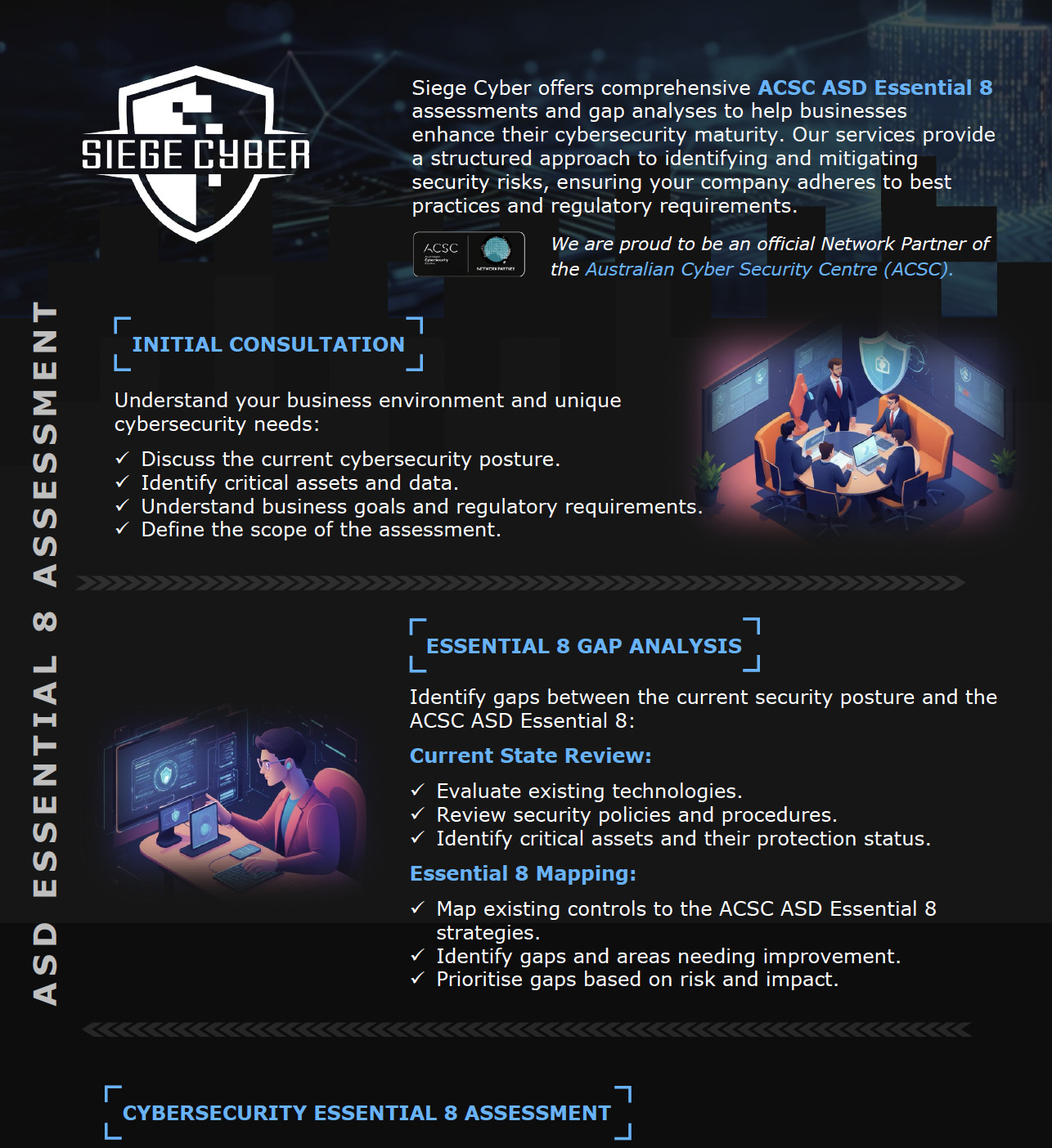
Ensure your organisation's cybersecurity aligns with industry standards through Siege Cyber's ASD Essential 8 Assessment and Gap Analysis service. Our experts will identify gaps in your security posture and provide actionable recommendations to enhance your defences. For insights on how our ASD Essential 8 compliance can fortify your cybersecurity strategy, download our detailed datasheet today.