SaaS Penetration Testing for Australian Startups
SaaS penetration testing is a scoped, human-led test of your multi-tenant application, its APIs and the cloud it runs on. The test that distinguishes it from a generic web application test is tenant isolation: proving that a logged-in customer cannot read, modify or delete another customer’s data. For an Australian startup, that single finding class is both the most likely serious bug in your product and the one your first enterprise customer will ask about. Scope for it deliberately, because a default scan will not look.
The rest of this article covers what to include, what to leave out, when to run the first test, and what enterprise buyers in Australia actually want to see afterwards.
What makes SaaS penetration testing different from a normal web app test?
SaaS penetration testing differs from a standard web application test because of multi-tenancy. In a single-tenant application, the worst case is usually that an attacker reaches one organisation’s data. In a multi-tenant SaaS platform, a single broken authorisation check can expose every customer you have, which turns a technical bug into an existential commercial event.
- Tenant isolation. Can a valid user of tenant A reach tenant B’s records by changing an identifier, replaying a token, or calling an API endpoint directly?
- Role boundaries inside a tenant. Can a read-only user perform an admin action because the permission check runs in the front end?
- API-first attack surface. Most SaaS platforms expose more through APIs than through the user interface, and the API often has weaker authorisation.
- Shared infrastructure. Background jobs, caches, search indexes, file storage and logs all cross tenant boundaries internally and are a common source of leakage.
- Self-service signup. If anyone can create an account, an attacker already has an authenticated foothold before testing begins.
- Tenant provisioning and offboarding. What happens to data and access when a trial lapses or a customer cancels?
Testing these properly is manual work. The OWASP Web Security Testing Guide devotes a whole section to authorisation testing for exactly this reason: a tool cannot know which record is supposed to belong to which tenant.
This is why unauthenticated testing alone tells you very little about a SaaS platform. Almost every meaningful finding requires a tester holding at least two separate accounts, and we explain the distinction in authenticated versus unauthenticated penetration testing.
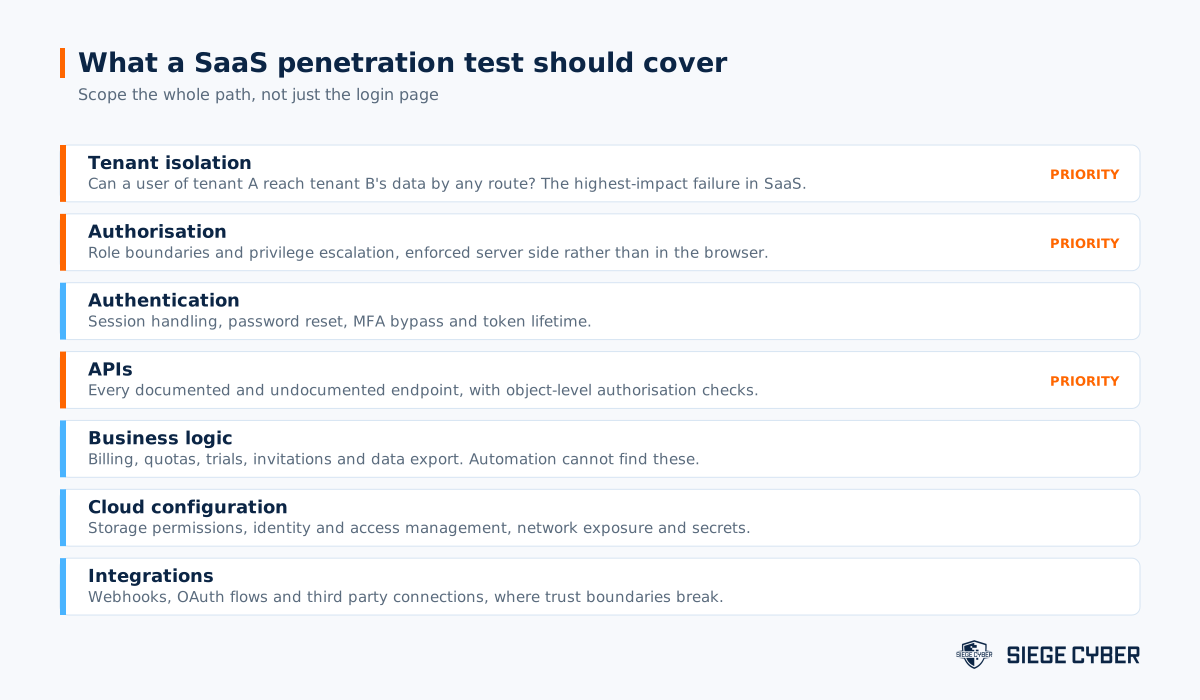
What should a SaaS penetration test actually cover?
A SaaS penetration test should cover the application, the APIs behind it, and the cloud configuration that supports both. Splitting those into separate engagements is common and usually a mistake for a small startup, because the interesting attack paths run between them.
| Area | What gets tested | Why it matters for SaaS |
|---|---|---|
| Tenant isolation | Cross-tenant access across every object type, using multiple accounts | The highest-impact failure mode in any multi-tenant product |
| Authorisation | Role boundaries, privilege escalation, server-side enforcement | Front-end-only permission checks are extremely common in young products |
| Authentication | Session handling, password reset, MFA bypass, token lifetime | Account takeover is the most common route into a tenant |
| APIs | Every documented and undocumented endpoint, object-level authorisation | APIs frequently expose more than the interface and are tested less |
| Business logic | Billing, quotas, trials, invitations, data export | Automation cannot find these, and they map directly to revenue |
| Cloud configuration | Storage permissions, identity and access management, network exposure, secrets | A misconfigured bucket bypasses every application control you built |
| Integrations | Webhooks, OAuth flows, third party connections | Trust boundaries between systems are where assumptions break |
If your product has a mobile client or a public API as its main surface, those deserve their own attention, covered in mobile app penetration testing for SaaS teams and API penetration testing in Australia.
When should an Australian startup run its first penetration test?
The right time for an Australian startup to run its first penetration test is when one of three things becomes true, and not before. Testing a product that is still changing weekly produces a report that is out of date before you have read it.
- You are holding real customer data. Once production contains data belonging to someone other than you, the risk is no longer theoretical.
- A customer or contract requires it. Enterprise security reviews routinely ask for an independent test, and the request usually arrives late in a sales cycle.
- You are pursuing certification. ISO 27001 and SOC 2 both lead most SaaS companies to commission testing, even though neither names it as a blunt mandatory requirement.
Before that point, the money is better spent on the basics: multi-factor authentication everywhere, dependency scanning in your pipeline, and server-side authorisation checks written properly the first time. We set those out in the SaaS security checklist for Australian startups.
Expect the test itself to take days rather than weeks for a typical early-stage platform, with scoping before it and retesting after.
How do you scope a SaaS penetration test without overspending?
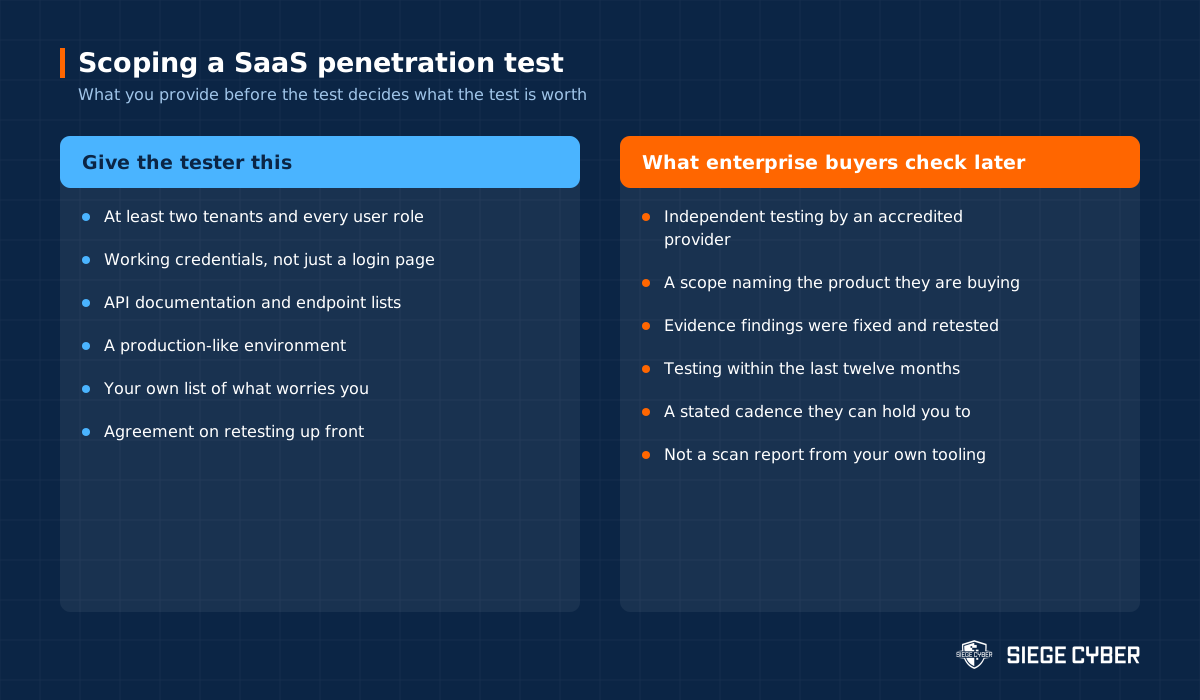
Scoping a SaaS penetration test well is the difference between a report that changes your roadmap and a report that lists TLS configuration notes. Cost scales with tester days, and tester days scale with the number of distinct roles, endpoints and environments in scope, so the decisions below are where you control the spend.
- Give the tester accounts, not a login page. At least two tenants and every role you support. Credentials cost nothing and double the value of the engagement.
- Hand over your API documentation. A tester who has to guess endpoints spends your budget on discovery rather than on finding bugs.
- Test a production-like environment. A staging environment with different configuration tests a product you do not ship.
- Say what you are worried about. If billing logic or a new integration keeps you up at night, say so and have it prioritised.
- Exclude what genuinely does not matter. A marketing site on a separate platform rarely needs to be in the same engagement.
- Agree retesting up front. Fixes need verification, and negotiating that afterwards is more expensive.
Our general guidance on how to scope a penetration test applies here too, with the SaaS-specific addition that multiple tenants and multiple roles are not optional extras.
What do enterprise customers in Australia want to see afterwards?
Enterprise customers reviewing an Australian SaaS vendor are rarely satisfied by the fact that a test happened. What they assess is whether the test was competent, whether the scope covered the thing they are buying, and whether you fixed what was found.
| What they ask for | What satisfies them | What does not |
|---|---|---|
| Evidence of independent testing | A report or attestation from a third party with a recognised accreditation | A scan report generated by your own tooling |
| Scope detail | A scope statement naming the application and APIs they are buying | A test of a different product or an unrelated environment |
| Findings and remediation | Evidence that findings were fixed and verified by retest | A list of open findings with no dates |
| Recency | Testing within the last twelve months, or after significant change | A report from two product rewrites ago |
| Cadence | A stated testing policy they can hold you to | An assurance that you test when you can |
Accreditation matters here because it is the only part of the answer a buyer can verify independently. CREST accreditation covers the methodology, the people and how your data is handled, which is why it appears by name in security questionnaires. We explain the reasoning in why CREST accreditation matters.
On remediation, the fix is the deliverable rather than the finding, and the discipline of closing items out is covered in penetration test remediation.
Common questions
How often should a SaaS company run a penetration test?
Annually as a baseline, plus after any significant change to authentication, authorisation, tenancy model or infrastructure. For SaaS specifically, a change that touches how tenants are separated warrants a test regardless of when the last one ran. If a customer contract or a certification requires testing, the contract wording sets the minimum and you should read it rather than assume annual.
Is DAST the same as a SaaS penetration test?
No. Dynamic application security testing runs automatically against your application, usually inside your build pipeline, and catches regressions in known vulnerability classes. A penetration test is a scoped, human-led engagement that includes those techniques plus the ones that need judgement, such as tenant isolation and business logic abuse. DAST is a useful control to run continuously. It does not answer the question an enterprise buyer is asking.
Does SOC 2 require penetration testing?
Not as a blanket rule. A SOC 2 examination tests the controls you defined, so if your own control description states that you perform annual penetration testing, the auditor will test exactly that. Many Australian SaaS companies write that control because customers expect it, which makes the testing effectively mandatory by their own hand. The detail is in our SOC 2 and penetration testing guide.
What does a SaaS penetration test cost in Australia?
Cost is driven by tester days, which are driven by scope: how many user roles exist, how many API endpoints are in scope, whether cloud configuration is included, and whether retesting is bundled. A single early-stage application with a handful of roles is a materially smaller engagement than a mature platform with multiple integrations. Ask providers to quote against the same written scope so you are comparing the same work.
Can we test our own SaaS product internally?
Internal testing is valuable and you should do it, particularly authorisation testing written into your automated test suite so that cross-tenant access is checked on every build. What internal testing cannot provide is independence, which is the specific thing a customer, auditor or insurer is asking for. The two are complementary rather than alternatives.
The thing worth getting right
If you take one decision from this, make it that your penetration test is scoped with multiple tenants and multiple roles, and that tenant isolation is tested explicitly rather than assumed. It is the finding class that matters most in SaaS, it is invisible to automated tooling, and it is the first thing a serious enterprise buyer will probe in a security review.
Our penetration testing services page explains how we scope SaaS engagements, and if you would like a view on what is worth testing at your stage you can get in touch. If the honest answer is that you are too early, we will say so.