Penetration Testing Melbourne: A Buyer’s Guide
A penetration test in Melbourne is a manual security assessment in which qualified testers try to compromise your systems the way a real attacker would, then hand you a prioritised report you can act on. Most Melbourne businesses with 2 to 100 staff need one of three tests: external network, web application, or internal network. Budget two to four weeks from signed scope to final report. If you supply the Victorian public sector, security testing is a contractual obligation rather than a nice to have.
That is the short version. The longer version matters because Melbourne has a particular mix of buyers. Victorian government departments and agencies, local councils, universities, superannuation funds and a large professional services sector all push security requirements down to their suppliers. If you sell to any of them, someone will eventually ask for a current penetration test report. This guide covers what to buy, what it should cost you in time, and how to tell a real test from an automated scan with a logo on it.
Which penetration test does a Melbourne business actually need?
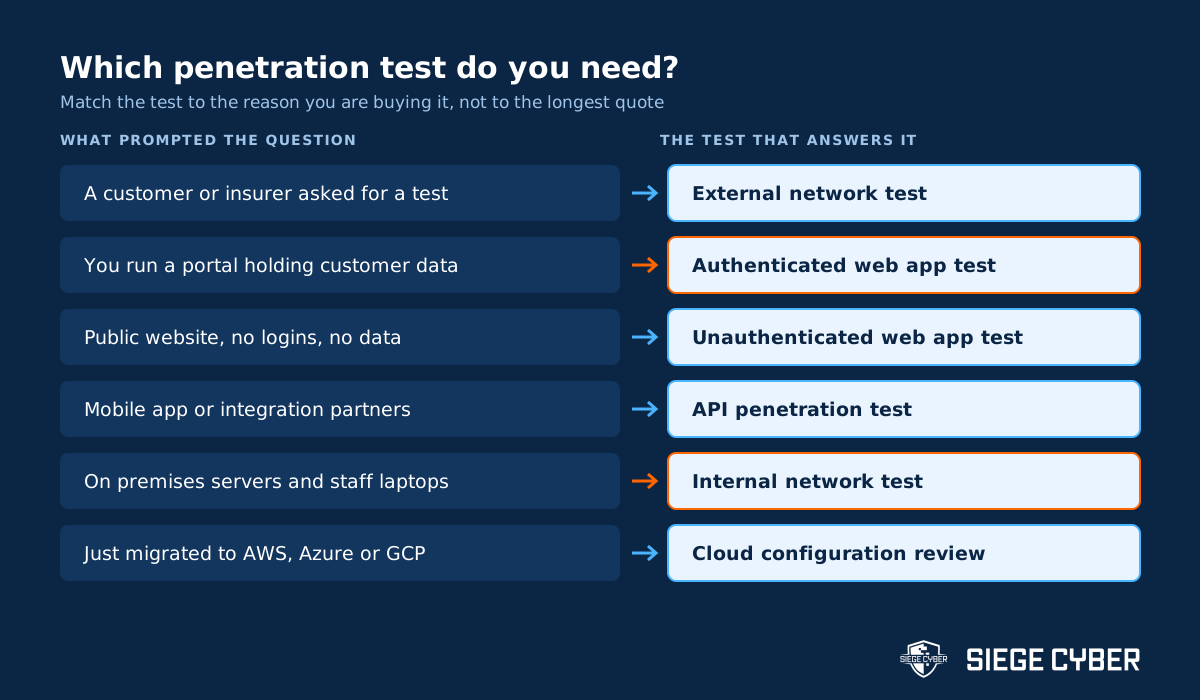
Most Melbourne businesses buying their first penetration test need an external network test, a web application test, or both. The choice comes down to where your sensitive data sits and what an attacker can reach from the internet. A business running a customer portal needs the application tested. A business whose exposure is a firewall, a VPN and a mail gateway needs the external perimeter tested. Buying the wrong one is the most common and most expensive mistake in this market.
The table below maps the common test types to the trigger that usually prompts them.
| Test type | What it covers | Usual trigger |
|---|---|---|
| External network | Internet facing infrastructure: firewalls, VPNs, mail, remote access | Insurance renewal, first customer security review, annual cycle |
| Unauthenticated web application | A public website or portal tested without login credentials | A marketing site or brochure site with a contact form |
| Authenticated web application | Every role inside the application, access controls between accounts | Any portal holding customer data or personal information |
| Internal network | What an attacker achieves once inside, lateral movement, privilege escalation | Post incident review, ISO 27001 or SOC 2 scope, office with on premises servers |
| API | Authentication, authorisation and business logic across endpoints | A mobile app or an integration partner asking questions |
| Cloud configuration | Identity, storage, network and logging configuration in AWS, Azure or Google Cloud | Migration to cloud, auditor asking for cloud assurance |
If you are unsure which applies, read our guide on how to scope a penetration test before you request quotes. Scope decided badly up front cannot be fixed by a good tester later.
Do Victorian government suppliers need penetration testing?
Suppliers to the Victorian public sector are frequently required to demonstrate security testing, because the Victorian Protective Data Security Standards reach beyond government itself. The Office of the Victorian Information Commissioner issues the standards under sections 86 and 87 of the Privacy and Data Protection Act 2014 (Vic). They set out 12 high level mandatory requirements covering governance, information, personnel, ICT and physical security, and they explicitly require contracted service providers with direct or indirect access to public sector information to adhere to the standards.
In practice that means a Melbourne business holding or processing Victorian public sector information inherits security obligations through its contract. The agency remains accountable, so it will ask you to prove your controls work. A current penetration test report is the cheapest, clearest way to answer that question. This is the single biggest difference between buying a penetration test in Melbourne and buying one anywhere else in Australia, and it is why “we are too small to need one” rarely survives a government tender.
How much does penetration testing cost in Melbourne?
Penetration testing in Melbourne is priced on tester days, not on your postcode. A provider estimates how many days a qualified tester needs to cover your scope properly, then prices those days. Two quotes for the same system can differ by a factor of three because they assume different numbers of days, so compare the days and the methodology before you compare the totals. Our Australian penetration testing pricing guide explains how the day count is built.
Five factors drive the day count more than anything else:
- Number of live hosts or endpoints in scope, not the number you own.
- Number of user roles in an application. Every additional role multiplies the access control testing.
- Whether credentials are provided. Authenticated testing finds far more, and takes longer.
- Retest inclusion. A test without a retest leaves you unable to prove anything was fixed.
- Reporting depth. A report written for an auditor or an insurer takes longer than a tool export.
Beware of a quote that is dramatically cheaper than the others. In almost every case the cheap quote is an automated vulnerability scan with light manual review. That has a place, and the difference between a scan and a test is real, but it will not satisfy an auditor who asked for a penetration test.
Does a Melbourne penetration tester need to be CREST accredited?
CREST accreditation is not legally required to perform penetration testing in Australia, but it is the clearest signal that a provider’s methodology, reporting and data handling have been independently examined. CREST assesses the company, not only the individual testers, which is what makes it useful when you are comparing firms you have never worked with. Several Australian government and financial services buyers now treat it as a baseline, so if you expect to be tendering, it is worth insisting on.
If a provider is not accredited, ask three questions instead: which methodology do you follow, which certifications do the individual testers hold, and can I see a sanitised sample report. A provider who cannot answer all three is selling you a scan. Our note on CREST accredited penetration testing in Australia covers what the accreditation actually examines.
How long does a penetration test take from start to finish?
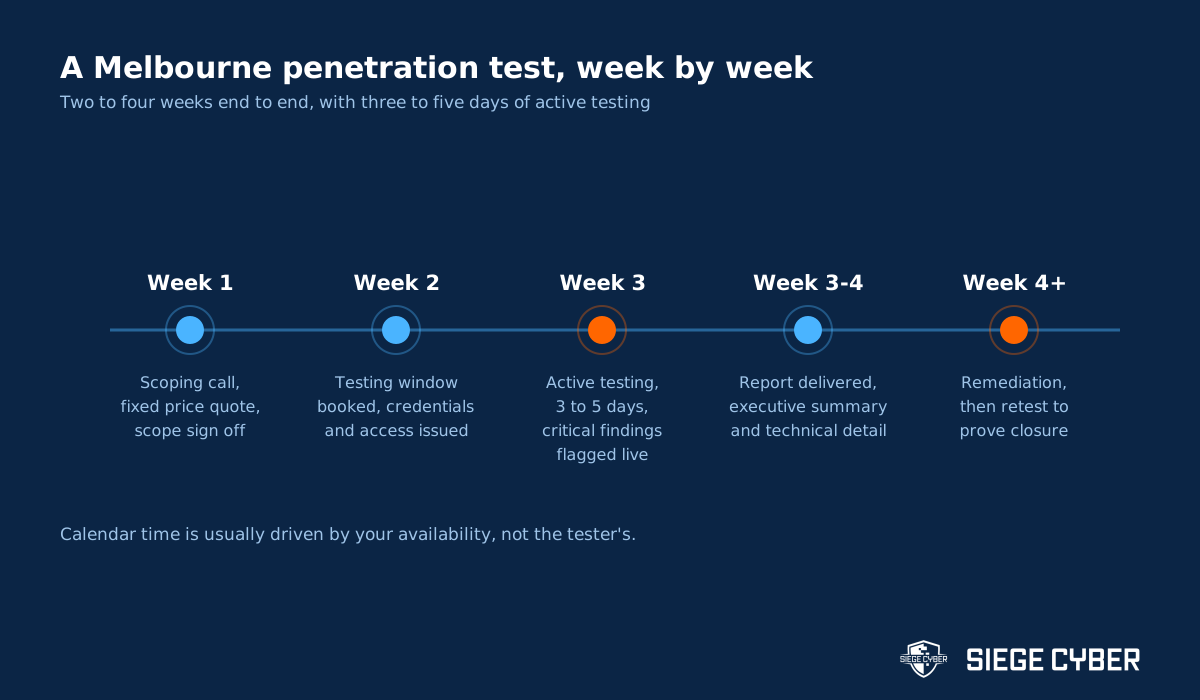
A typical penetration test for a Melbourne small or medium business runs two to four weeks end to end, of which the active testing is usually three to five days. The rest is scoping, scheduling, reporting and the remediation conversation. Businesses are often surprised that the calendar time is driven by their own availability rather than the tester’s: approving the scope, issuing credentials and confirming the testing window are the steps that slip.
Two scheduling notes specific to Melbourne buyers. Testing demand spikes in the weeks before 30 June, because testing budgets are tied to the Australian financial year, and again in February when government contracts are renewed. Book four to six weeks ahead in those windows. Also confirm whether your provider tests in business hours or after hours, since after hours testing protects production traffic but takes longer to complete.
What should a penetration test report contain?
A penetration test report should let two different readers act without a meeting. An executive needs a summary that states the overall risk position in plain language and names the two or three things that matter most. A technical owner needs, for every finding, the affected asset, reproduction steps, evidence, a risk rating with the reasoning behind it, and a specific remediation action. If the finding says “apply vendor patches”, the report has not done its job.
Check before signing whether a retest is included and how long you have to use it. A retest is what converts the report from a list of problems into evidence that you fixed them, and it is the artefact your customers, insurers and auditors actually want. We walk through this in how to read and act on a penetration testing report.
How often should a Melbourne business retest?
Annual penetration testing is the baseline most Australian auditors, insurers and enterprise customers expect, with an additional test after any significant change to the system in scope. Significant change means a new authentication method, a new payment flow, a migration between hosting providers, or a major release that alters how data moves. A certificate from 14 months ago will be queried in a customer security review.
If your systems change weekly, an annual test alone leaves long blind periods. In that case pair the annual test with continuous vulnerability scanning, and set the testing frequency from your rate of change rather than from the calendar.
Common questions
When is penetration testing performed?
Penetration testing is performed at four points: before a new system goes live, annually as part of a security programme, after a significant change to an existing system, and whenever a customer, insurer or auditor asks for current evidence. Testing before go live is the cheapest, because fixing a design flaw before launch costs a fraction of fixing it in production. Testing after an incident is the most expensive version of the same exercise.
What is the purpose of penetration testing?
The purpose of penetration testing is to find out whether your security controls actually stop an attacker, rather than whether they exist on paper. A scanner tells you a component has a known weakness. A penetration test tells you whether that weakness can be chained with others to reach your customer data. That difference is why auditors, insurers and enterprise procurement teams ask for a test rather than a scan.
What is physical penetration testing, and do Melbourne businesses need it?
Physical penetration testing assesses whether someone can walk into your premises and reach information or equipment, by testing reception processes, door controls, visitor handling and unattended workstations. Most Melbourne small businesses do not need it as a first test, because their real exposure is internet facing. It becomes relevant for organisations with a data centre, a records room, or protective security obligations attached to a government contract.
What is the difference between external and internal penetration testing?
External penetration testing starts from the internet with no access and asks how far an outsider gets. Internal penetration testing starts from inside your network, usually with the access level of a standard staff member or a compromised laptop, and asks how far that foothold spreads. Most businesses start externally, then add internal testing once they hold data on premises or need to satisfy an ISO 27001 or SOC 2 scope. Internal versus external penetration testing compares the two in detail.
Getting a penetration test booked in Melbourne
If you know which systems matter and who is asking for the evidence, scoping a penetration test is a short conversation rather than a project. Siege Cyber is a CREST accredited Australian provider, and we deliver fixed price penetration testing services to businesses across Melbourne and Victoria, with retesting included so you can prove the findings were closed.
Tell us what prompted the question, whether that is a tender, an insurer, a customer security review or a Victorian government contract, and we will tell you which test answers it. Get in touch and we will come back with a scope and a fixed price. If you are comparing cities or operating in more than one state, our guide to penetration testing in Sydney covers the equivalent regulated market there.