How to Choose an ISO 27001 Consultant in Australia
Choosing an ISO 27001 consultant in Australia comes down to three checks. Confirm they are independent of your certification body, because accreditation rules bar the body that certifies you from having consulted to you. Confirm what they hand over, so you are buying a working management system rather than a folder of templates. Confirm who does the work day to day, because the person in the sales meeting is often not the person who turns up. A consultant cannot certify you, and any who implies otherwise has told you something useful about themselves.
ISO 27001 consulting in Australia is an unregulated market. There is no licence to practise, no register to check, and no minimum competence standard. That is not an argument against using a consultant. It is an argument for knowing what you are buying before you commit to a project that typically runs three to nine months.
What does an ISO 27001 consultant actually do?
An ISO 27001 consultant helps you build and run an information security management system that will pass an accredited certification audit. The work is mostly structural rather than technical. Across a typical Australian engagement the consultant will cover some or all of the following.
- Scope definition. Deciding which parts of the business, which systems and which locations sit inside the management system, and writing a scope statement that will appear on your certificate.
- Gap analysis. Comparing what you already do against the clauses and the Annex A controls, then producing a prioritised plan.
- Risk assessment and treatment. Establishing a repeatable method, running it with your team, and recording decisions.
- Statement of Applicability. Justifying every Annex A control you include or exclude.
- Documentation. Policies, procedures and records. This is where template-heavy consultants live.
- Internal audit and management review. Both are mandatory before certification, and both are commonly left too late.
- Audit support. Preparing your people for what the auditor will ask and sitting with you through Stage 1 and Stage 2.
If you want detail on any single piece, we have written separately about defining your ISMS scope, running a gap analysis, writing the Statement of Applicability and running an internal audit that adds value.
Can the same firm consult on ISO 27001 and certify you?
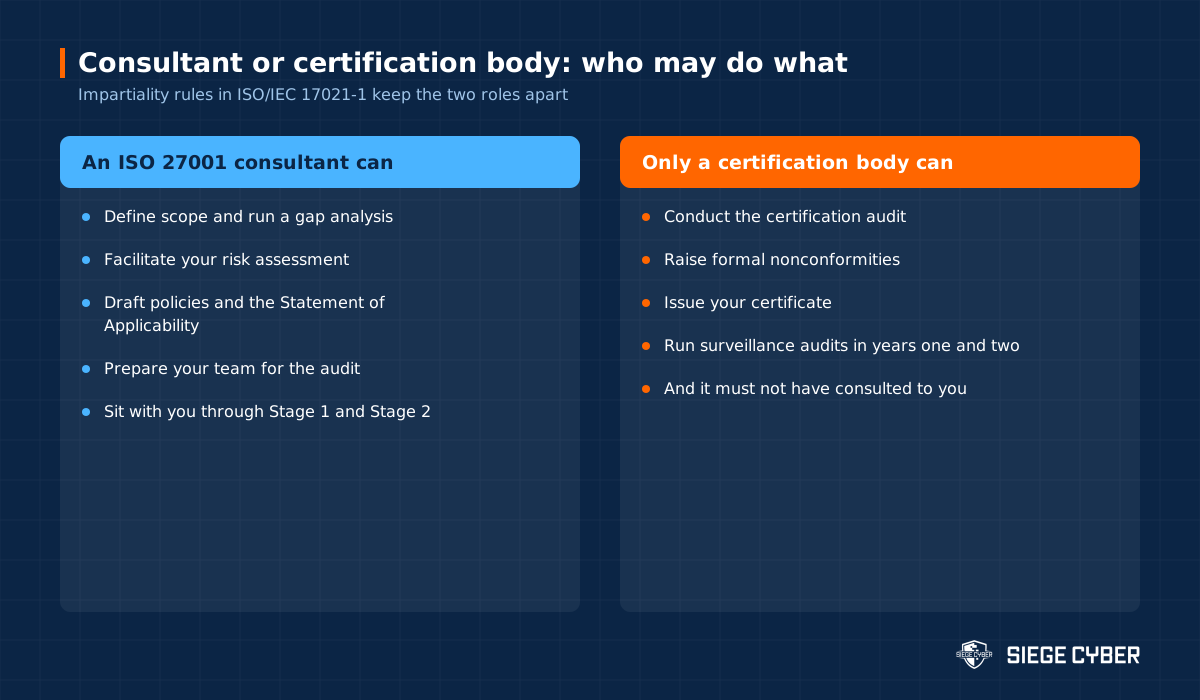
No, and this is the single most important thing to understand before you sign anything. Certification bodies that want to be accredited work to ISO/IEC 17021-1, the standard for bodies providing audit and certification of management systems. Its impartiality rules are explicit and they constrain who may do what.
- Clause 5.2.5 states that the certification body shall not offer or provide management system consultancy.
- Clause 5.2.7 states that where a client has received consultancy from a body related to the certification body, the certification body shall not certify that management system for a minimum of two years after the consultancy ends.
- Clause 5.2.10 states that personnel who provided the consultancy shall not take part in the audit for a minimum of two years after the consultancy ends.
- Clause 5.2.8 states that the certification body shall not outsource audits to a management system consultancy organisation.
- Clause 5.2.9 states that a certification body shall not state or imply that certification would be simpler, easier, faster or less expensive if a specified consultancy organisation were used.
The practical consequences are worth spelling out. A consultant who tells you they can get you certified is describing something they cannot do. A certification body that recommends a particular consultant is acting against the rules it is accredited under. A bundled offer of consulting plus certification from one brand is, at best, two legally separate entities and a two year wait. Accredited certification worldwide operates under the International Accreditation Forum arrangements that make this consistent across countries. The standard itself is available in Australia through Standards Australia.
Choosing the certification body is a separate decision with its own criteria, which we cover in how to choose an ISO 27001 certification body in Australia.
What should an ISO 27001 consultant deliver?
An ISO 27001 consultant should deliver a management system your team can run after they leave. The difference between a good engagement and an expensive one is usually visible in the deliverables list, so ask for it in writing before you sign.
| What you are buying | Good sign | Warning sign |
|---|---|---|
| Documentation | Policies edited to match how your business actually works, with your systems and roles named | A generic template pack with your logo dropped in |
| Risk assessment | Your team in a room making decisions, recorded in a method you can repeat next year | A risk register the consultant wrote alone and you have never read |
| Evidence | Controls operating, with records being generated as a by-product of normal work | Evidence assembled in the fortnight before the audit |
| Internal audit | An independent person auditing against the standard, raising real findings | A tick sheet completed by the person who wrote the policies |
| Handover | Named owners, a calendar of recurring obligations, and your team able to answer the auditor | The consultant answers for you at Stage 2 |
| After certification | A clear plan for surveillance audits in years one and two | The engagement ends on certificate day |
How much does an ISO 27001 consultant cost in Australia?
ISO 27001 consulting in Australia is normally quoted either as a fixed project fee for a defined scope or as a day rate against an estimated number of days. Neither is better by default, but they fail differently. A fixed fee protects you from scope drift and encourages the consultant to work quickly. A day rate is fairer when your scope is genuinely unclear, and riskier when it is not.
What actually drives the number is scope size, how much already exists, and how much of the work your team will do. Three things are worth separating in any quote. First, the consulting fee. Second, the certification body’s fees for Stage 1, Stage 2 and the two surveillance audits that follow, which are paid to a different organisation entirely. Third, tooling. Our compliance pricing page sets out how we structure engagements.
On tooling, you have real choices and they are not all platforms. Plenty of Australian SMBs certify using spreadsheets and a shared drive, which costs nothing and works until the evidence volume gets awkward. A consultant will often run the project in their own system. Enterprise GRC platforms automate evidence collection through deep integrations, at enterprise prices. Between those sits a smaller category of self-service tools, and CertAssist is one example: it lays out each control with policy and evidence templates and gives your auditor read-only access, and by design it holds no integrations into your systems. It publishes a list price of US$375 per month. Price the spreadsheet route first, then decide whether a tool earns its keep.
What should you still do yourself?
Some parts of ISO 27001 cannot be outsourced, and a consultant who offers to take them off your hands is selling you a certificate that will not survive a surveillance audit. Keep these in-house.
- Owning the risk decisions. The auditor will ask your people why a risk was accepted. A consultant’s answer is not evidence of management commitment.
- Running the controls. Access reviews, supplier reviews and incident handling have to be done by the people who do the work.
- Management review. Clause 9.3 requires top management to review the management system. That means your leadership, in a meeting, with minutes.
- Answering the auditor. At Stage 2 the auditor interviews your staff. If only the consultant can answer, the auditor has learned what they need to know.
The practical test is simple. If the consultant left tomorrow, could you still produce the evidence? Our guide to mandatory ISO 27001 documentation lists what has to exist regardless of who built it.
Do you need an ISO 27001 consultant at all?
You do not always need an ISO 27001 consultant. A business with an existing quality or management system, a technically strong team and genuine executive time can certify without one, particularly for a narrow scope. A business doing this for the first time, with no spare capacity and a customer deadline, usually finds that outside help pays for itself in time saved and rework avoided.
| Your situation | Likely best fit |
|---|---|
| First certification, tight customer deadline, no internal security lead | Consultant-led, with your team doing the control work |
| Existing ISO 9001 or similar management system, capable internal owner | Light touch advisory, gap analysis and pre-audit review only |
| Already running a compliance platform, unsure what is still missing | Independent gap analysis before you commit to anything larger |
| Small, narrow scope, strong technical team, flexible timeline | You may not need a consultant at all |
| Previous audit produced major nonconformities | Targeted remediation support, not a restart |
If you already use a compliance platform and are unsure what gap remains, we have addressed that case directly in whether you still need a consultant if you use Vanta or Drata.
What questions should you ask before signing?
Asking a consultant these questions before signing will tell you more than any capability statement. They are deliberately specific, because vague questions get vague answers.
- Which certification bodies have audited your clients, and have you worked with Australian accredited bodies?
- Who will do the work, what is their background, and will they be on site or remote?
- What exactly is in the deliverables list, and what remains our responsibility?
- How many of your clients have certified, and how many had major nonconformities at Stage 2?
- What happens if we fail Stage 2, and is remediation included?
- Does the engagement end at certification, or does it cover the first surveillance audit?
- Can you give us a reference from an Australian client of similar size and scope?
Common questions
How much does ISO 27001 certification cost in Australia?
There is no single figure, because the cost depends on scope, headcount, how many sites and systems are in scope, and how much already exists. What you can do is separate the components: consulting support if you use it, the certification body’s audit fees for Stage 1 and Stage 2, annual surveillance audits in years one and two, any tooling, and your own team’s time, which is usually the largest and least budgeted line.
Can an individual be ISO 27001 certified?
No. ISO 27001 certifies an organisation’s information security management system, not a person. Individuals can hold qualifications such as Lead Auditor or Lead Implementer, which say the person has passed a course and assessment. Those are useful signals when you are assessing a consultant, but they are a different thing entirely from your business holding certification.
How long does it take to get ISO 27001 certified?
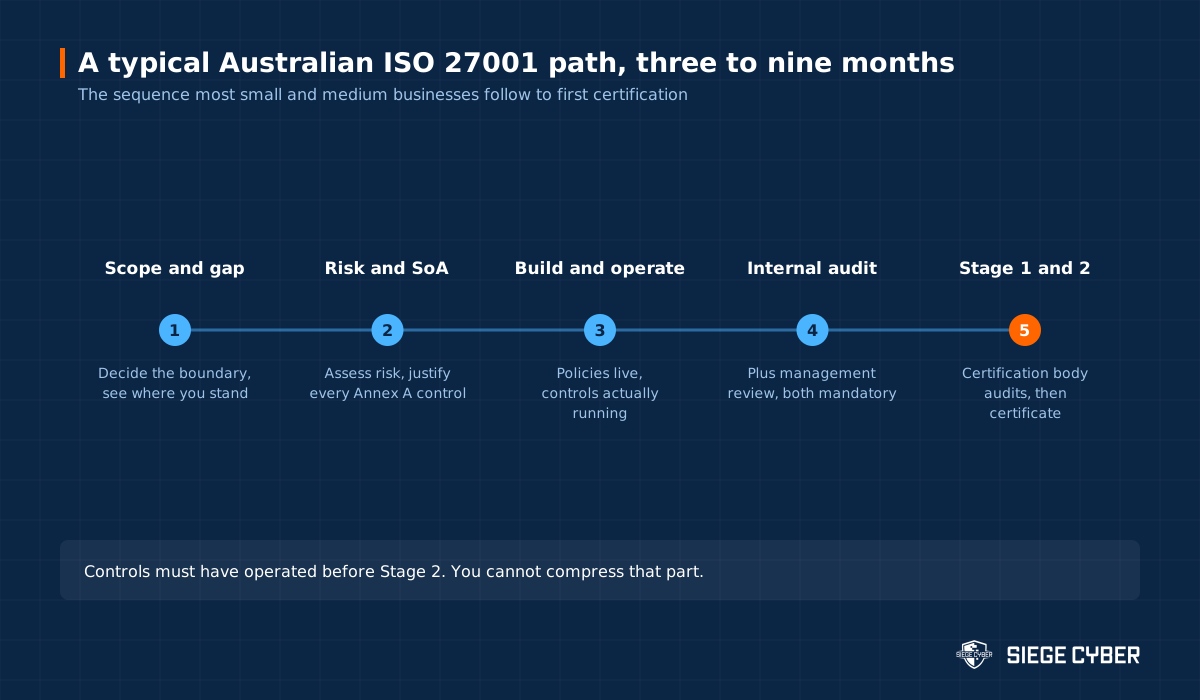
For most Australian small and medium businesses, three to nine months from a standing start to certification. The spread depends on scope size, how much documentation and control activity already exists, and how quickly your leadership can make decisions. One timing constraint catches people out: you must have run an internal audit and a management review before Stage 2, and the auditor will want to see controls that have actually operated.
Is ISO 27001 mandatory in Australia?
No. ISO 27001 is not required by Australian law for general commercial businesses. It becomes effectively mandatory through contracts, when an enterprise customer, a government buyer or a tender requires it. If nobody has asked you for it and you have no plan to sell into a market that will, there may be a cheaper baseline that meets your actual risk.
How often are ISO 27001 audits?
Certification runs on a three year cycle. After the initial Stage 1 and Stage 2 audits, your certification body conducts surveillance audits in years one and two, then a full recertification audit in year three. Separately, you must run your own internal audit programme covering the management system, which most businesses schedule annually.
The short version
A good ISO 27001 consultant shortens the path and reduces rework. They cannot certify you, they cannot run your controls for you, and they should not be recommended to you by the body that will audit you. Ask who does the work, what gets handed over, and what happens after the certificate arrives.
If you would like an honest read on how much help you actually need, our ISO 27001 services page explains how we scope engagements, or get in touch and we will tell you if you would be better off doing it yourself.