How Long Does a Penetration Test Take in Australia?
A penetration test takes two to ten testing days for a typical small or medium Australian environment. The whole engagement takes longer. Counting from your first enquiry to a report with verified fixes, allow six to ten weeks. Roughly a quarter of that is someone actively testing. The rest is scoping, waiting for a tester to come free, authorisations, report writing and quality assurance, then your own remediation and the retest.
That gap between testing days and calendar weeks is where project plans come unstuck. A provider quotes five days, the buyer writes five days into the board paper, and nobody mentions the three week wait for a slot or the fortnight of report writing that follows.
How long does a penetration test take from start to finish?
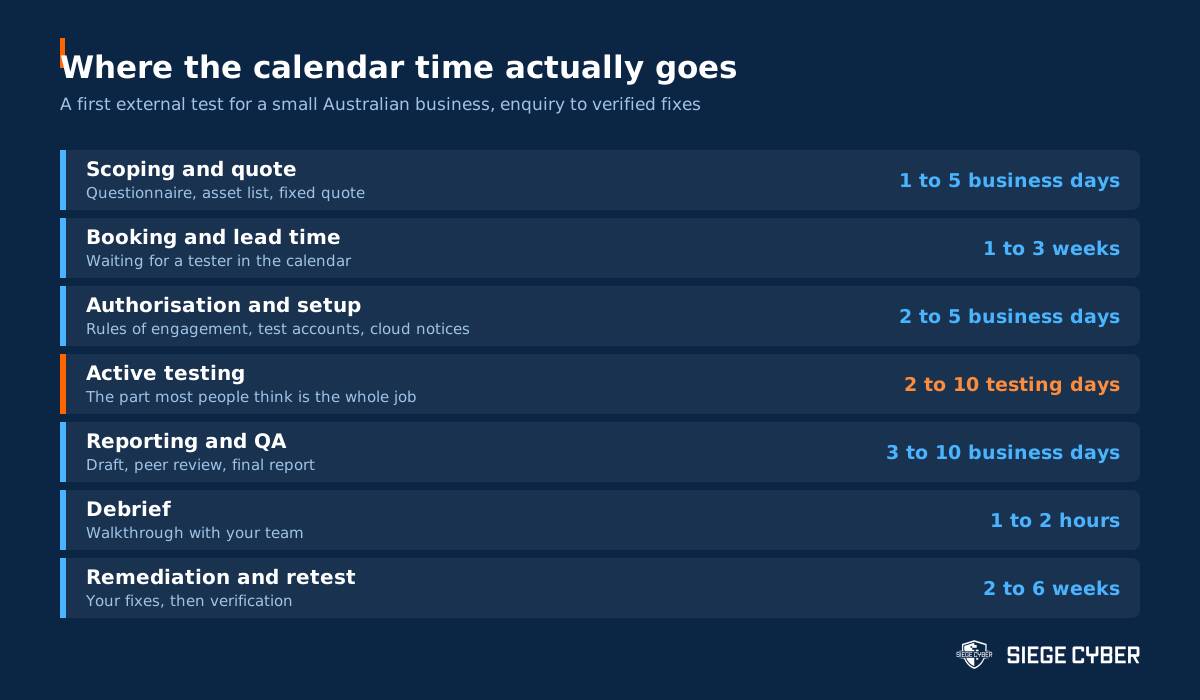
A penetration test engagement for an Australian small or medium business runs through seven stages, and only one of them involves active testing. Scoping and quoting takes one to five business days. Booking a tester takes one to three weeks, because good testers are scheduled in advance. Authorisation and setup takes two to five business days. Active testing takes two to ten testing days. Reporting and quality assurance takes three to ten business days. The debrief takes an hour or two. Remediation and retest take another two to six weeks, driven almost entirely by how quickly your team ships fixes.
Added together, a first external penetration test lands between six and ten weeks end to end. A repeat test with the same provider and scope, with a slot already booked, can be done in three to four weeks.
How many testing days does each type of penetration test need?
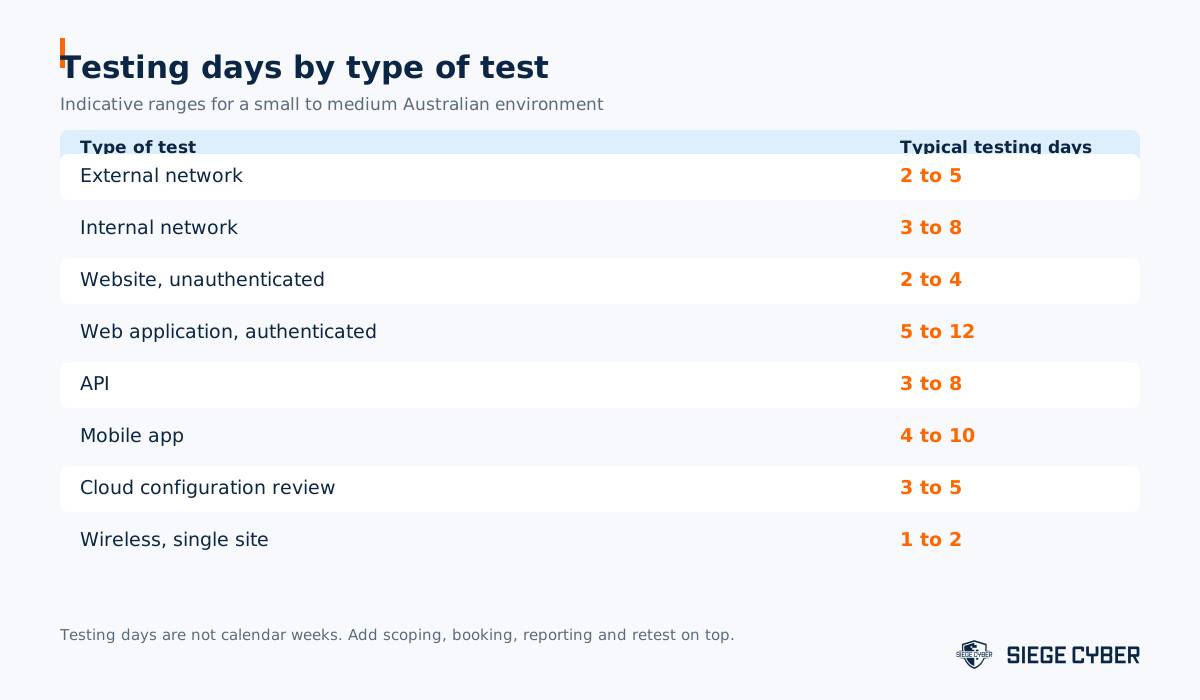
The number of testing days depends on what is being tested, not on how big your company is. A twelve person software business with a complex multi role application needs more testing days than a sixty person services firm with a brochure website and a Microsoft 365 tenant. The ranges below are indicative for a small to medium Australian environment and assume a competent manual test, not an automated scan with a report template over the top.
| Type of test | Typical testing days | What drives the number |
|---|---|---|
| External network | 2 to 5 | Count of live internet facing hosts and services |
| Internal network | 3 to 8 | Number of sites, subnets and domain complexity |
| Website, unauthenticated | 2 to 4 | Page count and whether there are forms or uploads |
| Web application, authenticated | 5 to 12 | Number of user roles and distinct functions per role |
| API | 3 to 8 | Endpoint count and authorisation model |
| Mobile app | 4 to 10 | iOS, Android or both, plus the backend API |
| Cloud configuration review | 3 to 5 | Number of accounts, subscriptions or projects |
| Wireless, single site | 1 to 2 | Number of SSIDs and the authentication method |
When comparing quotes, ask for testing days and the number of testers, not just the calendar window. Two testers for three days is six tester days. One tester for five days is five. The window can look identical while the depth of work differs by a third. Our guide to scoping a penetration test covers the questions that produce a defensible day count.
Why is the waiting time longer than the testing time?
Waiting time dominates a penetration test engagement because experienced testers are booked ahead and because several setup steps depend on other people. The single largest block is booking lead time. A reputable Australian provider will usually offer a start date one to three weeks out, and longer in the run up to 30 June and across the Christmas and January shutdown, when everyone with a deadline tries to book at once.
The second block is authorisation. Rules of engagement need signing. Test accounts need creating, one per role, and they need to actually work. If a third party hosts or manages the system, they need to approve the test in writing. Each step is quick on its own. Together they routinely add a week when nobody has been made responsible for chasing them.
The third block is reporting. A finding is not written up the moment it is found. The tester finishes testing, writes the report, and a second person reviews it before it reaches you. That review is what stops a false positive landing in a document you forward to a customer. Our guide to reading a penetration test report explains what the finished document should contain.
What makes a penetration test take longer than quoted?
Penetration tests slip for a short list of predictable reasons, and most of them are on the client side rather than the tester side. Knowing them in advance is the difference between a six week engagement and a ten week one.
| What causes the delay | Typical cost in time | How to avoid it |
|---|---|---|
| Test accounts not ready on day one | 1 to 3 testing days | Create and log into every role account a week before |
| Scope grows mid test | 2 to 5 testing days | Freeze the asset list at quote stage |
| Third party hosting approval missing | 3 to 10 business days | Request it the day you accept the quote |
| Environment unstable or offline | 1 to 4 testing days | Nominate a technical contact who can restore it quickly |
| Testing restricted to out of hours | Adds 30 to 50 per cent | Only restrict hours where it is genuinely required |
| Slow sign off on rules of engagement | 2 to 5 business days | Identify the signatory before the quote is issued |
| Remediation stalls after the report | 2 to 6 weeks | Book the retest date before testing starts |
The last row catches people out. The test finishes on schedule, the report arrives, then nothing happens for a month because no one owns the fixes. Treat remediation as a scheduled project with named owners. Our guide to penetration test remediation sets out how to triage findings and close them.
How far ahead should you book a penetration test before a deadline?
Book a penetration test eight to ten weeks before the date you need the finished report, and twelve weeks if the report must show findings as resolved. That allows for booking lead time, testing, reporting, your remediation and a retest, with a fortnight of slack for the thing that always goes wrong.
Deadlines in Australia tend to come from four places. An ISO 27001 surveillance or recertification audit. A SOC 2 observation period that needs a test inside the window. A customer or tender requiring a current report before signature. Or a cyber insurance renewal. There is also a standing reason that has no date attached: the Office of the Australian Information Commissioner expects entities to take reasonable steps to protect personal information, and its guide to securing personal information treats regular testing as part of that.
| Your deadline | When to start | Why |
|---|---|---|
| Report needed, findings not yet fixed | 8 to 10 weeks before | Booking, testing and reporting only |
| Report needed showing findings resolved | 12 weeks before | Adds remediation and a retest |
| Repeat test, same scope, known provider | 4 to 6 weeks before | Scoping and authorisation are quick |
| Deadline falls in December or January | Add 2 to 3 weeks | Shutdown period reduces available testing days |
| Deadline falls in late June | Add 1 to 2 weeks | End of financial year demand peaks |
If your deadline is already inside four weeks, say so when you ask for a quote rather than after. A provider can sometimes narrow the scope to the assets that matter most and deliver a tighter test on time, which is a better outcome than a broad test that arrives late. What a provider cannot do is compress quality assurance without compressing quality.
How long does the retest take after you fix the findings?
A retest after a penetration test usually takes one to three testing days and is scheduled one to two weeks after you confirm remediation is complete. The retest verifies the specific findings from the original report. It is not a fresh test, so it does not take as long and should not cost as much as the original engagement.
Two things make a retest slower than it needs to be. Submitting fixes in dribs and drabs, which means the tester verifies the same system three times. And fixing the symptom rather than the finding, so the tester reports the issue as still open and you need a third round. Fix everything you intend to fix, confirm it in your own environment first, then book one retest.
Ask in advance whether the retest produces an updated report or a separate verification letter. Agreeing that deliverable before testing starts saves a fortnight of correspondence later.
Common questions
How long does a pen test take?
Active testing takes two to ten days for most small and medium Australian environments. The whole engagement, from enquiry through scoping, booking, testing, reporting and retest, usually takes six to ten weeks. The testing days are the smallest part of the calendar time, which is why a quote expressed only in days can be misleading when you are planning around a deadline.
How long does a penetration test last?
The findings in a penetration test report describe your environment on the days it was tested. Most Australian organisations treat a report as current for twelve months, and most auditors, insurers and enterprise customers expect a test no older than that. If you make a significant change, such as a new application, a migration or a merger, the report no longer describes what you run and a further test is warranted sooner.
How long should pen testing take for a small business?
A first external test for a small Australian business with a website and a modest internet footprint is commonly three to five testing days, delivered within four to six weeks of accepting a quote. If that same business runs a customer facing application with logins, add five to twelve testing days for an authenticated web application test, which is the test that actually examines customer data and access controls.
When is penetration testing performed?
Penetration testing is performed before a system goes live, after a significant change, and then on a regular cycle, most commonly annually. Many Australian organisations schedule it around a compliance date, such as an ISO 27001 audit or a SOC 2 observation period, or around a commercial trigger such as a tender or an insurance renewal. Testing immediately after a major release is more useful than testing on a fixed date that no longer matches your environment.
Does an internal penetration test take longer than an external one?
Internal penetration tests usually take longer than external ones, commonly three to eight testing days against two to five. An external test examines a defined and usually small internet facing footprint. An internal test examines everything reachable from inside your network, which in most businesses is far larger and includes directory services, file shares and internal applications. Our comparison of internal and external penetration testing covers which to choose first.
Planning a penetration test around a deadline?
Siege Cyber is a CREST accredited Australian penetration testing provider. If you have a date you need to hit, whether that is an audit, a tender or an insurance renewal, tell us the date and we will tell you honestly whether it is achievable and what scope fits inside it. See our penetration testing services, read our preparation checklist so day one is not spent waiting on test accounts, or get in touch for a scoping conversation. If budget is the next question, our guide to penetration testing costs in Australia covers what drives the number.