Automated Penetration Testing: What It Cannot Find
Automated penetration testing is tool-driven testing that scans your systems, matches what it finds against known vulnerabilities, and in some products attempts to exploit them without a person involved. It is genuinely good at known software flaws, missing patches, weak or reused credentials and exposed services, and it runs as often as you like. It cannot find business logic flaws, broken access control between two legitimate accounts, or attack chains that need judgement. On its own it will not satisfy an ISO 27001 or SOC 2 auditor who asks for penetration testing.
That is the short answer. The longer answer matters, because the sales pitch for these tools is usually some version of “continuous penetration testing, no humans required”. For an Australian business with 2 to 100 staff, the useful question is which parts of a test a machine does well, which parts it cannot do at all, and what you are contractually obliged to produce.
What is automated penetration testing?
Automated penetration testing is a category of security tooling that performs reconnaissance, vulnerability identification and, in the stronger products, controlled exploitation, on a schedule and without a tester driving it. Vendors in this space market it as continuous security validation, automated security validation, or automated pentesting. The products vary a lot. At the simple end the tool is an authenticated vulnerability scanner with better reporting. At the sophisticated end it will chain a credential it has cracked into lateral movement inside a test network and show you the path it took.
What all of these products share is that the attack logic was written in advance by a human. The tool executes known techniques against your environment. It does not form a hypothesis about how your application is meant to work and then test whether that assumption can be broken.
What can automated penetration testing actually find?
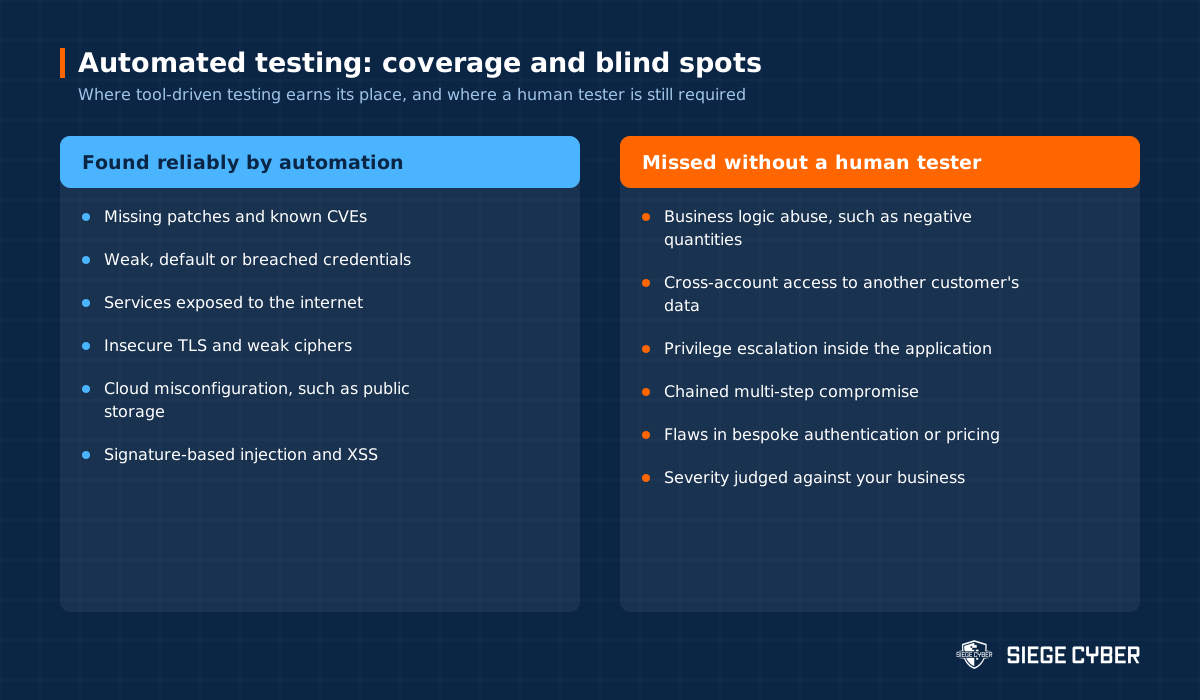
Automated penetration testing reliably finds the classes of problem that can be described in advance as a signature, a version number or a configuration state. For most Australian small and medium businesses, that is a large share of real-world risk, and it is the share that ransomware operators exploit most often.
- Missing security patches and end-of-life software with a published CVE.
- Default, weak, reused or previously breached credentials.
- Services exposed to the internet that were never meant to be, such as a management interface or a database port.
- Misconfigured TLS, insecure protocols and weak cipher suites.
- Common web vulnerabilities with a deterministic signature, including many injection and cross-site scripting cases.
- Cloud configuration errors such as a public storage bucket or an over-permissive security group.
Because an automated tool runs cheaply, it can run weekly or daily. A human-led penetration test is a point-in-time exercise, so running automation between tests closes the gap where a new server is built or a patch is missed.
What does automated penetration testing miss?
Automated penetration testing misses the findings that depend on understanding what your business does. A scanner has no idea that an invoice should only ever be approved by someone other than the person who raised it. These are the categories that a tool cannot reason about, and they are consistently where the most serious findings in a real penetration test come from.
- Business logic flaws. Changing a quantity to a negative number to generate a refund, or skipping a payment step by going straight to the confirmation URL.
- Broken access control between accounts. Logging in as customer A and reading customer B’s records by changing an identifier. A scanner usually has one session and no concept of which record belongs to whom.
- Privilege escalation inside an application. A standard user reaching an administrative function because a permission check runs in the browser rather than on the server.
- Multi-step attack chains. A low-severity information leak plus a weak password reset plus a verbose error message, which individually look trivial and together take over an account.
- Flaws in anything bespoke. Custom authentication, custom pricing logic, custom integrations with a third party.
- Context on severity. A tool rates a finding against a generic scale. It does not know that one of those servers holds your entire customer database and another is a test box with nothing on it.
This is why the Open Worldwide Application Security Project splits its testing guidance the way it does. Large parts of the OWASP Web Security Testing Guide describe tests that require a human to understand the application’s intended behaviour before judging whether something is broken.
Is automated penetration testing the same as vulnerability scanning?
Automated penetration testing and vulnerability scanning overlap heavily, and in some products they are the same thing with different marketing. A vulnerability scanner identifies and reports weaknesses. An automated penetration testing tool goes a step further and attempts to confirm the weakness by exploiting it, which cuts down false positives and shows real impact.
The distinction matters commercially, because a customer or auditor who asks for a penetration test is usually asking for something a scan does not provide. We cover the difference in more detail in penetration testing versus vulnerability scanning, and the related question of DAST versus penetration testing for development teams.
| Finding type | Automated tool | Human-led test |
|---|---|---|
| Missing patch or known CVE | Yes, reliably and continuously | Yes, but a slower way to find it |
| Weak or breached credentials | Yes | Yes |
| Exposed service or open port | Yes | Yes |
| Cloud misconfiguration | Yes | Yes |
| Broken access control between accounts | Rarely | Yes, this is core testing work |
| Business logic abuse | No | Yes |
| Chained multi-step compromise | Limited, within known techniques | Yes |
| Severity judged against your business | No | Yes |
| Report an auditor or enterprise customer will accept | Usually not on its own | Yes |
Does an automated penetration test satisfy ISO 27001, SOC 2 or the Essential Eight?
An automated penetration test on its own generally does not satisfy a framework that asks for penetration testing, because what the auditor assesses is whether your technical testing is appropriate to your risk, performed competently, and acted upon. A scan report with no scope statement, no methodology and no retest evidence rarely clears that bar for an internet-facing application holding customer data.
| Obligation | What it asks for | Is automation alone enough? |
|---|---|---|
| ISO 27001:2022 | Technical vulnerability management under Annex A 8.8 and evidence that controls are tested. Penetration testing is not a named mandatory control. | Sometimes for low-risk scope. Rarely for an internet-facing application holding customer data. |
| SOC 2 | Controls you defined yourself, tested by the auditor. If your control says you perform annual penetration testing, you must evidence exactly that. | Only if your stated control genuinely describes automated testing, and your auditor accepts it. |
| PCI DSS v4.0.1 | Internal and external penetration testing at defined intervals, using a documented methodology, performed by a qualified resource. | No. The methodology and tester competence requirements are explicit. |
| Essential Eight | Patching timeframes and the other seven mitigation strategies. It does not require penetration testing at all. | Not applicable. Automation helps you evidence patching, which is the point. |
| Enterprise customer or insurer | Whatever their questionnaire or policy schedule says, which increasingly names an independent test. | Usually not. Read the clause before you buy anything. |
If an obligation is driving the spend, read the wording before you choose a tool. We have written up the specifics for ISO 27001 and for SOC 2. In both cases the framework is less prescriptive than most vendors imply, and the real driver is usually a customer contract rather than the standard itself.
Will AI replace penetration testers?
AI has made automated testing meaningfully better at reconnaissance, at reading application responses and at reducing false positives, and tools that use large language models to plan attack steps are improving quickly. What has not changed is that the hardest findings require knowing what the application is for. An AI agent can be told the business rules, and then it can test them, but someone still has to establish what the rules are and judge whether breaking one matters.
For a small Australian business, AI-assisted automation is lowering the cost of the routine half of testing, and the routine half was never where your worst risk was. Treat claims that a tool fully replaces a human test with the scepticism you would apply to any product that promises to remove professional judgement from a regulated process.
How should an Australian business combine automated and manual testing?
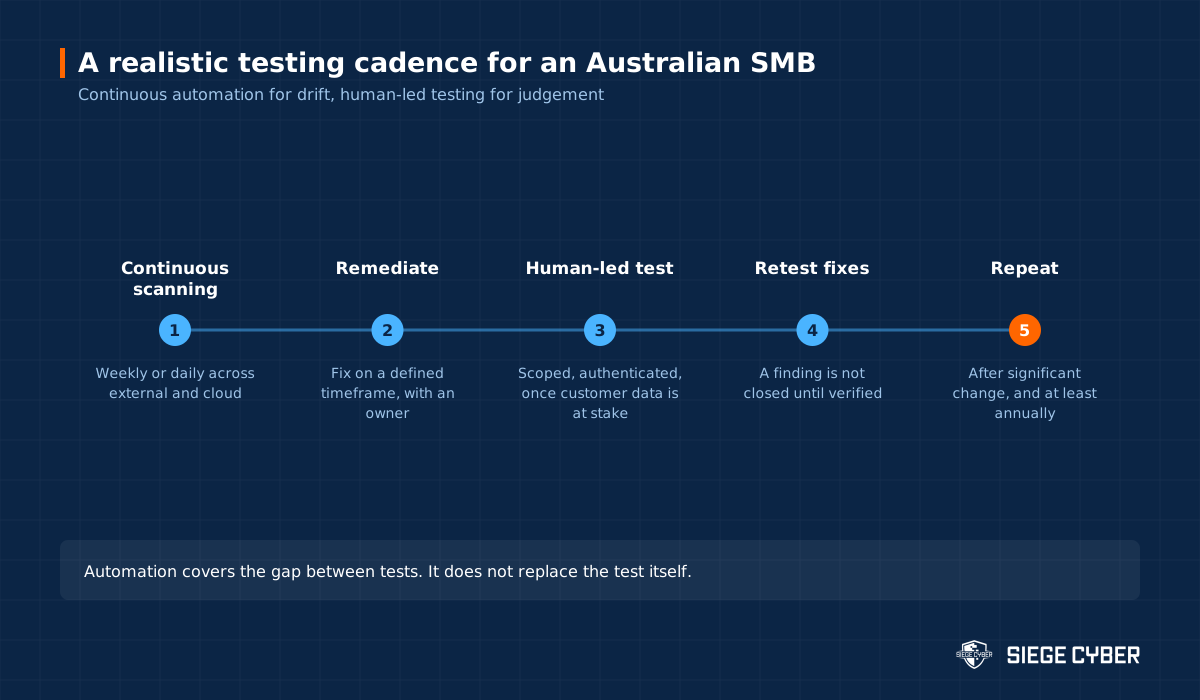
Combining automated and manual testing works best when each one does the job it is good at, rather than treating them as competing purchases. The pattern below suits most Australian businesses with 2 to 100 staff and one or two internet-facing applications.
- Run authenticated vulnerability scanning continuously across your external footprint and your cloud configuration. This is the cheap layer and it should never be off.
- Fix what the scanning finds on a defined timeframe. Unactioned scan output is worse than no scanning, because it documents that you knew.
- Commission a human-led penetration test for anything that holds customer data, handles money, or has custom authentication and access control.
- Test authenticated as well as unauthenticated, because most serious access control findings only appear once the tester has a valid login.
- Retest the fixes, then repeat the human-led test after significant change and at least annually if a contract requires it.
On frequency, the right answer depends on your rate of change rather than the calendar, which we work through in how often you should run a penetration test. On scope, the decisions made before a test starts determine whether it finds anything useful, covered in how to scope a penetration test.
How do you tell a real penetration test from a scan with a nice report?
Telling a real penetration test from a dressed-up scan comes down to three checks you can make before you sign. Ask who performs the work and what accreditation they hold, because an accreditation such as CREST covers the methodology, the people and the handling of your data, as we explain in why CREST accreditation matters. Ask for a redacted sample report and look for findings that reference business logic, not just CVE numbers. Ask whether authenticated testing and retesting of fixes are included, because a provider who will not verify a fix is selling you a document rather than an outcome.
Common questions
Can penetration testing be automated?
Parts of it can. Reconnaissance, known vulnerability identification, credential testing and configuration review are all automated routinely and well. The parts that depend on understanding what an application is meant to do, such as business logic abuse and access control between two valid accounts, are not reliably automated today. Most mature testing programs use automation continuously and human-led testing periodically, rather than choosing one.
Will penetration testing be replaced by AI?
Not in the near term, though the balance is shifting. AI-assisted tools are getting better at the repeatable parts of testing and at reducing false positives, which lowers cost. The judgement-heavy work, deciding what should not be possible in your application and then proving it is, still needs a person who understands your business.
Is DAST the same as penetration testing?
No. Dynamic application security testing is automated testing of a running application, usually wired into a development pipeline so that it runs on every build. Penetration testing is a scoped, human-led assessment that includes DAST-style techniques alongside manual testing, and produces a report with business context and severity judgement. DAST is a useful control for catching regressions early. It is not a substitute for a test.
How much does automated penetration testing cost compared with a manual test?
Automated tooling is normally sold as an annual subscription priced on the number of targets, so the cost scales with your footprint rather than with testing effort. A human-led test is priced on scope and tester days. The two are not really alternatives, and budgeting for them as if they were usually ends with continuous scanning and no independent test, which is the combination most likely to fail a customer security review.
Where this leaves you
Automated penetration testing is worth running. For patching and configuration drift it outperforms any annual exercise. It is not a penetration test in the sense your auditor, your enterprise customer or your insurer means, and buying it as one is how businesses end up with a shelf full of reports and an access control flaw nobody ever looked for.
If you want a clear view of what is worth automating in your environment and what genuinely needs a tester, our penetration testing services page sets out how we scope engagements, or you can get in touch and we will tell you honestly which half of the problem you actually have.