DAST vs Penetration Testing: What SaaS Teams Need
DAST is not penetration testing. Dynamic application security testing is an automated scanner that probes a running application for known classes of vulnerability, and it finds the same categories of issue every time it runs. A penetration test is a person using tools, who chains small weaknesses together and tests the logic your application is built on. A SaaS team needs both, and auditors treat them differently, which is the part that catches people out.
Most comparisons of these tools are written by companies selling one of them, for enterprise application security teams that do not exist in a 20 person Australian SaaS business. This guide is written for the team that has a CI pipeline, a handful of engineers, a security questionnaire from a large customer, and a decision to make about where the next dollar goes.
Is DAST the same as penetration testing?
DAST and penetration testing are not the same, although they overlap. Dynamic application security testing runs automatically against a deployed application, sends crafted requests, and reports where the responses match known vulnerability patterns. It is fast, repeatable and cheap per run. A penetration test is a scoped engagement in which a tester reasons about your specific application: what the roles are, what the data means, what an attacker would want, and how two harmless looking behaviours combine into a real problem.
The distinction matters commercially because the two produce different artefacts. DAST produces a report that changes every deployment and is mostly consumed by engineers. A penetration test produces a point in time report with a methodology statement, an independent tester, and findings rated for business risk, which is the artefact customers, insurers and auditors ask for. Running DAST does not let you answer “yes” to “have you had a penetration test”.
What is the difference between SAST, DAST and SCA?
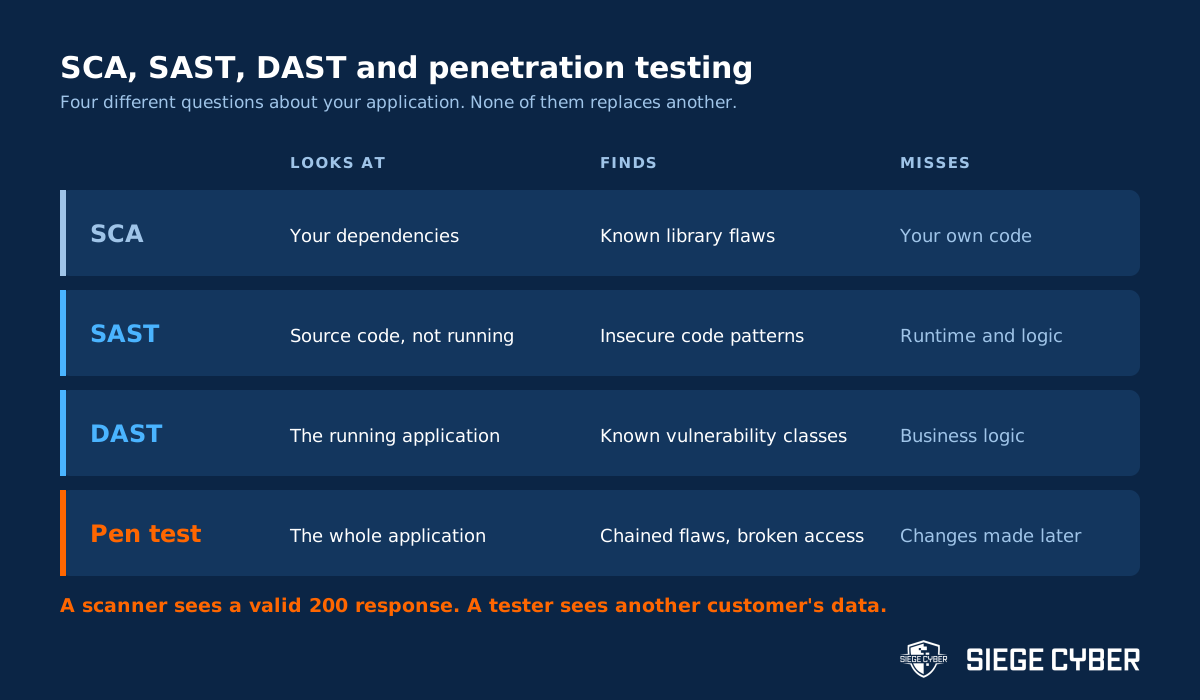
SAST, DAST and SCA look at three different things. Static application security testing reads your source code without running it, and finds insecure patterns in code your team wrote. Dynamic application security testing attacks the running application from the outside with no view of the code. Software composition analysis inspects your dependencies and flags known vulnerabilities in third party libraries you did not write. They do not substitute for each other, and most SaaS teams adopt them in a particular order.
| Looks at | Finds | Misses | |
|---|---|---|---|
| SCA | Your dependencies | Known vulnerabilities in libraries, licence problems | Anything in your own code |
| SAST | Source code, not running | Insecure patterns, injection risks, hardcoded secrets | Runtime and configuration issues, logic flaws |
| DAST | The running application | Known vulnerability classes visible from outside | Business logic, access control between accounts |
| Penetration test | The whole application and its context | Chained weaknesses, logic flaws, broken authorisation | Problems introduced after the test date |
Which should an Australian SaaS startup buy first?
Start with software composition analysis, because it is usually free in your existing tooling and dependency vulnerabilities are the most common way small SaaS products get compromised. Add static analysis next, since most code hosting platforms include a usable version and it catches mistakes before review. Add an annual penetration test when you begin selling to customers who ask about security. Add DAST last, when you have the engineering capacity to handle a continuous stream of findings.
That order surprises teams who assume the automated tools come first because they are cheaper. The reasoning is about what unblocks revenue and what fits your capacity. An unreviewed DAST pipeline that nobody triages produces a backlog, not security, and the backlog becomes an audit finding of its own. A penetration test produces a short list of real problems and a report your sales team can use, which is a better return for a small team.
Does DAST satisfy a SOC 2 or ISO 27001 auditor?
Automated scanning alone rarely satisfies an auditor who has asked for evidence of independent security testing. Neither SOC 2 nor ISO 27001 names DAST or penetration testing as a required activity, because both describe outcomes rather than tools. In practice, auditors assessing vulnerability management want to see that vulnerabilities are identified, prioritised and remediated on a defined timeline, and that independent testing occurs. Scanner output alone demonstrates identification, and rarely demonstrates independence or remediation.
The combination that satisfies most Australian auditors is continuous automated scanning plus an annual independent penetration test, with documented evidence that findings from both were triaged and closed. Our guides on whether penetration testing is required for SOC 2 and what an ISO 27001 auditor expects from penetration testing set out what each framework actually asks for. For the surrounding process, see vulnerability management for ISO 27001 and SOC 2.
What do SAST and DAST always miss?
SAST and DAST miss anything that requires understanding what your application means rather than how it is built. The clearest example in SaaS is broken access control between tenants: user A changes an identifier in a request and sees user B’s data. To a scanner that is a valid request returning a valid response with a 200 status code. To a human tester it is the most serious finding in the report, and it is the one that ends deals when a customer discovers it.
The same blind spot covers business logic generally: a discount that can be applied twice, an invitation flow that grants more privilege than intended, an export that ignores the role check, a password reset that can be replayed. The OWASP Web Security Testing Guide treats authorisation and business logic testing as their own categories precisely because tools cannot infer intent. This is the specific gap a penetration test fills, and it is why multi tenant SaaS products are tested with credentials for more than one account.
Where does each tool belong in a CI/CD pipeline?
Each tool belongs at the point where its feedback is cheapest to act on. Software composition analysis and static analysis belong on every pull request, where a developer still has the change in their head. Dynamic scanning belongs against a staging environment on a schedule, because it needs a running application and takes too long to block a merge. Penetration testing belongs on a calendar, before major releases and annually, because it is a scoped engagement rather than a pipeline step.
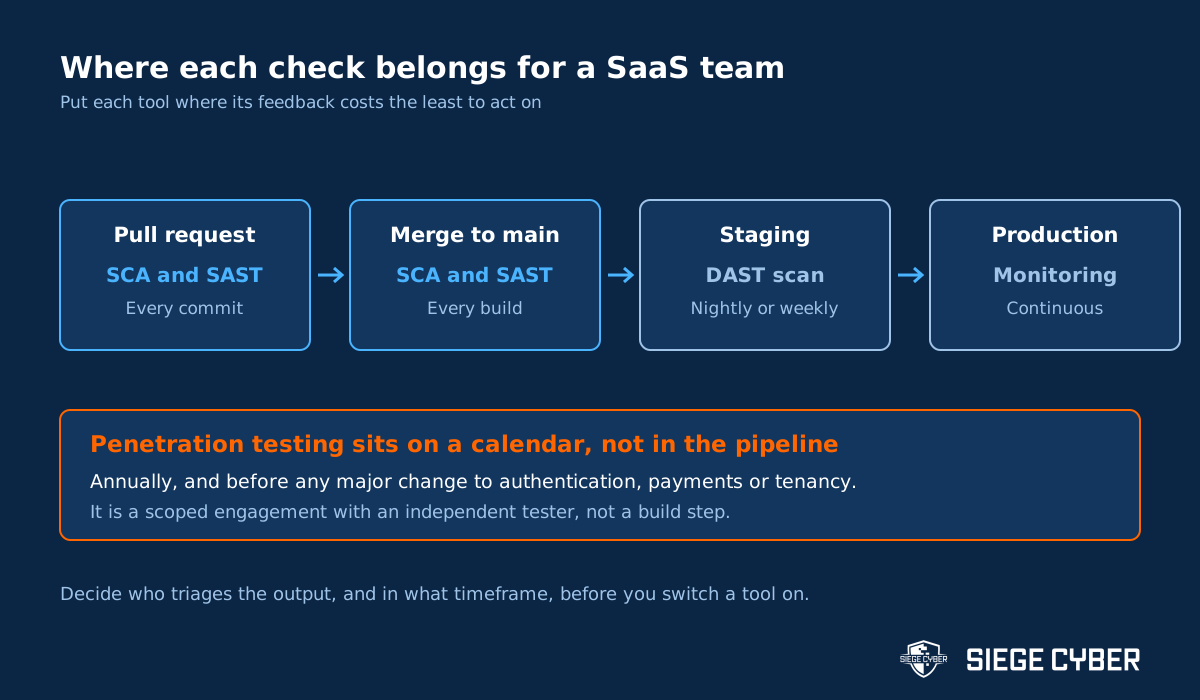
One rule prevents most of the pain: decide the triage owner and the response time before you switch a tool on. A scanner with no owner generates a growing queue of unreviewed findings, and that queue is worse than having no scanner, because an auditor will ask why 400 findings have sat open for eight months. Agree who looks at the output each week and what severity gets fixed in what timeframe, then turn it on.
Common questions
Is DAST a pen test?
No. DAST is an automated scanner that runs against a deployed application and reports matches against known vulnerability patterns. A penetration test is a scoped engagement performed by a tester who reasons about your application and chains findings together. Some penetration testers use DAST tools during an engagement, which is where the confusion starts, but the tool is one input to the test rather than the test itself.
How does SAST differ from DAST?
SAST reads source code without executing it and can point at the exact line that introduces a risk, but it has no view of how the application behaves once deployed and tends to produce false positives. DAST attacks the running application with no view of the source, so its findings are usually real but it cannot tell you where in the code the problem lives. Teams run both because each covers the other’s blind spot.
Which is better, SAST or DAST?
Neither is better in general, because they answer different questions. For a small SaaS team deciding where to start, static analysis usually delivers value sooner, since it is often included in your code hosting platform and runs on every pull request without needing a deployed environment to point at. Dynamic scanning becomes worthwhile once you have a stable staging environment and someone whose job includes triaging what it reports.
What are SAST and DAST tools primarily used for?
SAST and DAST tools are primarily used to catch common, well understood vulnerability classes early and repeatedly, so that human effort can be spent on the problems tools cannot find. They are volume instruments: cheap per run, consistent, and suited to the long tail of coding mistakes. They are not assurance instruments, which is why a customer asking for evidence of security testing wants a penetration test report rather than a scanner export.
Getting the balance right
For most Australian SaaS teams the right answer is automated tooling running continuously on findings someone owns, plus an independent penetration test once a year and before any major change to authentication, payments or tenancy. That combination covers both the volume problem and the logic problem, and it produces the evidence your customers and auditors ask for.
Siege Cyber is a CREST accredited Australian provider, and we test multi tenant SaaS applications with credentials for multiple roles so access control between accounts is actually examined. Our penetration testing services are fixed price with retesting included, and if you need the continuous side as well, our vulnerability assessment services cover the scanning programme. Get in touch and tell us what your customers are asking for.