SOC 2 Policies: Which Ones Do You Actually Need?
SOC 2 does not prescribe a list of named policies. The Trust Services Criteria require you to deploy control activities through policies and procedures, but they do not name a single document you must produce. Every numbered policy list you have seen is a vendor’s or an auditor’s interpretation of that requirement, which is why published lists range from nine policies to twenty four. For most small Australian companies, eight policy areas cover the Security criteria, and several of them can live in one document.
That is a more useful starting point than a download of twenty four templates, because an auditor does not test whether you own a document called a Workstation Security Policy. They test whether the control it describes was operating, and whether you can prove it.
Which policies does SOC 2 actually require?
The requirement for SOC 2 policies comes from criterion CC5.3, which adopts COSO Principle 12: the entity deploys control activities through policies that establish what is expected, and through procedures that put those policies into action. The points of focus under that criterion cover establishing policies and procedures, assigning responsibility and accountability for executing them, performing them in a timely manner, taking corrective action, using competent personnel, and reassessing the policies periodically.
Read that list again and notice what is absent. There is no document name anywhere in it. The criteria describe a process, not a filing cabinet. You can confirm this for yourself in the AICPA Trust Services Criteria, where the word policy appears only in generic terms.
What your policy set must do is cover the criteria you have included in scope. If you are doing a Security only examination, which is what most Australian companies start with, your policies need to address the common criteria. If you have added Availability, Confidentiality or Privacy, the set grows accordingly. Our guide to which Trust Services Criteria apply explains how that choice is made.
Why do published SOC 2 policy lists range from nine to twenty four?
Published SOC 2 policy lists differ because splitting documents is an editorial choice, not a requirement. One publisher treats business continuity and disaster recovery as a single policy. Another splits them. One folds password rules into access control. Another gives passwords their own document. Neither is wrong, and an auditor will accept either, provided the content is there and someone owns it.
The lists also differ because many are produced by companies selling policy template libraries, where a longer list is a longer product. That is not dishonest, but it does mean the number should not be read as a requirement. Treat any list you find, including this one, as a coverage check rather than a shopping list.
| Common claim | What is actually true |
|---|---|
| SOC 2 requires 21 policies | No number is specified anywhere in the criteria |
| These templates are mandatory | Templates are one way to meet CC5.3, not a requirement |
| Every policy needs its own document | Document structure is your choice if coverage is complete |
| Policies must be reviewed annually | Periodic reassessment is required, annual is a sensible norm |
| A signed policy proves the control works | Acknowledgement proves receipt, not operation |
Which SOC 2 policies can a small team combine?
A team under about twenty people can cover the Security criteria with eight policy areas, and can combine several of them into a single information security policy with clearly named sections. The test is whether a reader can find the rule, see who owns it, and tell when it was last approved. If a combined document passes that test, it is a defensible structure.
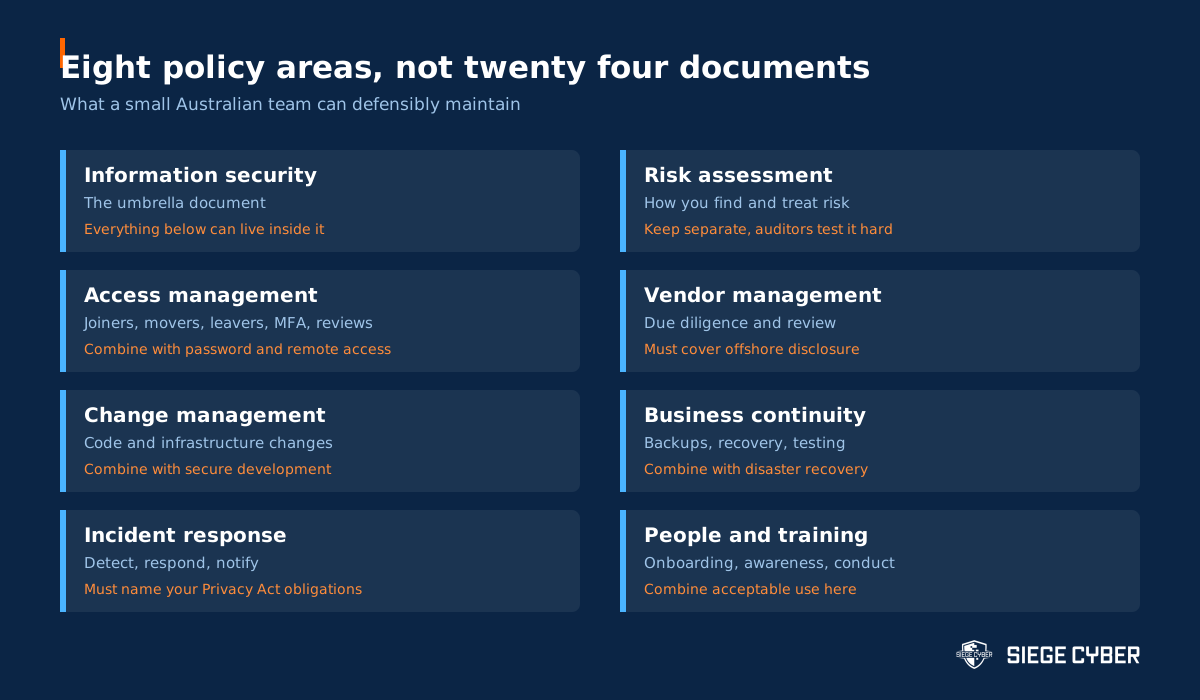
| Policy area | What it must cover | Can it be combined |
|---|---|---|
| Information security | Scope, roles, the umbrella rules | This is the parent document |
| Access management | Joiners, movers, leavers, MFA, access reviews | Yes, absorb password and remote access |
| Change management | How code and infrastructure changes are approved | Yes, absorb secure development |
| Incident response | Detection, response, escalation, notification | Keep separate, it is used under pressure |
| Risk assessment | How risks are identified, rated and treated | Keep separate, auditors test it closely |
| Vendor management | Due diligence, review, offshore disclosure | Yes, can sit inside the parent document |
| Business continuity | Backups, recovery objectives, testing | Yes, absorb disaster recovery |
| People and training | Onboarding, awareness, acceptable use, conduct | Yes, absorb acceptable use |
Two of the eight are worth keeping as standalone documents. Incident response, because it gets used at two in the morning by someone who needs to find it fast. And risk assessment, because it is the process auditors examine most closely and it benefits from being readable on its own.
What must an Australian SOC 2 incident response policy say?
An Australian company’s incident response policy needs to address the Notifiable Data Breaches scheme as well as the SOC 2 criteria, and most imported templates do not. Under the Privacy Act, an entity that suspects an eligible data breach must carry out a reasonable and expeditious assessment, and the Office of the Australian Information Commissioner expects that assessment to be completed within thirty days. If the breach is eligible, the entity must notify the Commissioner and affected individuals as soon as practicable.
A policy written for a United States audience will reference state notification laws and will be silent on all of that. Your auditor may not catch it, because they are testing against the SOC 2 criteria rather than Australian privacy law. Your customers and your regulator will. The OAIC guidance on notifiable data breaches sets out the obligation, and our guide to the Australian Privacy Principles covers the wider duties.
The same localisation issue affects vendor management. Australian Privacy Principle 8 governs disclosure of personal information to overseas recipients. If your SOC 2 vendor management policy was drafted for a United States company, it will not mention it, and almost every Australian SaaS business discloses to overseas recipients the moment it uses a United States cloud provider.
Who approves a SOC 2 policy and how often is it reviewed?
A SOC 2 policy must be approved by someone with the authority to enforce it, and the approval must be recorded with a date. In a large organisation that is usually an executive or a board. In a twelve person Australian company it is commonly the founder or the CTO, and that is acceptable. What is not acceptable is an unapproved document, or an owner field that says to be confirmed.
Review frequency is a judgement rather than a rule. The criteria require periodic reassessment, and annual review is the norm that auditors expect and that most organisations can sustain. Review earlier when something changes materially: a new product, a significant new vendor, an incident, or a change to the obligations the policy references.
Record three things on every policy: the owner, the approver and the approval date, and the date of the next review. Those three fields answer most of the questions an auditor will ask about the document itself, and they take a minute to maintain.
What evidence proves a SOC 2 policy is being followed?
A policy document proves that a rule exists. It does not prove the rule was followed, and in a SOC 2 Type 2 examination the second question is the one that matters. For each policy, an auditor will ask what record is produced when the process runs, and then test a sample of those records across the observation period.
| Policy area | Evidence that the control operated |
|---|---|
| Access management | Completed quarterly access reviews, provisioning approvals, MFA configuration |
| Change management | Change tickets showing request, review, approval and deployment |
| Incident response | Incident records, timelines, post incident reviews, a tabletop exercise |
| Risk assessment | A dated risk register with treatment decisions and owners |
| Vendor management | Due diligence records and reviews of key suppliers |
| Business continuity | Backup success records and a documented restore test |
| People and training | Training completion records and signed acknowledgements |
Work backwards from this table when you write the policy. If a policy commits you to quarterly access reviews and you can only show two across a twelve month period, the policy has created the exception. Commit to what you will actually do. Our guide to the SOC 2 readiness assessment covers how to find those gaps before the auditor does.
Common questions
What are SOC 2 policy requirements?
SOC 2 policy requirements come from criterion CC5.3, which requires control activities to be deployed through policies and procedures, with responsibility assigned, timely performance, corrective action and periodic reassessment. The criteria do not name individual policies. Your policy set must cover the criteria you have put in scope, and you choose how to structure the documents.
Can I use free SOC 2 policy templates?
Yes, as a starting structure. Two cautions apply. A template describes a company that is not yours, so every commitment in it becomes a control you will be tested against, including ones you do not perform. And templates written for a United States audience will not reference the Privacy Act, the Notifiable Data Breaches scheme or Australian Privacy Principle 8, which Australian companies need in their incident response and vendor policies.
What does SOC 2 cover?
A SOC 2 examination covers the Trust Services Criteria you select. Security, the common criteria, is always included. Availability, Processing Integrity, Confidentiality and Privacy are optional and are added where customer commitments require them. Most Australian companies begin with Security only, then add criteria as customer contracts demand. The criteria in scope determine which policies you need.
Do SOC 2 and ISO 27001 need different policies?
The content overlaps heavily, but the structures differ. ISO 27001 names specific mandatory documents, including a Statement of Applicability and a documented risk assessment method, while SOC 2 names none. A company pursuing both usually maintains one policy set and maps it to each framework. Our guide to ISO 27001 mandatory documentation lists what the standard genuinely requires.
Need a policy set your auditor will accept?
Siege Cyber helps Australian companies build a SOC 2 policy set that is proportionate to the business, localised for Australian privacy obligations, and backed by evidence you can actually produce. See our SOC 2 services, work through our SOC 2 compliance checklist, read our guide to setting your SOC 2 scope, or get in touch.