Red Team Testing vs Penetration Testing in Australia
Red team testing is a goal-driven simulation of a real attacker, run against your live environment without telling your defenders, to find out whether anyone notices and responds. A penetration test is a scoped, time-boxed hunt for vulnerabilities in a defined set of systems, run with your team’s full knowledge. Most Australian businesses under 100 staff need the penetration test, not the red team. Red teaming only pays for itself once you already have someone watching your alerts, because what it tests is the watching.
That distinction matters because red team engagements typically cost several times a penetration test and take weeks rather than days. Buying one before you have detection in place produces an expensive report confirming what you could have predicted for free: nobody saw it.
What is red team testing?
Red team testing is an adversary simulation. A team of testers is given an objective, such as reaching a specific database, obtaining domain administrator rights, or exfiltrating a sample of customer records, and then works toward that objective using whatever realistic techniques are within the agreed rules of engagement.
The defining features of red team testing are the objective and the secrecy. Only a small group, usually the executive sponsor and one or two others, knows the exercise is happening. Everyone else, including the IT team and any managed security provider, is expected to react as though the activity is real.
A red team engagement combines techniques a standard penetration test treats separately: external network and web attacks, phishing and other social engineering, physical entry where it is in scope, lateral movement once a foothold exists, and simulated exfiltration to prove the objective was reached. Techniques are usually mapped to MITRE ATT&CK, a catalogue of real-world adversary tactics that most Australian testing firms reference in their reporting, so results can be compared over time.
What is the difference between red teaming and penetration testing?
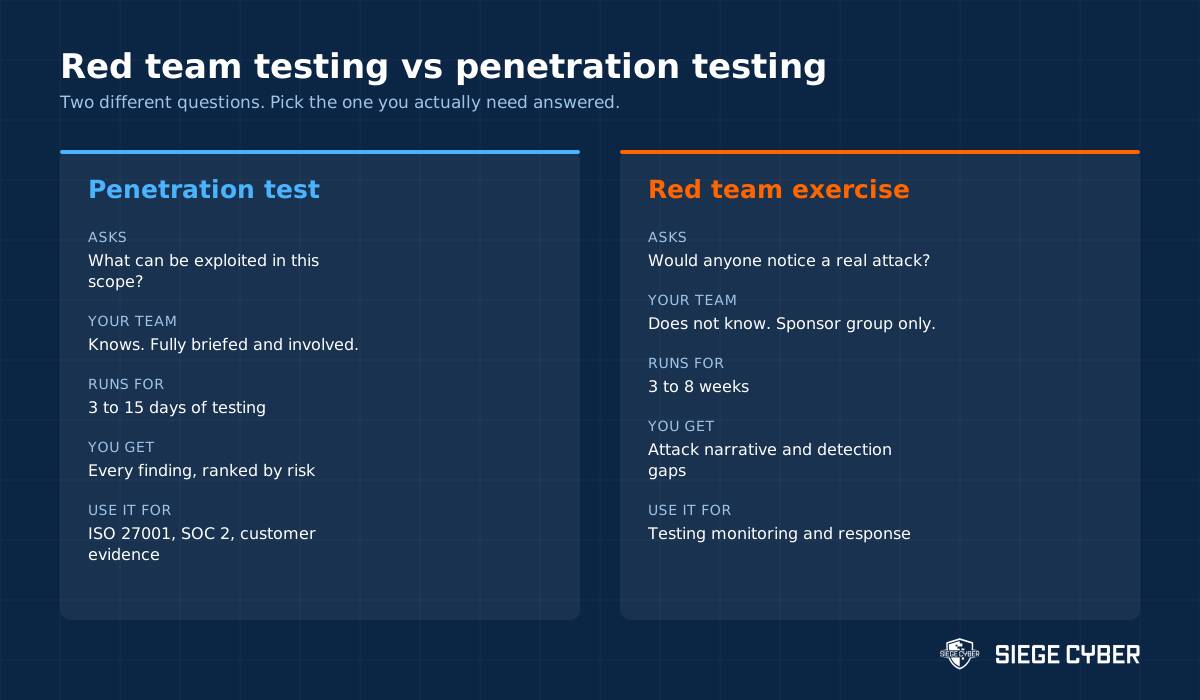
The difference between red teaming and penetration testing is coverage versus realism. A penetration test aims to find as many exploitable weaknesses as possible inside an agreed scope, and tells you about all of them. A red team exercise aims to reach one objective the way a real attacker would, and tells you about the path it took and whether you detected it.
Neither is better. They answer different questions, and the question you need answered depends on what you already know about your environment.
| Penetration test | Red team exercise | |
|---|---|---|
| Question it answers | What can be exploited here? | Would we notice a real attack? |
| Scope | Defined list of systems or applications | Broad, often the whole organisation |
| Your team knows | Yes, fully briefed | No, only a small sponsor group |
| Typical duration | 3 to 15 days of testing | 3 to 8 weeks |
| Output | Full list of findings, ranked by risk | Attack narrative plus detection gaps |
| Coverage | High within scope | Only the path taken to the objective |
| Relative cost | Baseline | Several times a penetration test |
| Needed for compliance | Commonly, including ISO 27001 and SOC 2 | Rarely required by any framework |
One practical consequence: a red team exercise is a poor way to satisfy an auditor. An ISO 27001 or SOC 2 assessor asking for evidence of technical testing wants the systematic coverage a penetration test provides. A red team report documenting one successful path says nothing about the ninety systems the team walked past. If compliance is the driver, start with what a penetration test actually is.
Does your Australian business actually need a red team test?
Most Australian businesses with fewer than 100 staff do not need a red team test yet, and should spend the same money on penetration testing, detection and remediation instead. The honest test is simple: if you cannot name the person or service that would see the alert at 2am on a Sunday, a red team exercise has nothing to measure.
Red team testing is worth the money when all of the following are true:
- You have a security operations capability, either in house or through a managed provider, that monitors alerts outside business hours.
- You have an incident response plan that people have actually rehearsed, not just a document.
- You have had recent penetration tests and have fixed the high and critical findings from them.
- You have logging across endpoints, identity and cloud, retained long enough to investigate with.
- Someone senior genuinely wants to know the answer, including if the answer is embarrassing.
If any of those five are missing, the exercise will find the gap you already suspected. Buy the missing capability first, then test it.
There are exceptions. Australian organisations holding large volumes of personal information, operating critical infrastructure under the SOCI Act, or supplying Defence under DISP sometimes face contractual expectations for adversary simulation regardless of size. If a customer contract names red teaming, that settles it.
What do red team, blue team and purple team mean?
Red team, blue team and purple team describe three roles in a security exercise, not three products. The red team attacks, the blue team defends, and a purple team exercise runs both together in the open so each learns from the other in real time.
- Red team. The offensive side. External testers, or an internal offensive team at larger organisations, who simulate an adversary against an objective.
- Blue team. The defensive side. Your IT staff, security analysts or managed security provider, who monitor, detect, investigate and contain.
- Purple team. A collaborative exercise rather than a secret one. Attackers run specific techniques while defenders watch, so you can tune detection rules technique by technique.
For most Australian small and medium businesses, a purple team exercise delivers more value per dollar than a true red team engagement. It removes the secrecy that makes red teaming expensive, produces a concrete list of detection improvements rather than a single narrative, and is far less disruptive, because nobody spends a weekend investigating what turns out to be a test.
How long does a red team engagement take and what does it involve?
A red team engagement typically runs three to eight weeks from kick off to report, with the majority of that time spent on reconnaissance and patient, quiet movement rather than noisy exploitation. Compressing the timeline defeats the purpose, because a real attacker is not in a hurry.
A typical engagement moves through five phases:
- Objectives and rules of engagement. You agree the goal, the systems and techniques that are off limits, the emergency contact who can stop the exercise, and how the testers will prove they are legitimate if challenged.
- Reconnaissance. The team maps your external footprint, staff, suppliers and technology from public sources, exactly as an attacker would.
- Initial access. Phishing, an exposed service, a weak credential or physical entry, whichever route the reconnaissance suggests is most likely to work.
- Objective pursuit. Lateral movement, privilege escalation and persistence, aiming at the agreed goal while avoiding detection.
- Debrief and replay. The valuable part. The team walks your defenders through the full timeline so you can check which steps generated a log, which generated an alert, and which alert nobody acted on.
Insist the debrief and replay is written into the statement of work. An engagement that ends with a report and no joint walkthrough wastes most of what you paid for.
What should you have in place before you buy a red team test?
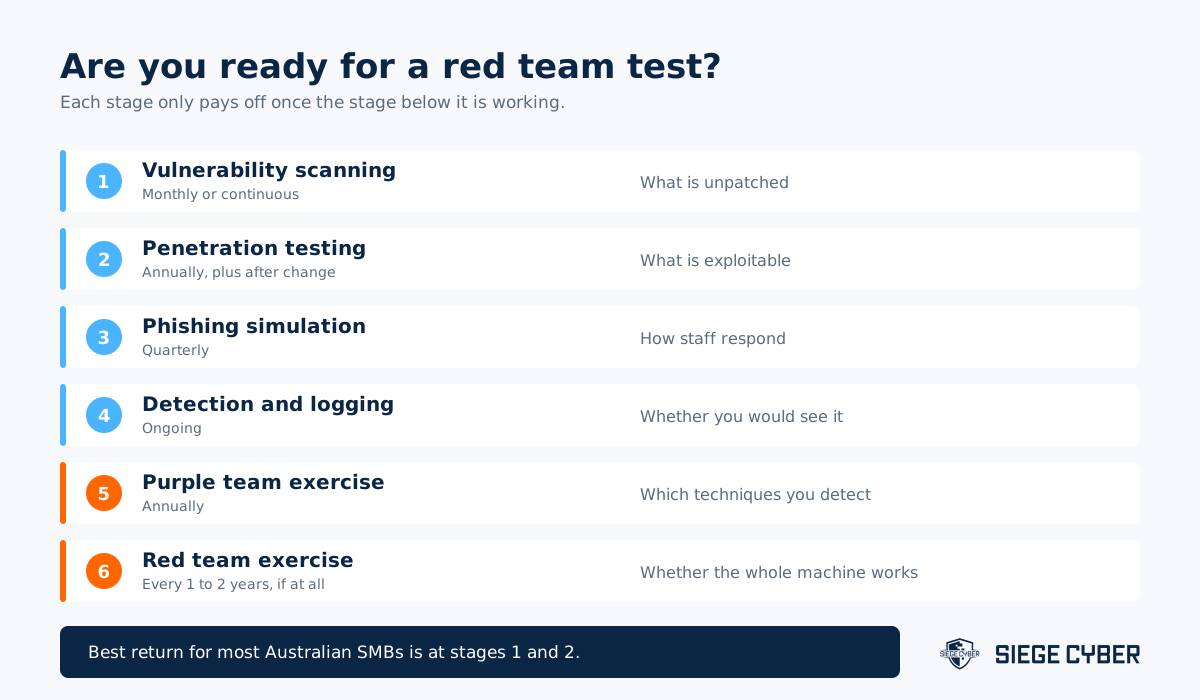
Before buying a red team test, you should have current penetration testing, remediated critical findings, centralised logging, monitored alerts and a rehearsed incident response plan. The sequence below is the order most Australian businesses get the best return from, working upward.
| Stage | What you do | Typical cadence | What it tells you |
|---|---|---|---|
| 1. Vulnerability scanning | Automated scanning of external and internal assets | Monthly or continuous | What is unpatched or misconfigured |
| 2. Penetration testing | Manual testing of external perimeter and key applications | Annually, plus after major change | What an attacker could actually exploit |
| 3. Phishing simulation | Controlled phishing against staff with follow-up training | Quarterly | How your people respond to a lure |
| 4. Detection and logging | Centralised logs, alerting, someone watching them | Ongoing | Whether you would see anything at all |
| 5. Purple team exercise | Techniques run openly against your detection | Annually | Which specific techniques you detect |
| 6. Red team exercise | Objective-driven covert simulation | Every 1 to 2 years, if at all | Whether the whole machine works under pressure |
Stages one and two are where almost every Australian SMB gets the best return, and they are what auditors and insurers ask about. See our guides to penetration testing frequency, internal versus external testing and how to scope a penetration test.
One prerequisite that is easy to overlook: your obligations if the exercise touches real personal information. Under the Notifiable Data Breaches scheme, an entity that suspects an eligible data breach has a maximum of 30 days to assess it. Your rules of engagement should state clearly that simulated exfiltration uses synthetic or minimised data, so a test never starts a real notification clock.
Common questions about red team testing
What is red team testing in cyber security?
Red team testing in cyber security is a covert, objective-driven simulation of a real attacker against a live environment. A team of testers is given a goal, such as reaching a particular system or dataset, and pursues it using realistic techniques while the organisation’s defenders are not told the exercise is happening. The purpose is to measure detection and response, not to produce a complete list of vulnerabilities.
Is red teaming the same as penetration testing?
No. Penetration testing is an announced, scoped search for exploitable weaknesses that aims for broad coverage and reports every finding. Red teaming is an unannounced pursuit of a single objective that reports the path taken and the detection gaps along it. A penetration test answers what can be exploited; a red team exercise answers whether anyone would notice.
What is red team penetration testing?
Red team penetration testing is a loose term providers use two ways, so ask which is meant. Sometimes it means a genuine covert red team engagement. More often it means a penetration test that borrows red team techniques such as phishing or physical entry, while staying announced and scoped. The second is usually what an Australian SMB wants, and costs considerably less.
What is a red team review?
A red team review is an adversarial review of a plan, design or decision rather than a technical attack. A separate group argues the opposite case and finds the flaws before implementation. In security it is often applied to architecture designs or incident response plans. It involves no live testing and needs no special tooling, only people willing to disagree.
How much does red team testing cost in Australia?
Red team engagements cost substantially more than penetration tests because they run for weeks rather than days and involve multiple specialists. Pricing varies with the objective, the environment and whether physical entry and social engineering are included. Ask providers to quote consultant days and confirm the debrief session is included, because that is where quotes stop being comparable.
Start with the test that matches your maturity
If you have monitoring, rehearsed response and clean penetration test results behind you, a red team exercise will tell you something you cannot learn any other way. If you do not, a scoped penetration test will tell you more, cost less, and give you something you can act on next week.
Siege Cyber is a CREST accredited Australian penetration testing firm, and we will say plainly if adversary simulation is not the right spend for where you are. Read about our penetration testing services or get in touch and we will talk through what your environment needs.