Incident Response Retainer: Do You Need One in Australia
An incident response retainer is a pre-signed agreement with a forensic and response firm that guarantees you a defined response time when you are attacked, so you are not negotiating a contract at 11pm on a Friday. Before you buy one, check your cyber insurance policy. Most Australian cyber policies require you to use the insurer’s panel responder, and engaging your own firm first can reduce or void the claim. For many Australian SMBs with cyber cover, the right answer is a rehearsed plan and the insurer’s hotline number, not a second retainer.
That is not the answer most retainer pages give, because most of them are selling the retainer. It is still the answer that saves the most Australian businesses the most money, and the one worth checking before anything else.
What is an incident response retainer?
An incident response retainer is a contract agreed in advance with a specialist firm, covering the commercial terms, scope and response times for handling a cyber incident. The point is that the paperwork, the rates and the authority to act are already settled before the day you need them.
A retainer typically includes:
- A guaranteed response time. Commonly 1 to 4 hours to first contact, 24 hours a day. This is the part you are actually paying for.
- Pre-agreed rates. Hourly or daily rates fixed in advance, instead of emergency pricing negotiated while your systems are encrypted.
- Pre-cleared legal terms. Liability, confidentiality and data handling agreed when your lawyers have time to read them.
- Prepaid hours. A block of hours paid up front, often usable for proactive work such as tabletop exercises if no incident occurs.
- A named contact and escalation path. A number that reaches a human who already knows your environment.
Retainers are sold in a few shapes. A zero-fee or standby retainer costs nothing up front and only reserves your place in the queue. A prepaid retainer buys hours in advance, usually with unused hours convertible to proactive work. A subscription retainer bundles response with ongoing monitoring. The second type is the most common for Australian mid-sized businesses.
Why should you check your cyber insurance before buying a retainer?
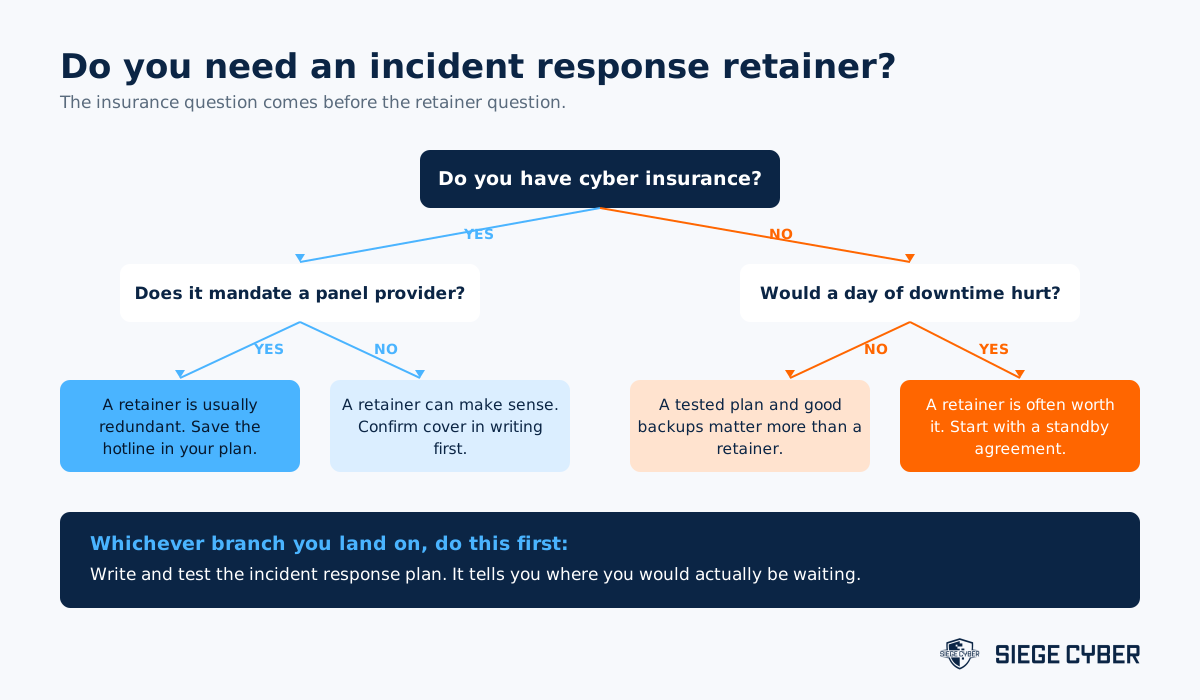
You should check your cyber insurance before buying an incident response retainer because most Australian cyber policies name an approved panel of incident response providers, and using a firm outside that panel without the insurer’s consent can reduce or decline your claim. Paying for a retainer you are contractually discouraged from using is a straightforward waste.
Open your policy and find the answers to these four questions before you talk to any provider:
- Does the policy require you to use a panel provider, or merely recommend it?
- Who is on the panel, and is there a 24 hour notification hotline you are required to call first?
- What is the notification deadline, and does cover for response costs begin only after the insurer has been notified?
- Can you nominate your own provider to be added to the panel, and what does that approval take?
That last question is the useful one. Many Australian insurers will approve a preferred provider if you ask during policy negotiation or renewal, which lets you keep a firm who knows your environment while staying inside the policy. Asking after an incident has started almost never works. Our guide to cyber insurance requirements in Australia covers what else insurers now expect before they will quote.
If you have no cyber insurance at all, the calculation changes completely. Without cover, nobody else is appointing a responder or paying for one, and a retainer becomes considerably more attractive.
Does your Australian business need an incident response retainer?
Your Australian business probably needs an incident response retainer if you have no cyber insurance panel to fall back on, you hold data where a breach would trigger notification obligations, and downtime costs you real money per hour. If your insurer already appoints a responder and your business can tolerate a day of disruption, your money is better spent on prevention and rehearsal.
| Your situation | Retainer worth it? | What to do instead or as well |
|---|---|---|
| Cyber policy with a mandatory panel | Usually not | Save the insurer hotline in your plan. Ask to add a preferred provider at renewal. |
| No cyber insurance | Often yes | A standby or prepaid retainer, or get cover first and reassess. |
| Regulated or holding sensitive personal data | Often yes | Pair it with legal counsel engaged in advance for privilege. |
| Managed service provider runs your IT | Check first | Ask what their contract actually covers. Many MSP agreements exclude forensic response. |
| Under 20 staff, low data sensitivity | Rarely | A written plan, tested backups and multi-factor authentication buy far more safety. |
| Contractual obligation to a customer | Yes if named | Match the retainer’s response time to the contract’s requirement, not the sales brochure. |
The managed service provider row is the one that catches people out. Many Australian businesses assume their MSP will handle a ransomware incident. Most MSP agreements cover restoring service, not forensic investigation, legal reporting or negotiating with an attacker. Read the contract before you rely on it.
What are your legal obligations during an Australian cyber incident?
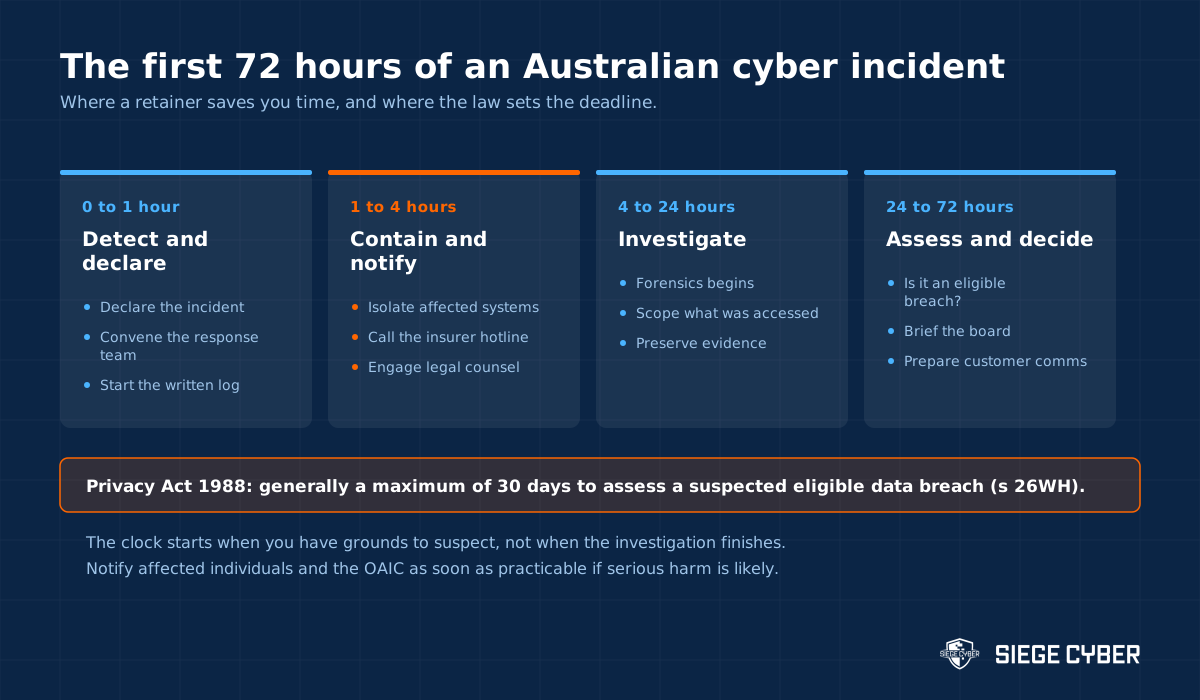
If you are covered by the Privacy Act 1988 and you suspect an eligible data breach, you must assess it and, generally, you have a maximum of 30 days to complete that assessment. If the breach is likely to result in serious harm, you must notify affected individuals and the Office of the Australian Information Commissioner as soon as practicable.
The important detail is that the 30 day clock starts when you become aware of grounds to suspect an eligible breach, not when your investigation finishes. A forensic engagement that takes six weeks to start does not pause it. That timing pressure is the strongest practical argument for having a responder arranged in advance, whether through your insurer or a retainer.
The Notifiable Data Breaches scheme guidance from the OAIC sets out the assessment and notification requirements in full. Build the deadlines into your incident response plan rather than looking them up during the incident. Our guide to building an incident response plan covers the structure, and incident response communications covers who you tell and when.
Separate obligations may apply on top of the Privacy Act. Critical infrastructure assets have reporting duties under the SOCI Act, APRA regulated entities have notification requirements under CPS 234, and your customer contracts may impose shorter deadlines than any of them. Know which apply to you before an incident, because you will not have time to work it out during one.
What should you check before signing an incident response retainer?
Before signing an incident response retainer, confirm the response time is contractual rather than aspirational, check which hours are included, confirm the responders are based where you need them, and establish whether unused hours can be spent on proactive work. Ask these in writing and compare the answers, not the brochures.
- Is the response time a service level or a target? Ask what happens if they miss it. If the answer is nothing, it is marketing.
- Response to what, exactly? First phone contact, a triage call, or someone actually working your incident. These are very different commitments.
- Where are the responders? An overnight Australian incident handled from another time zone is a real constraint. Ask where the on-call roster physically sits.
- What does the retainer not cover? Legal advice, public relations, ransom negotiation, data recovery and rebuilding are often excluded or billed separately.
- Can unused hours be used proactively? Tabletop exercises and plan reviews are the best possible use of hours you have already paid for.
- Does the retainer include an onboarding session? A responder who has never seen your environment spends the first hours of your incident learning it.
- How does it interact with your insurer? Get this in writing from both sides.
The onboarding point deserves emphasis. The single biggest difference between a retainer that helps and one that does not is whether the provider has already documented your environment, your key contacts and your escalation path. Insist that onboarding happens within weeks of signing, not when the incident starts.
Common questions about incident response retainers
What is an incident response retainer service?
An incident response retainer service is a pre-arranged agreement with a forensic and response firm covering guaranteed response times, agreed rates and pre-cleared legal terms for handling a cyber incident. Some retainers charge an annual fee for prepaid hours, others cost nothing up front and simply reserve priority access. The value is removing the procurement delay at the worst possible moment.
How much does an incident response retainer cost in Australia?
Costs vary widely with the response time guaranteed, the hours included and whether the retainer is standby or prepaid. Zero-fee standby retainers cost nothing up front but charge full rates when used. Prepaid retainers bill an annual fee covering a block of hours. When comparing quotes, normalise them to cost per guaranteed response hour, and confirm whether unused hours expire.
Is an incident response retainer the same as cyber insurance?
No. Cyber insurance is a financial product that reimburses costs and losses after an incident, often including response costs. A retainer is a service contract that guarantees a team will answer the phone. They are complementary, but most Australian cyber policies direct you to a panel provider, so check whether your policy makes a separate retainer redundant.
What is the difference between an incident response plan and a retainer?
An incident response plan is your internal document setting out roles, decision authority, communications and legal obligations. A retainer is an external contract for specialist help. The plan is mandatory in practice and costs nothing but effort. The retainer is optional and costs money. Writing the plan first is the right order, because the plan tells you whether you need the retainer.
How often should you test your incident response arrangements?
Test at least annually with a tabletop exercise, and again whenever your environment, key staff or providers change materially. The test that matters most is the simplest: can the people on call find the plan, reach the responder and reach your insurer outside business hours? Most arrangements fail on that, not on technical detail. See our guide to incident management training and testing.
Write the plan, then decide on the retainer
The order matters. A tested incident response plan, a current contact list and a clear understanding of what your insurer requires will serve most Australian businesses better than a retainer bought without any of those. Once the plan exists, the question of whether you need a retainer usually answers itself, because you can see exactly where you would be waiting.
Siege Cyber helps Australian businesses build and rehearse incident response plans, and will tell you honestly when a retainer is not the right spend. Have a look at our virtual CISO services and cyber security advisory, or get in touch for a conversation about what your business actually needs in place.