CIRMP in 2026: What Changed and Who It Applies To
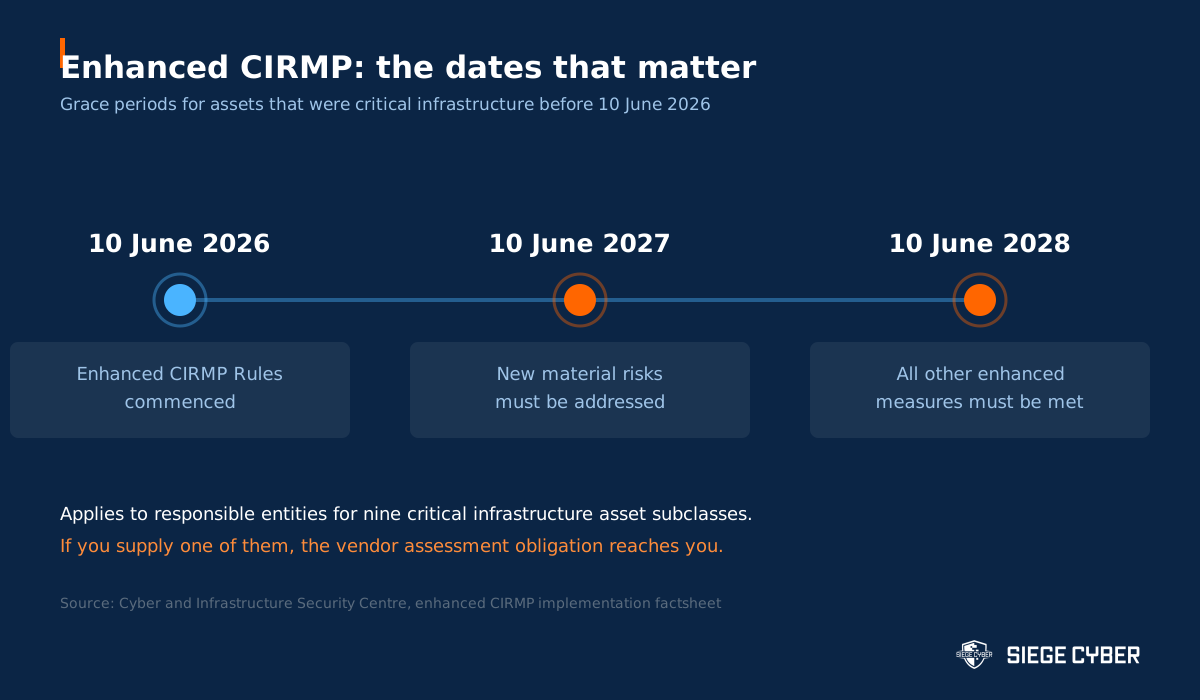
A CIRMP is a critical infrastructure risk management program, required under Part 2A of the Security of Critical Infrastructure Act 2018 for responsible entities of certain critical infrastructure assets. On 10 June 2026, the enhanced CIRMP Rules commenced, adding a more prescriptive layer of requirements for nine asset subclasses. Existing entities have until 10 June 2027 to address the new material risks and until 10 June 2028 for the remaining measures.
If your business is not a responsible entity, which covers almost every Australian small and medium business, this still reaches you through one clause. The enhanced rules require those entities to carry out vendor assessments of their major suppliers. If you supply one of them, their questions about your security are about to get considerably sharper.
What is a CIRMP and what changed in 2026?
A critical infrastructure risk management program is a documented program that identifies the material risks to a critical infrastructure asset and sets out the processes and systems used to minimise or eliminate them. Part 2A of the Security of Critical Infrastructure Act 2018 requires certain responsible entities to adopt, maintain and comply with one, and the CIRMP Rules specify what it must contain. The original rules addressed four hazard categories: cyber and information security, personnel, supply chain, and physical security and natural hazards.
The Security of Critical Infrastructure Legislation Amendment (Enhanced Critical Infrastructure Risk Management Program) Rules 2026 commenced on 10 June 2026. They amend the CIRMP Rules to add a more prescriptive tier of requirements for a defined set of asset subclasses. The shift is meaningful: the original framework was principles based, and the enhanced requirements name specific risks and specific measures.
The current consolidated requirements sit in the CIRMP Rules on the Federal Register of Legislation as amended, and the Cyber and Infrastructure Security Centre has published an enhanced CIRMP implementation factsheet summarising them.
Which businesses must have a critical infrastructure risk management program?
The enhanced CIRMP Rules apply to responsible entities that own or operate nine critical infrastructure asset subclasses. These are large operators of national infrastructure, not small businesses. If your company is not on the list below, you are not a responsible entity under the enhanced rules and you do not need a CIRMP of your own.
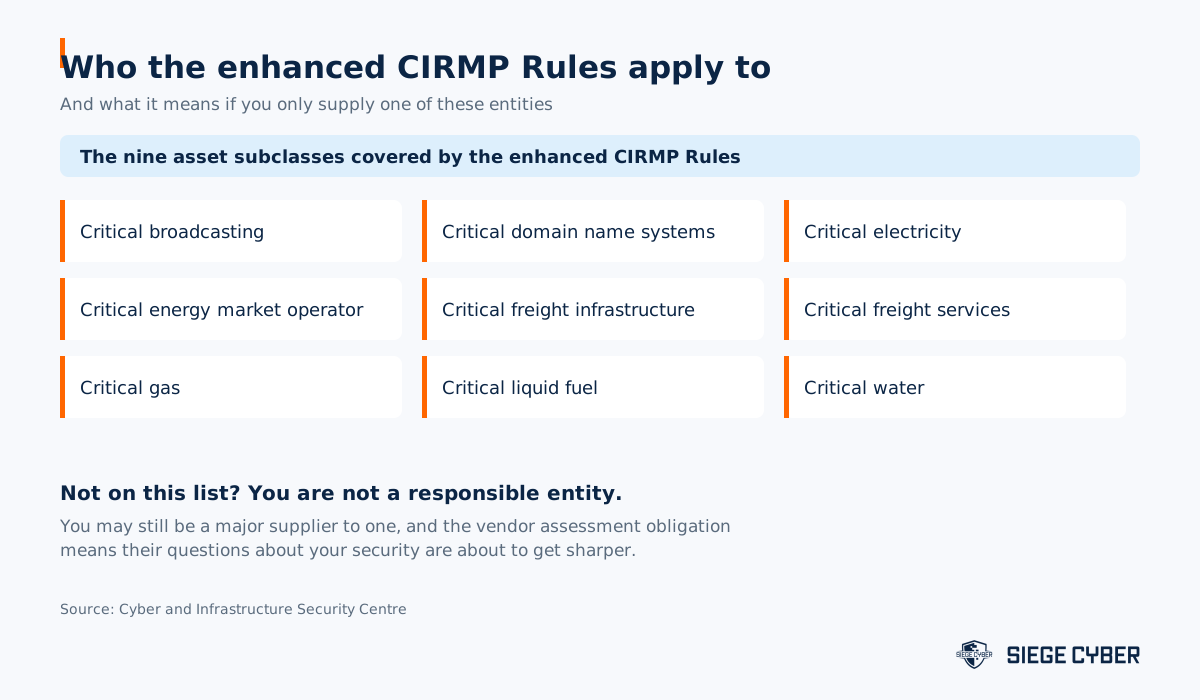
- Critical broadcasting assets
- Critical domain name systems
- Critical electricity assets
- Critical energy market operator assets
- Critical freight infrastructure assets
- Critical freight services assets
- Critical gas assets
- Critical liquid fuel assets
- Critical water assets
Other classes of critical infrastructure asset remain subject to the baseline CIRMP Rules without the enhanced layer. The broader obligations under the Security of Critical Infrastructure Act, including asset registration and incident reporting, apply more widely again. Our guide to the SOCI Act covers which obligations attach to which assets.
What do the enhanced CIRMP Rules add?
The enhanced CIRMP Rules add new categories of material risk and more specific measures within the existing hazard categories. At the overarching level, a covered entity’s program must now address risks of impairment that would prejudice Australia’s social or economic stability, national security or defence, risks arising from foreign ownership, control and influence, and offshore or remote access to operational technology control systems and to business critical data.
| Hazard category | What the enhanced rules add |
|---|---|
| All hazard material risks | Prejudice to national security or social and economic stability, foreign ownership control and influence, offshore remote access to control systems and business critical data |
| Cyber and information security | Unpatched systems and legacy technology, unsupported critical components, deployment and hostile use of advanced and emerging technology including AI, and alignment with a higher maturity level of a prescribed cyber framework |
| Credential compromise | Phishing resistant multi factor authentication |
| Lateral movement | Segregation of critical systems |
| Personnel security | Unauthorised or unsupervised access to critical systems, credential misuse, access by non critical workers, incoming and outgoing critical workers, ongoing suitability monitoring and background checking |
| Supply chain | Supply chain mapping and vendor assessment of major suppliers |
| Physical and natural hazards | A physical security and natural hazard plan, and physical consequences arising from other hazard types |
The cyber framework requirement is worth noting for the wider market. Where an entity relies on the Essential Eight to meet its cyber obligation, the enhanced rules raise the expectation to maturity level two. Our guide to the Essential Eight maturity assessment covers what each level requires in practice.
When do the enhanced CIRMP requirements take effect?
The enhanced CIRMP Rules commenced on 10 June 2026, with grace periods for assets that were already critical infrastructure assets before that date. The new material risks, covering the all hazard risks, the new cyber material risks and the new personnel material risks, must be addressed by 10 June 2027. All other enhanced measures must be met by 10 June 2028.
One practical note on reporting. Responsible entities did not need to report on the enhanced material risks or measures in the 2025 to 2026 annual reporting period. That reprieve is temporary, and the grace periods are the dates that matter for planning.
For an asset that becomes a critical infrastructure asset after 10 June 2026, the transitional arrangements differ, and entities in that position should read the rules as they apply to their circumstances rather than relying on the dates above.
What does the enhanced CIRMP mean if you are a supplier, not a responsible entity?
The supply chain provisions are where the enhanced CIRMP Rules reach beyond the nine asset classes. A covered entity must map its supply chain for major suppliers and critical components, and must carry out a vendor assessment for each major supplier. Those assessments must consider foreign ownership, control and influence, legal and sanctions exposure, and the supplier’s access to or influence over the asset.
In practical terms, if you provide software, managed services, maintenance or professional services to an electricity network, a water utility, a gas operator, a freight business or a broadcaster, expect three changes. The security questionnaire will get longer and more specific. You will be asked about ownership and control, including beneficial ownership and where your staff and data sit. And you may be asked to commit contractually to things you previously answered informally.
This is the same pattern Australian suppliers saw with APRA regulated entities, where a regulation aimed at one group reshaped procurement for everyone selling to them. Our guide to APRA CPS 234 for suppliers covers that precedent, and our guide to answering vendor security questionnaires covers the mechanics.
How should a smaller supplier prepare for a CIRMP vendor assessment?
A supplier to a covered entity should prepare the evidence a vendor assessment will ask for, before it arrives. Most of it is material a reasonably mature business already has, and the work is in finding it rather than creating it.
| What the assessment will probe | What to have ready |
|---|---|
| Ownership and control | Current ownership structure, beneficial ownership, any foreign holdings |
| Where your people and data are | Locations of staff, subcontractors, hosting and backups |
| Access to the customer environment | Who has access, how it is granted, reviewed and revoked |
| Your own cyber posture | Essential Eight maturity, certification status, recent test results |
| Your own supply chain | Your critical suppliers and what access they hold |
| Outage tolerance | Your recovery objectives and evidence they have been tested |
| Incident handling | Your incident response plan and notification commitments |
Two steps give the best return. Know your Essential Eight maturity level, because it is the most common yardstick and an honest answer beats a vague one. And have a current penetration test report for anything that touches the customer environment. Our guide to where to start with a cyber security strategy sets out a sensible order if you are beginning from scratch.
Common questions
What does CIRMP stand for?
CIRMP stands for critical infrastructure risk management program. It is the documented program required under Part 2A of the Security of Critical Infrastructure Act 2018 for responsible entities of specified critical infrastructure assets. The program must identify the material risks to the asset and describe the processes and systems used to minimise or eliminate them.
What is the SOCI CIRMP?
The SOCI CIRMP is the risk management program required by the Security of Critical Infrastructure Act 2018, commonly shortened to the SOCI Act. The detailed content requirements sit in the CIRMP Rules made under section 61 of that Act. Those rules were amended by the enhanced CIRMP Rules, which commenced on 10 June 2026 and apply an additional tier of requirements to nine asset subclasses.
Who must comply with the enhanced CIRMP Rules?
Responsible entities that own or operate critical broadcasting assets, critical domain name systems, critical electricity assets, critical energy market operator assets, critical freight infrastructure assets, critical freight services assets, critical gas assets, critical liquid fuel assets or critical water assets. Suppliers to those entities are not directly regulated, but are affected through the vendor assessment obligation.
Do the enhanced CIRMP Rules apply to small businesses?
Not directly. The enhanced CIRMP Rules apply to responsible entities for nine classes of national infrastructure, which are large operators. A small Australian business is affected indirectly, as a supplier, when a covered entity carries out the vendor assessment the rules require. The practical effect is tougher procurement questions rather than a legal obligation of your own.
What is the deadline for enhanced CIRMP compliance?
For assets that were critical infrastructure assets before 10 June 2026, the new material risks must be addressed by 10 June 2027 and all other enhanced measures by 10 June 2028. The rules themselves commenced on 10 June 2026. Entities whose assets became critical infrastructure assets after commencement should check how the transitional provisions apply to them.
Selling into regulated infrastructure?
Siege Cyber helps Australian businesses work out what a customer’s regulatory obligations actually require of them, and get the evidence in order before the questionnaire lands. See our cyber security advisory services or our Essential Eight services, read our overview of safeguarding critical infrastructure in Australia, or get in touch for a conversation about where you stand.