
DISP Membership: How Defence Suppliers Prove Cyber Security Compliance Without Drowning in Evidence
If your organisation wants to work with the Australian Department of Defence, DISP membership is now one of the clearest signals that you can be trusted with Defence information, systems and assets. For many Defence suppliers, the hardest part is proving, in a structured way, that those controls are effective and operating day to day.
This post explains how DISP cyber security expectations link to the ASD Essential Eight at Maturity Level 2, what Defence assessors are really looking for, and how you can build an evidence framework that proves compliance without drowning your team in paperwork.

Why DISP cyber compliance is changing
The Defence Industry Security Program (DISP) sets minimum security requirements for organisations that want to be part of the Defence supply chain. It covers four domains: governance, personnel security, physical security, and information/cyber security.
In recent years, Defence has steadily uplifted expectations in the cyber security domain. Australian government agencies are required to align to the ASD Essential Eight at Maturity Level 2, and DISP cyber technical standards increasingly expect industry suppliers to meet the same baseline. For Defence suppliers, this means:
-
You need the full ASD Essential Eight implemented to Maturity Level 2 for in-scope systems, not just a subset of controls.
-
You must be able to demonstrate this maturity during DISP applications, renewals, and assurance activities, not just state it in a questionnaire.
This shift from having controls in place to being able to prove they are effective is what catches many organisations off guard.
Governance and privacy obligations that sit alongside DISP
Australian Defence suppliers rarely have to think about DISP in isolation. Cyber security expectations sit alongside broader governance and regulatory requirements, including the Privacy Act 1988 and sector‑specific rules such as APRA CPS 234 for regulated financial entities.
For many organisations, this means the same controls and evidence used to demonstrate DISP cyber maturity also help show compliance with the Australian Privacy Principles (APPs), notifiable data breach obligations, and internal governance expectations around risk and accountability.
Taking a unified view of governance and privacy reduces duplication: one risk register, one set of security policies, and one evidence framework can support DISP, privacy compliance, and other regulatory audits at the same time.
What Essential Eight Maturity Level 2 means
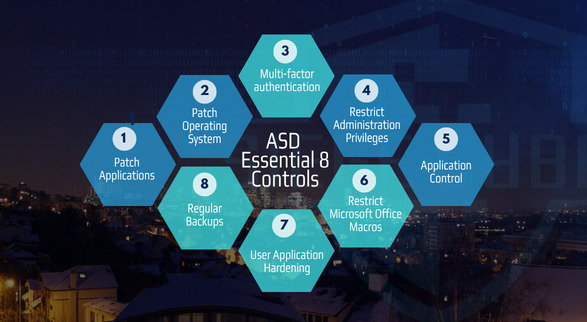
The ASD Essential Eight is a set of baseline mitigation strategies that make it significantly harder for adversaries to compromise systems. At Maturity Level 2, Defence and ASD expect controls to be implemented consistently, enforced across relevant systems and supported by governance and evidence.
In practical terms, that includes:
-
Patch applications: Security patches for software are applied within defined timeframes and tracked, not left to best efforts.
-
Patch operating systems: Operating system updates are deployed promptly, with reporting to show coverage and exceptions.
-
Multi-factor authentication: MFA is enforced wherever feasible, especially for remote access, privileged accounts and critical systems.
-
Restrict administrative privileges: Admin accounts are tightly limited, monitored, and reviewed on a regular schedule.
-
Application control: Only approved applications are allowed to run, with a documented process for approving and reviewing software.
-
Restrict Microsoft Office macros: High-risk macros are blocked or tightly controlled, particularly for files from the internet or untrusted locations.
-
User application hardening: Features commonly abused by attackers in browsers and productivity tools are disabled or restricted where possible.
-
Regular backups: Backups are performed, tested, and stored securely to support recovery from incidents such as ransomware.
At Maturity Level 2, these controls must be consistent and defensible. Partial implementation, ad‑hoc exceptions and undocumented processes will undermine your DISP position.
From controls to evidence: what Defence assessors look for
DISP assessors are not only interested in whether you say you have controls in place, but they want to see proof. For cyber security, this typically includes:
-
Documented policies and procedures that describe how Essential Eight controls are implemented and maintained.
-
Configuration and system evidence showing controls are applied (for example, screenshots, configuration exports, group policy settings).
-
Operational records such as patch reports, access reviews, incident logs, and backup test results.
-
Governance artefacts like risk registers, security incident reports, and management review minutes.
The key is that this evidence should exist as a natural output of your operations. If you have to scramble to create it just before an audit, your DISP maturity will look fragile.
Designing a DISP evidence framework that actually works
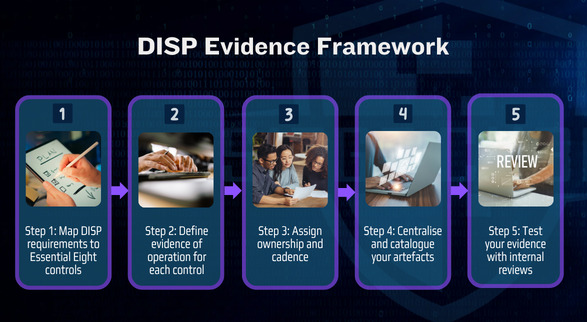
To avoid drowning in ad‑hoc documentation, it helps to treat DISP evidence as an operating model rather than a one‑off task. A pragmatic approach looks like this:
-
Map DISP requirements to Essential Eight controls.
Start by listing relevant DISP cyber requirements for your membership level, then map them to specific Essential Eight controls and supporting processes. This creates a clear line of sight from Defence expectations to your control environment. -
Define evidence of operation for each control.
For every Essential Eight control, identify what good evidence looks like. Examples include patch compliance reports, MFA enforcement logs, system hardening baselines, or access review records. -
Assign ownership and cadence.
Allocate responsibility for maintaining each control and its evidence (for example, IT operations, security, compliance). Define whether evidence should be generated or reviewed monthly, quarterly, or aligned to risk. -
Centralise and catalogue your artefacts.
Use SharePoint, a GRC platform, or a compliance automation tool to store artefacts in a structured way. Tag them by control, DISP domain, and system or business unit so they are easy to retrieve during assessments. -
Test your evidence with internal reviews.
Run lightweight internal audits or readiness reviews and ask whether you can prove Essential Eight ML2 for a sample of systems using existing artefacts. Where you struggle, refine your processes.
This approach turns DISP evidence from a last‑minute scramble into a manageable, repeatable part of your cyber program.
Strong DISP evidence: practical examples
To make this concrete, consider a few typical scenarios for Defence suppliers:
-
Patching and vulnerability management
-
Weak evidence: Occasional emails showing critical patches were applied; no central record of patch status.
-
Strong evidence: Automated patch reports for in-scope systems, showing compliance with defined SLAs, plus tickets or change records evidencing exceptions and remedial actions.
-
-
Multi-factor authentication (MFA)
-
Weak evidence: A statement that MFA is enabled for users, with no proof of coverage or enforcement.
-
Strong evidence: Exported configurations from identity platforms showing MFA policies, coverage metrics, and records of policy changes and exceptions.
-
-
Administrative privilege management
-
Weak evidence: A list of admin accounts compiled just before an audit.
-
Strong evidence: A routine access review process with documented outcomes, changes, and approvals, plus logs demonstrating the use of admin accounts is monitored.
-
Building a bank of strong evidence for each control is what turns your DISP membership from a checkbox into a defensible position with Defence.
Small Defence suppliers: doing this without an enterprise team
Smaller organisations often worry that DISP cyber expectations and Essential Eight Maturity Level 2 are geared towards large primes with dedicated security teams. In reality, most SMEs simply do not have the time or internal capacity to design, implement and evidence all eight controls to the level Defence now expects.
Rather than trying to build everything from scratch, it is usually more effective to work with a specialist partner who can:
-
Help you scope ruthlessly, focusing first on systems and data that touch Defence work or sensitive information.
-
Simplify your environment by standardising operating systems, identity platforms and endpoint tools so controls and evidence are easier to manage.
-
Configure automation platforms such as Vanta and Drata around Essential Eight controls, so they collect meaningful evidence instead of noise.
-
Establish lightweight but robust governance (roles, procedures, reviews and internal audits) that fits a small team without becoming a burden.
For most small Defence suppliers, the risk is not a lack of intent. It is trying to juggle DISP and Essential Eight uplift on top of day to day work. Working with Siege Cyber means you have experienced practitioners driving the uplift and evidence framework while your internal team stays focused on core business.

Using compliance platforms without losing control
Compliance automation can be powerful for DISP and Essential Eight if used correctly. To get value rather than noise:
-
Start by defining your control set and evidence needs for Essential Eight ML2.
-
Configure the platform to track those specific controls (for example, MFA, patch compliance, device encryption, admin privileges).
-
Integrate ticketing and change management so that remediation actions are logged and traceable.
-
Use dashboards to identify gaps and trends, then feed that into your security improvement plan.
This way, the platform amplifies your existing governance.
How Siege Cyber helps Defence suppliers prove compliance
Siege Cyber works with Australian Defence suppliers to move from thinking they are compliant to being able to prove they are compliant, in a way that aligns with DISP and Essential Eight expectations.
Support typically includes:
-
DISP and Essential Eight gap assessments focused on both control implementation and evidence maturity.
-
Design of cyber and compliance operating models that embed evidence generation into everyday processes.
-
Practical uplift projects to reach Essential Eight Maturity Level 2 for in-scope systems.
-
Audit and readiness support to prepare for DISP membership applications, renewals, and Defence assurance activities.
-
Ongoing vCISO and advisory services to keep controls, evidence, and governance aligned as your business grows.
The outcome is a cyber security posture that not only meets DISP requirements on paper but also stands up to external scrutiny.

Next steps for organisations seeking DISP membership
If you are planning to join the Defence supply chain or need to renew your DISP membership under the uplifted cyber standard, the most effective first step is a structured review of your Essential Eight maturity and evidence posture.
From there, you can:
-
Identify specific controls where you lack both implementation and defensible evidence.
-
Prioritise remediation activities by risk and business impact.
-
Build a simple, repeatable framework for collecting and maintaining the artefacts you need.
If you would like support in designing this framework, uplifting your Essential Eight maturity, or preparing for DISP assessments, you can reach out to Siege Cyber via siegecyber.com.au or contact the team directly at [email protected].