What We Deliver
Siege Cyber provides comprehensive phishing simulation services that test your employees with realistic attack scenarios, identify high-risk users, provide targeted training, and track improvement over time. You get measurable results that reduce risk and satisfy compliance requirements without creating a culture of fear or blame.
Here is what you get:
- Realistic phishing campaigns designed for Australian businesses – We design and launch phishing simulations that mirror real-world attacks your employees are likely to encounter. This includes credential harvesting attempts, invoice fraud, CEO impersonation, malicious attachments, QR code phishing, and modern threats like AI-generated deepfakes and callback phishing. We tailor scenarios to your industry, size, and threat profile.
- Baseline assessment and ongoing measurement – We establish a baseline click rate and reporting rate across your organisation, then track improvement over time through regular campaigns (monthly, quarterly, or as required by your compliance framework). You get clear metrics showing whether your security awareness is improving or if specific departments need additional support.
- Identification of high-risk users – Not everyone in your organisation poses the same level of risk. We identify which employees consistently fall for phishing attempts, which departments are most vulnerable, and which types of attacks are most effective against your workforce. This allows you to target training where it is needed most rather than applying generic awareness programmes across the board.
- Detailed reporting for technical and executive audiences – You receive comprehensive reports that show overall organisational performance (click rates, reporting rates, compromise rates), departmental breakdowns, individual user performance (anonymised or identified, depending on your preference), and trend analysis over time. Reports are formatted for both technical teams and executive stakeholders, including board reporting.
- Compliance evidence for ISO 27001, SOC 2, and Essential Eight – Phishing simulation provides the documented evidence auditors expect for ISO 27001 Annex A 6.3 (information security awareness training) and SOC 2 Trust Service Criteria CC1.4 (competence). We deliver reports formatted for audit, showing that you are actively testing and measuring employee security awareness, not just conducting annual training sessions that nobody remembers.
- Targeted micro-training for vulnerable users – When an employee clicks a simulated phishing link, they immediately receive targeted training explaining what they missed, why the email was suspicious, and how to identify similar attacks in future. This just-in-time education is far more effective than generic annual training because it happens when the user is most receptive to learning.
Our Phishing Simulation Process
We have conducted phishing simulations for hundreds of Australian organisations. Here is how it works.
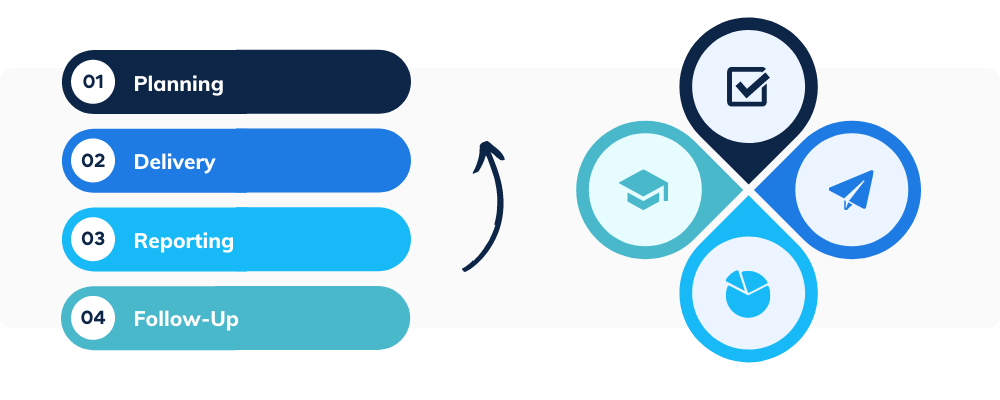
1. Scoping and Campaign Design
We meet with your team to understand your organisation, industry, compliance requirements, and specific concerns. How many employees will be tested? What departments or roles are highest risk? What compliance frameworks apply? Have you run phishing simulations before, or is this your first baseline assessment? We design realistic phishing scenarios tailored to your environment and threat profile.
2. Baseline Phishing Campaign Launch
We launch the initial phishing simulation across your organisation (or targeted departments if preferred). Employees receive realistic phishing emails during normal business hours. We track who clicked, who opened attachments, who entered credentials, and critically, who reported the suspicious email to IT. This establishes your baseline security awareness.
3. Immediate Micro-Training for Users Who Clicked
When an employee clicks a simulated phishing link, they are immediately directed to a brief training module (typically 3-5 minutes) that explains what they missed, shows the red flags they should have noticed, and provides practical guidance on identifying similar attacks. This just-in-time training is far more effective than generic annual sessions because it happens when the lesson is most relevant.
4. Detailed Reporting and Risk Analysis
We deliver comprehensive reports showing organisational performance, departmental breakdowns, high-risk user identification, and comparison against industry benchmarks. You learn which types of attacks are most effective against your workforce, which departments need additional support, and where your security awareness programme should focus.
5. Ongoing Campaign Programme (Monthly/Quarterly)
For organisations that need regular simulation (ISO 27001 and SOC 2 typically require ongoing evidence), we establish a scheduled campaign programme. This might be monthly simulations with varied scenarios, quarterly campaigns aligned with your audit cycle, or event-driven testing after security incidents. We track improvement over time and adjust scenarios to ensure employees are exposed to evolving threats.
6. Compliance Reporting and Audit Support (Ongoing)
We provide compliance-ready reports formatted for ISO 27001, SOC 2, or internal audit requirements. When your auditor asks for evidence of security awareness training and testing, you have documented proof of regular phishing simulations, improvement metrics, and remediation efforts for high-risk users.
Who This Is For
This service is designed for Australian SaaS companies, professional services firms, financial services organisations, healthcare providers, and any business that needs to measure employee security awareness, reduce phishing risk, or meet compliance requirements.
You are a good fit if:
- You need to satisfy ISO 27001 Annex A 6.3 requirements for security awareness training and testing
- You are pursuing SOC 2 compliance and need evidence of ongoing security awareness programmes (Trust Service Criteria CC1.4)
- You are working towards Essential Eight maturity and need to demonstrate a security-aware culture
- You have experienced a phishing incident (or near-miss) and want to prevent it happening again
- Your board, investors, or customers are asking how you are addressing the human risk factor
- You have conducted generic security awareness training but have no data on whether it is effective
- You need baseline metrics before your next compliance audit
- You want to identify which employees pose the highest risk so you can target additional training
If you are using Vanta or Drata for compliance automation, phishing simulation provides the documented evidence these platforms need for ISO 27001 and SOC 2 security awareness requirements. As official partners of both platforms, we know exactly what format and frequency of testing satisfies auditor requirements. We can integrate our phishing simulation reports directly into your compliance documentation.
Why Choose Siege Cyber
20+ years of cybersecurity expertise. Our Technical Director, Peter Stewart, has spent over two decades in offensive security, penetration testing, and security advisory roles. We design phishing simulations based on real-world attack techniques we have seen succeed (and fail) in hundreds of engagements. You get realistic scenarios, not generic templates.
Australian context and compliance expertise. We understand ISO 27001, SOC 2, Essential Eight, and APRA CPS 234 requirements. We know what Australian auditors expect, and we deliver phishing simulation reports formatted for compliance. If you are in a regulated industry (financial services, healthcare), we can align phishing scenarios with your specific threat profile and regulatory obligations.
Educational approach, not punitive. Phishing simulation should improve security awareness, not create fear or resentment. We design campaigns that educate employees immediately after they click, rather than shaming or punishing them. High-performing security cultures are built on learning, not blame. We help you achieve measurable improvement without damaging morale.
Realistic, modern threat scenarios. Our phishing simulations reflect 2026 threat tactics, including AI-generated emails, QR code phishing, deepfake voice attacks, callback phishing, and sophisticated CEO fraud. We do not send generic "you won a prize" emails that employees spot immediately. We create scenarios that mirror the attacks your organisation is likely to face, ensuring your training is relevant and effective.
Official Vanta and Drata partner. If you are using compliance automation platforms, we know how to integrate phishing simulation evidence into your compliance programme. We provide the reports, metrics, and documentation these platforms require, on the schedule your audit demands.
Frequently Asked Questions
How often should we run phishing simulations?
For baseline assessment, start with a single campaign to establish your current security posture. For ongoing compliance and continuous improvement, we recommend monthly or quarterly simulations. ISO 27001 and SOC 2 auditors expect evidence of regular testing, not just a one-off campaign. Monthly simulations provide the most consistent improvement, while quarterly campaigns are sufficient for many compliance frameworks. We can align the frequency with your audit schedule and risk tolerance.
Will employees know the phishing emails are simulations?
Initially, no. The goal is to test how employees respond to realistic threats under normal conditions. However, after an employee clicks (or reports) a simulated phishing email, they receive immediate feedback confirming it was a test and providing education. Over time, employees become aware that phishing simulations occur regularly, which actually improves vigilance. Organisations that run consistent simulations see reduced click rates because employees develop pattern recognition and healthy scepticism.
What happens to employees who repeatedly fail phishing tests?
We identify high-risk users in our reports, but we recommend an educational approach rather than punitive measures. Employees who consistently click should receive additional targeted training, one-on-one coaching, or role-specific awareness sessions. Punishment for failing phishing tests typically creates resentment and fear, which actually reduces reporting rates when employees encounter real attacks. The goal is to improve behaviour through education and positive reinforcement.
Can phishing simulations damage employee morale or trust?
Only if implemented poorly. Phishing simulation should be positioned as an educational tool that helps employees protect themselves and the organisation, not as a "gotcha" exercise to catch people doing something wrong. We recommend communicating upfront that regular security awareness testing will occur, explaining why it matters, and emphasising that the goal is learning and improvement. Organisations that take this approach typically see increased reporting of suspicious emails and improved security culture.
Do phishing simulations work for remote and hybrid workforces?
Absolutely. Phishing attacks target email inboxes and messaging platforms, regardless of where employees are located. In fact, remote workers are often at higher risk because they have less opportunity for informal security awareness (like asking a colleague "does this email look legitimate to you?"). Phishing simulation works equally well for office-based, remote, and hybrid teams. We can also test multiple channels including email, SMS, and collaboration platforms if relevant to your environment.
How do phishing simulations satisfy ISO 27001 and SOC 2 requirements?
ISO 27001 Annex A 6.3 requires organisations to provide information security awareness, education, and training, including testing to ensure effectiveness. SOC 2 Trust Service Criteria CC1.4 requires that the entity demonstrates competence in security awareness. Phishing simulation provides documented evidence that you are actively testing employee awareness, measuring performance, providing targeted training, and tracking improvement over time. This is exactly what auditors expect to see. We deliver reports formatted for audit compliance.
What metrics should we expect from phishing simulations?
Industry benchmarks suggest well-trained organisations achieve click rates below 5%, while organisations without regular training often see click rates of 20-40% or higher. We track click rate (percentage who clicked the link), credential entry rate (percentage who entered credentials on a fake login page), attachment open rate (for scenarios with malicious attachments), and critically, reporting rate (percentage who reported the suspicious email to IT). Improving reporting rate is often more valuable than reducing click rate, because it indicates employees are acting as a first line of defence.
Ready to Test Your Security Awareness?
Phishing attacks are not going away. They are getting more sophisticated, more targeted, and harder to spot. The only way to know whether your employees will recognize and report them is to test them under realistic conditions. Waiting until a real attack succeeds to discover which employees are vulnerable is too late.
Book a free 30-minute consultation with our team. We will discuss your current security awareness programme, recommend an appropriate testing frequency based on your compliance requirements, and design a baseline phishing simulation to assess your organisation's current risk. You will leave the call knowing exactly what your employees would do when targeted by a real phishing attack.