vCISO vs Full Time CISO: Which Does Your Business Need?
A vCISO gives you experienced security leadership for a set number of days each month. A full time CISO gives you one person, every day, who owns security completely. For most Australian businesses under about 100 staff a vCISO is the better fit, because there is not yet a security team for a full time CISO to lead. The switch usually makes sense once you have hired security staff of your own.
That is the short answer. The longer answer depends on what is actually driving the decision, because businesses reach for security leadership for very different reasons and the right choice follows the reason. This guide sets out the trade offs plainly, including the cases where a vCISO is the wrong answer.
What does a vCISO actually do?
A vCISO, short for virtual chief information security officer, is an experienced security leader engaged on a part time or retained basis rather than employed. The role is deliberately strategic. A vCISO builds and runs your security programme rather than performing hands on technical work.
In a typical Australian engagement that means owning the security risk register, setting the roadmap and defending it to the board, running the compliance programme for whatever framework applies, handling the security side of customer contracts and questionnaires, choosing and overseeing suppliers such as penetration testers, and being the accountable person when something goes wrong.
What a vCISO is not is an outsourced security operations team, a help desk, or someone who will configure your firewall. Engagements that fail almost always fail because the business needed hands and bought a head, or bought two days a month and expected daily availability.
How does a vCISO compare with a full time CISO?
The honest comparison covers three options, because the third one is frequently the right answer and rarely gets offered. A vCISO gives you ongoing part time leadership. A full time CISO gives you a dedicated employee. A project consultant gives you one defined outcome and then leaves.
| vCISO | Full time CISO | Project consultant | |
|---|---|---|---|
| What you get | Set days per month, ongoing | One person, every day | A fixed engagement with a defined end |
| Breadth of experience | Sees many environments, audits and incidents | Deep knowledge of your business only | Deep knowledge of one problem |
| Best at | Building and running a security programme | Leading a security team at scale | Delivering one specific outcome |
| Time to start | Weeks | Months, including recruitment and notice periods | Weeks |
| Where it struggles | Not present for day to day incidents | Hard to justify below roughly 100 staff | No ownership once the project ends |
| Usual trigger | Compliance or customer pressure arrives | You have security staff who need leading | One audit, one certification, one incident |
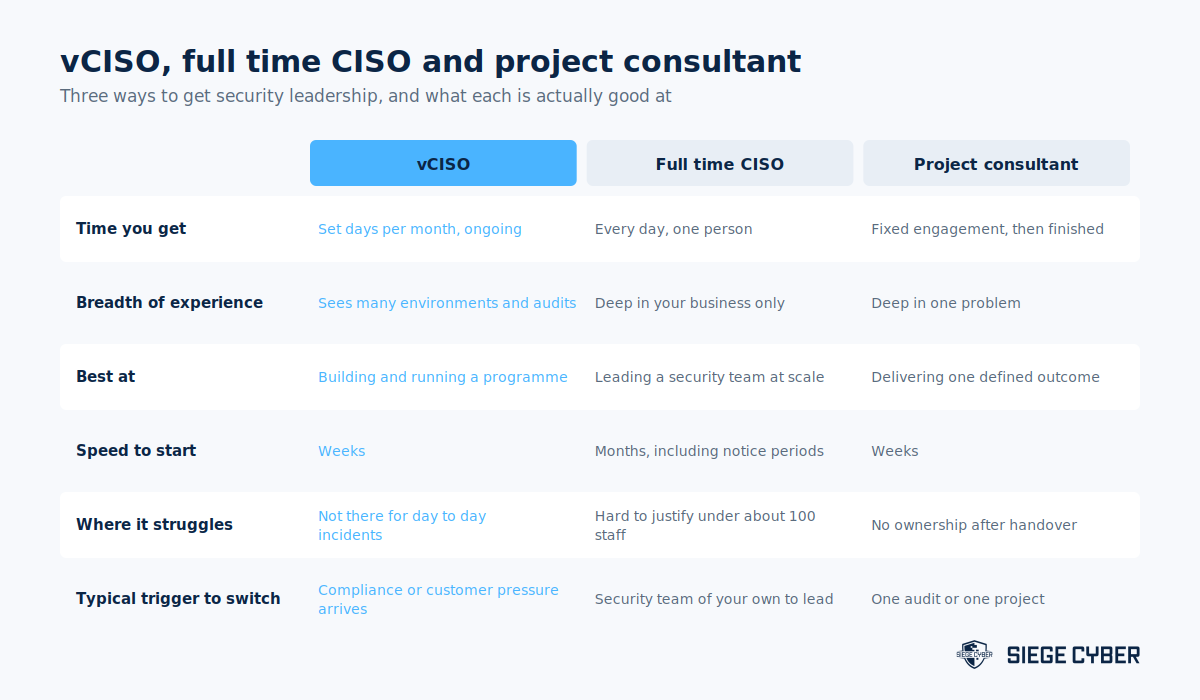
The experience trade off is the one worth thinking hardest about. A good vCISO has taken multiple organisations through certification and has sat through more audits and incidents than any single in house CISO of similar tenure. That breadth is genuinely valuable when you are doing something for the first time. It is worth less once you are running a mature programme, where depth of context about your own business matters more.
When is a vCISO the right choice for an Australian business?
A vCISO fits best when you have a real need for security leadership but not enough work to occupy a senior person full time. In Australian businesses that pattern shows up in four recognisable situations.
- Customers have started asking security questions your team cannot answer, through questionnaires, contract clauses or procurement reviews.
- You are pursuing ISO 27001, SOC 2 or Essential Eight alignment and need somebody who has done it before to own it rather than learn on your budget.
- Security currently sits with your IT manager or your CTO alongside everything else they carry, and it keeps losing to more urgent work.
- Your board or your insurer has begun asking questions that need a credible, accountable answer.
A vCISO is the wrong answer when what you actually need is execution capacity. If your problem is that nobody patches servers or reviews alerts, hiring a strategic leader to point at the problem will not solve it. Buy the hands, or buy a managed service, and revisit leadership afterwards.
When should you hire a full time CISO instead?
Hire a full time CISO when you have a security team to lead, when security decisions need to be made daily rather than fortnightly, or when your regulatory environment demands a named accountable executive who is present in the business.
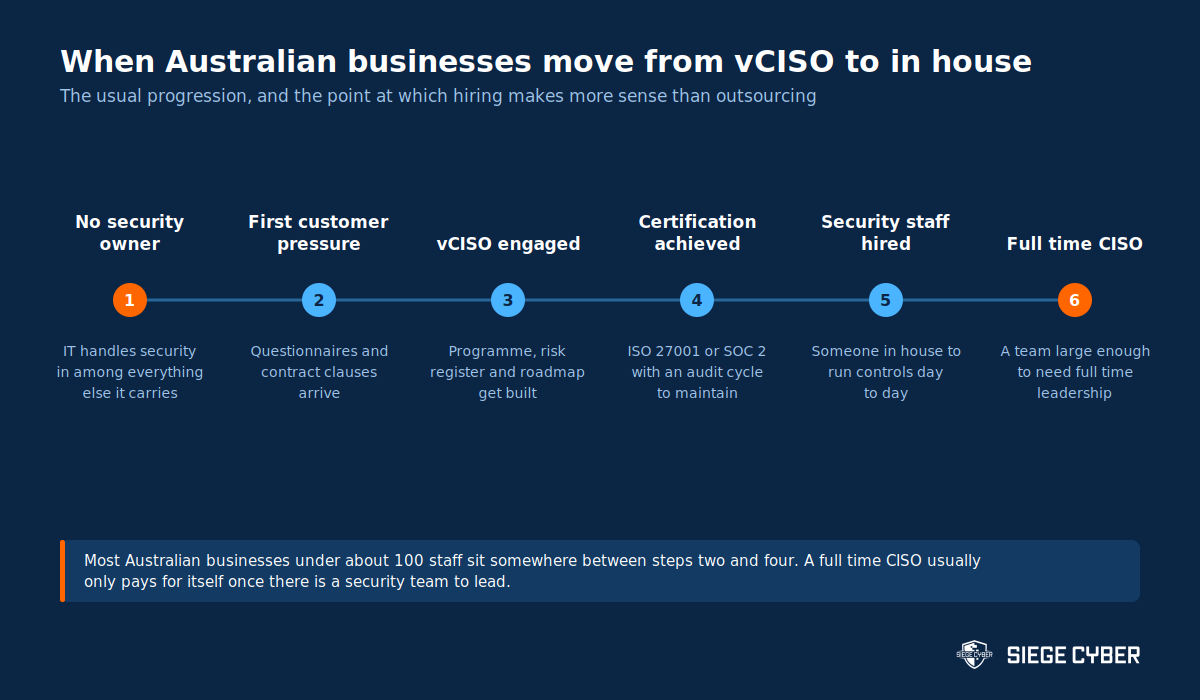
The team test is the most reliable one. A CISO is a leadership role, and leadership roles need something to lead. A full time CISO with no team spends their week doing work that a more junior specialist could do, which is an expensive way to organise a business and usually ends with the CISO leaving out of boredom.
There is also a sequencing argument. Hiring a full time CISO before the programme exists means paying a senior salary during the eighteen months it takes to build foundations. Many Australian businesses use a vCISO to build the programme, then hire a full time CISO to run and grow it. The vCISO engagement doubles as a well informed brief for that hire.
What is the difference between a vCISO and a fractional CISO?
In practice, very little. Virtual CISO and fractional CISO describe the same arrangement, which is experienced security leadership bought part time. Fractional is the more common term in the United States, and virtual is more common in Australia and the United Kingdom. CISO as a service is a third label for the same thing.
Where genuine differences appear, they are in the delivery model rather than the name. Some providers assign a single named individual to your business for the length of the engagement. Others provide a team, with a lead consultant supported by specialists and analysts. Neither is inherently better, but they suit different needs, and you should establish which one you are buying.
One term that is not interchangeable is vCIO. A virtual chief information officer covers technology strategy broadly, including systems, vendors and IT spend. A vCISO covers information security specifically. Managed service providers sometimes offer a vCIO and describe it as covering security, which it does only at a surface level.
What should you ask before engaging a vCISO?
The quality gap between vCISO providers is wide, and the market has attracted a number of firms selling a templated compliance programme under a leadership label. Six questions separate them.
- Who specifically will be your vCISO, what have they run before, and can you meet them before signing?
- How many days per month, and how are those days used if you have a quiet month or an incident?
- Have they taken an organisation of your size through the specific framework you are pursuing, and can they describe how?
- What is their availability if you have a security incident outside their allocated days?
- Are they independent of the suppliers they will recommend, or do they resell the tools and testing they will propose to you?
- What does the handover look like if you later hire in house, and does the engagement leave you with documentation you own?
The independence question matters more than it sounds. A vCISO who resells the security tooling they recommend has an interest in the recommendation. That does not make them wrong, but you should know before the advice arrives, not after.
Common questions
What is a vCISO?
A vCISO, or virtual chief information security officer, is an experienced security leader engaged part time rather than employed. They own your security strategy, risk register, compliance programme and board reporting for a set number of days each month. The role is strategic rather than hands on, and it suits organisations that need leadership but not a full time salary.
What are vCISO services?
vCISO services typically cover security strategy and roadmap, risk assessment and the risk register, compliance programme management for frameworks such as ISO 27001 or SOC 2, policy development, supplier and third party risk, board and executive reporting, incident response planning, and oversight of technical work such as penetration testing performed by others.
What is the difference between a vCISO and a fractional CISO?
There is no meaningful difference. Virtual CISO, fractional CISO and CISO as a service all describe experienced security leadership engaged part time. Virtual is the more common term in Australia, fractional in the United States. Focus on what is actually being delivered, how many days, and who specifically will do the work, rather than the label.
What is the difference between a vCISO and a vCIO?
A vCIO covers information technology strategy broadly, including systems, vendors, budgets and IT roadmap. A vCISO covers information security specifically, including risk, compliance, policy and security governance. The skill sets overlap but are not the same, and a vCIO offering that includes security as one line item rarely provides the depth a compliance programme requires.
How many days a month does a vCISO engagement usually run?
Engagements vary widely with the work at hand. A business actively pursuing certification needs materially more time than one maintaining an established programme. Rather than anchoring on a number, agree what has to be delivered in the first six months and let that set the days, then review it once the programme is running.
Can a vCISO help us get ISO 27001 or SOC 2 certified?
Yes, and that is one of the most common reasons Australian businesses engage one. A vCISO can own the whole programme, from scoping through to sitting alongside you in the audit. Be aware that a certification body cannot both consult on your management system and certify it, so your vCISO and your certifier must be separate organisations. In Australia, accredited certification bodies are assessed by JAS-ANZ, and that independence requirement is part of what accreditation enforces.
Work out which one your business actually needs
Siege Cyber provides virtual CISO services to Australian businesses, and we will tell you plainly if a scoped project or an in house hire would serve you better. See our virtual CISO services, or our cyber security advisory services if you need help defining the problem first.
Our post on our first 90 days as your vCISO sets out what an engagement looks like in practice. If compliance is the driver, our ISO 27001 and SOC 2 pages cover that work directly.
Get in touch for a straight conversation about it.
Siege Cyber provides vCISO support for Australian businesses that need senior security leadership without a full-time hire. Get a Fixed-Price Quote.