SOC 2 vs ISO 27001 in Australia: Which Compliance Framework is Right for Your Business?
If you are asking yourself “which compliance framework do I need?”, you’re not alone. Many Australian SaaS and technology businesses bounce between SOC 2 and ISO 27001, especially once larger customers, investors or overseas partners start asking for proof of security. Both SOC 2 and ISO 27001 are well recognised, but they solve slightly different problems and send different signals to the market.
SOC 2 and ISO 27001: the basics
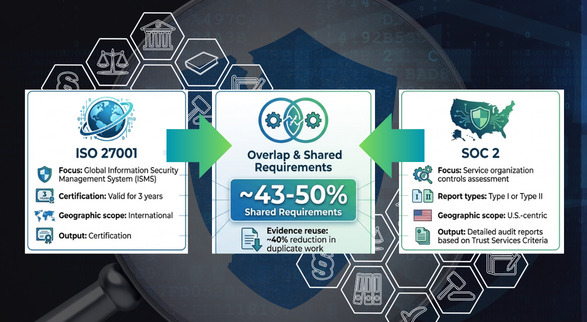
At a simple level, ISO 27001 is a certification for your information security management system. It looks at how you run security across the organisation, not just for one product. An accredited certification body audits you and, if you pass, issues an ISO 27001 certificate that is valid for three years with annual surveillance audits.
SOC 2 is an attestation report issued by an independent audit firm, commonly in the United States. Instead of a certificate, you get a detailed report that describes your controls and tests whether they operated effectively over a period of time. Customers use that report as part of their vendor due diligence, particularly if you are handling production data for them.
In practice, Australian SaaS providers that sell into North America are often pushed towards SOC 2, while those dealing with government, regulated industries or European customers find ISO 27001 aligns more naturally with expectations and other standards.
Key differences between SOC 2 and ISO 27001
Although they overlap heavily, there are some important differences between SOC 2 and ISO 27001 that affect which suits you best.
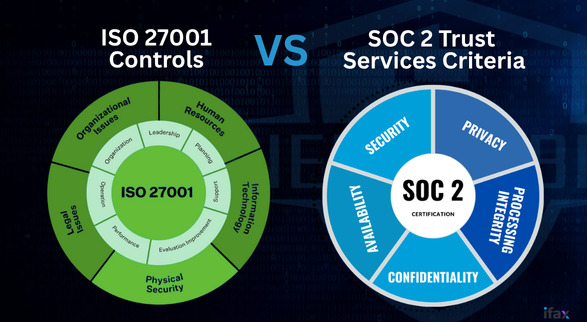
ISO 27001 is a formal standard published by the International Organisation for Standardisation. It defines a set of requirements for an information security management system and includes an annex of reference controls. You choose which controls are applicable to your risk profile and document any that are not. The focus is on having a structured, risk based system for managing security, tied into your governance, legal and regulatory obligations such as the Privacy Act, ASD Essential Eight, and for some sectors APRA CPS 234.
SOC 2 is based on the AICPA’s Trust Services Criteria. Rather than prescribing an exact set of controls, it describes outcomes around security, availability, confidentiality, processing integrity and privacy. Your auditor assesses whether the controls you have designed meet those criteria and, for a Type 2 report, whether they worked consistently over 6–12 months.
This leads to some practical differences:
-
ISO 27001 tends to be broader across the organisation, including HR processes, supplier management, asset management and physical security, not just your SaaS platform.
-
SOC 2 reports often go deeper into the service itself, including how you manage customer data, how incidents are handled and how changes are deployed and tested.
-
ISO 27001 certification is pass or fail against the standard. SOC 2 reports describe what the auditor tested and what exceptions they found, which customers then interpret in their own risk assessments.
Neither is “better” in absolute terms. The right answer depends on who you need to convince and what they are asking for.
Which compliance framework do you need?
Most Australian SaaS companies fit into one of three scenarios.
If you mainly sell to Australian organisations, especially in government, not‑for‑profits, health or financial services, ISO 27001 is usually the first and most efficient move. It aligns well with local expectations, supports mapping to ASD Essential Eight and other frameworks, and helps you demonstrate to boards that you have a structured approach to security.
If you are targeting US or global enterprise customers, especially larger technology platforms, SOC 2 is often the ticket to entry. Their procurement teams already have SOC 2 review processes and many security questionnaires explicitly ask for a SOC 2 Type 2 report. In those cases, ISO 27001 alone may not remove all the friction from your sales cycle.
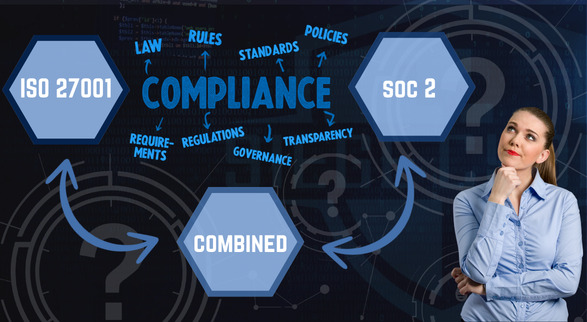
If you are scaling quickly and expect to sell into both markets, a combined approach often makes sense. You design a security and compliance foundation that can support both SOC 2 and ISO 27001, then decide which attestation to pursue first based on current pipeline. Many Australian SaaS businesses start with ISO 27001 and then add SOC 2 once US expansion is real, or vice versa.
If you are unsure where you sit, a short scoping conversation and high level gap review usually makes the path forward obvious. Siege Cyber offers both SOC 2 readiness and ISO 27001 consulting, along with fixed‑price packages tailored for Australian SaaS security compliance.
How Australian regulations change the picture
Local regulation does not explicitly mandate SOC 2 or ISO 27001, but it does shape what “good enough” looks like.
The Privacy Act requires organisations to take reasonable steps to protect personal information. For any SaaS handling significant volumes of personal data, ISO 27001 or SOC 2 is a strong way to evidence those “reasonable steps” to regulators and customers.
If you are subject to APRA CPS 234, you must maintain information security commensurate with threats and have clear controls over third parties. Many regulated entities look for ISO 27001 or SOC 2 in their suppliers as a shortcut to satisfying that obligation.
The ASD Essential Eight maturity model is increasingly used as a reference point for technical controls. While it is not a one‑to‑one mapping, a well implemented ISO 27001 system makes it easier to plan and demonstrate Essential Eight uplift, and many SOC 2 control sets are designed with the same technical expectations in mind.
The net effect is that choosing a framework is less about ticking a box and more about having something you can point to when customers, boards or regulators ask how you manage security.
Practical considerations: cost, effort and timelines
Beyond the theory, there are some very practical questions you need to answer.
ISO 27001 certification projects usually involve establishing policies, risk registers, asset inventories, supplier assessments and internal audit cycles, as well as tightening technical controls. For a typical SaaS company that has some basics in place, you might be looking at six to twelve months from initiation to certification, depending on resourcing and appetite.
SOC 2 readiness involves defining a control set mapped to the Trust Services Criteria, implementing any missing controls, and then operating them consistently for a period so you can evidence them. Many organisations find the ongoing evidence collection and documentation to be the heavy lifting, not the design of the controls themselves.
Compliance automation platforms such as Vanta and Drata can reduce that ongoing burden dramatically by collecting technical evidence from your cloud, identity and ticketing systems. Siege Cyber is an official partner of both, which means we can help you decide whether one of these platforms suits your environment or not and then design the policies, controls and audit‑ready documentation that is required.
If you are not sure how ready you are, a targeted readiness assessment is often the best first step. Siege Cyber offers structured readiness and gap assessments for both SOC 2 and ISO 27001, along with clear remediation roadmaps and estimated timelines.
How Siege Cyber can help your Australian SaaS business
Choosing between SOC 2 and ISO 27001 is both a security decision and a commercial decision. The right framework reduces deal friction, supports faster vendor reviews and gives your team a common language for managing risk.
Siege Cyber has helped Australian SaaS providers, managed service providers and technology companies in Brisbane and across Australia to:
-
Decide whether SOC 2, ISO 27001 or a staged combination is the best fit for their go‑to‑market strategy.
-
Design and implement security controls that satisfy both frameworks without over‑engineering.
-
Work effectively with tools like Vanta and Drata so automation handles the busywork and your internal team can focus on real risk.
If you know you need SOC 2 or ISO 27001 but are not sure where to start, our SOC 2 and ISO 27001 service pages outline typical engagement models and deliverables. Transparent compliance pricing is available on Siege Cyber’s website so you can budget with confidence.
If you are ready to move forward, the next step is simple. Visit siegecyber.com.au, review our SOC 2 and ISO 27001 services, and get in touch via the contact form or email to arrange a no‑obligation discussion about your situation. A short call is usually enough to clarify whether SOC 2, ISO 27001 or both are right for your business and how we can help you get there without derailing product delivery.
Siege Cyber’s CERTIFY ISO 27001 package takes Australian businesses from gap analysis to certification with a fixed scope and a fixed price. Get a Fixed-Price Quote.