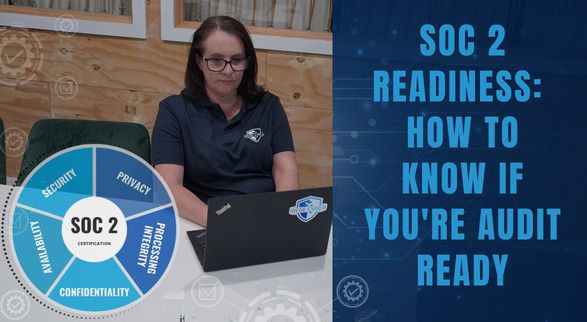
SOC 2 Readiness Assessment: How to Know If You’re Audit-Ready
Being ready for a SOC 2 audit is less about saying you follow a framework and more about proving that your controls are in place and working over time. A SOC 2 readiness assessment turns that idea into something practical by checking your scope, controls and evidence before you commit to audit dates.
In this post, we walk through what SOC 2 audit readiness really means, what a SOC 2 readiness assessment covers, and how to work out whether you need outside help.
What SOC 2 audit readiness really means
SOC 2 is not just a badge for your website. It is an assurance report issued by an independent auditor, based on whether your controls are designed and operating effectively over a defined period.
Being audit ready means you have defined which systems and services are in scope. You have selected the right Trust Services Criteria for your clients and risk profile. Your policies, procedures and controls exist, are implemented and can be evidenced. You can demonstrate that controls have operated consistently over the review period for a Type 2 report.
A SOC 2 readiness assessment checks all of this in advance, in a lower pressure setting, so that the actual audit feels more like a confirmation than a surprise. If you want more detail on what a structured readiness engagement looks like, there is an overview here:
https://siegecyber.com.au/services/soc2/
1. Scope and TSC selection: do you know what you’re signing up for?
SOC 2 starts with scope. Which products, services, environments and locations are included and which customer promises does the report need to support.
Your readiness assessment should confirm which systems and services are in scope, for example your core SaaS platform, supporting services and key third party dependencies. It should also make clear which Trust Services Criteria (TSC) you are including, such as Security which is always included, and possibly Availability, Confidentiality, Processing Integrity and Privacy. Finally, it should show how that scope lines up with your contracts, privacy obligations and risk appetite.
If you cannot explain scope and TSC selection in a couple of clear sentences for your leadership team and your auditor, you are not ready yet.
2. Policies and procedures: are they real, used and consistent?
Many organisations start SOC 2 using templates from a platform or a previous project. There is nothing wrong with that, as long as the documents are tailored and actually used.
A SOC 2 readiness assessment will typically review whether your information security policies reflect current practice, tools and organisational structure. It will check that there are clear procedures for onboarding and offboarding, access management, change management, incident response and vendor risk. It will also look for policies that reference relevant Australian obligations where appropriate, such as the Privacy Act, ASD Essential Eight uplift and APRA CPS 234 in regulated sectors.
Auditors can tell the difference between a policy that was written for the audit and one that staff have seen and follow.
3. Control design: do controls actually cover the risks?
A SOC 2 report is based on controls mapped to the Trust Services Criteria. A readiness review looks at whether each control makes sense and whether there are gaps.
Typical focus areas include:
-
Access control and identity management, including multifactor authentication and least privilege.
-
Change management and deployment practices, especially for cloud hosted systems.
-
Logging, monitoring and incident response, along with vendor risk management and data handling.
-
Business continuity and backup practices for in scope systems.
If your controls are thin or inconsistent, a readiness assessment will flag that and give you time to adjust before the audit period starts.
4. Evidence and tooling: can you prove your controls work?
SOC 2 is evidence driven. It is not enough to say you do something, but rather you need to show artefacts that demonstrate it.
As part of SOC 2 audit readiness, you should check whether you have a consistent way to store and retrieve evidence, including tickets, logs, screenshots, reports and approvals. You should confirm that controls are set up to generate evidence by design, not as an afterthought. You also need to ensure your evidence covers the whole period for a Type 2 report, not just a single point in time.
Many Australian organisations use platforms such as Vanta or Drata to automate evidence collection and reminders. These platforms are very helpful, but you still need someone to design the control set, review exceptions and make sure what is in the tool matches what actually happens in your environment.
5. Operational maturity: can you sustain this for 6 to 12 months?
A SOC 2 Type 2 report typically covers a 6 to 12 month period. That means your controls need to operate consistently, not just for a week before the auditor turns up.
A good SOC 2 readiness assessment will look at whether there is a clear owner for the SOC 2 programme. It will examine how you manage joiners, movers and leavers over time. It will check how incidents and near misses are recorded and handled, and how exceptions to policies or controls are documented and approved.
If your organisation is still relying on one person to remember everything, you may struggle to keep up once the audit period starts.
6. Internal readiness: is your team prepared for the audit process?
Even if your controls and evidence are in good shape, the audit can feel stressful if people do not know what to expect.
Readiness work should include making sure key staff understand what SOC 2 is and what their role is during the audit. It should confirm that subject matter experts can explain how their processes work in plain language. It should also include a run through of likely questions the auditor will ask about your control environment.
This is often the difference between a smooth audit and a painful one.
7. Using a SOC 2 readiness assessment to avoid surprises
A structured SOC 2 readiness assessment pulls all of this together. You get a view of where you are already meeting expectations, where you have partial coverage, and where there are gaps that could cause issues in an audit.
Done well, it gives you a prioritised action list, not just a long spreadsheet of tasks. A typical SOC 2 readiness engagement includes a structured assessment, practical recommendations and support as you close gaps, using your existing tooling wherever possible: https://siegecyber.com.au/services/soc2/
8. How Siege Cyber can help you get SOC 2 audit ready
Siege Cyber works with Australian organisations that are preparing for SOC 2, often alongside other frameworks such as ISO 27001 and ASD Essential Eight.
In practice, that usually means help to define SOC 2 scope and select appropriate Trust Services Criteria. It includes reviewing and tuning policies, procedures and controls so they match both SOC 2 expectations and local obligations under the Privacy Act, APRA CPS 234 and the Essential Eight. It also involves designing a practical evidence strategy, whether you are using Vanta, Drata or your own processes, and running a SOC 2 readiness assessment that leaves you with a clear roadmap to audit readiness.
If you want to get a sense of budget, Siege Cyber publishes indicative compliance consulting and SOC 2 pricing here:
https://siegecyber.com.au/#compliance-pricing
Are you ready for a SOC 2 audit?
If a prospective customer, board member or investor asked you whether you are ready for a SOC 2 audit, could you answer confidently, with specifics. If not, a readiness assessment is likely the missing step.
If you would like an experienced partner on your side, Siege Cyber can help you move from we think we are ready to we know where we stand and what is left to do. You can start with the SOC 2 service page at https://siegecyber.com.au/services/soc2/, then get in touch via siegecyber.com.au or email [email protected] to book a consultation and discuss your SOC 2 audit readiness.