ISO 27001 vs SOC 2: A Side-by-Side Comparison for Australian Companies
If you run a small to mid-sized business in Australia, you have probably been told that you need ISO 27001 or noticed that bigger customers are starting to ask for SOC 2. Many Australian founders now search for terms like ISO 27001 small business Australia or SOC 2 Australia because security questionnaires and procurement teams are getting tougher every year.
This article walks through ISO 27001 vs SOC 2 in plain language, explains the differences, and gives you a practical way to decide which one makes sense for your business right now.
Quick overview: What are ISO 27001 and SOC 2?
At a high level, both ISO 27001 and SOC 2 are information security compliance frameworks that help you prove you take data security seriously.
-
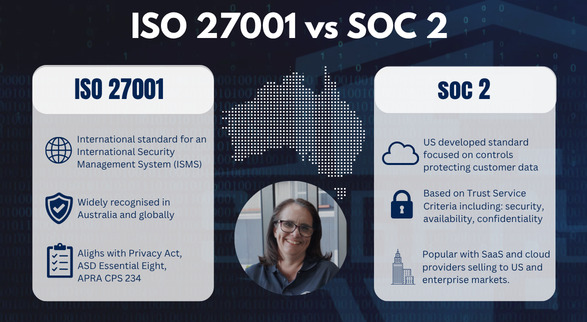
ISO 27001 is an international standard for building and running an Information Security Management System (ISMS). It is widely recognised in Australia and globally and aligns well with local expectations like the Privacy Act, ASD Essential Eight and APRA CPS 234.
-
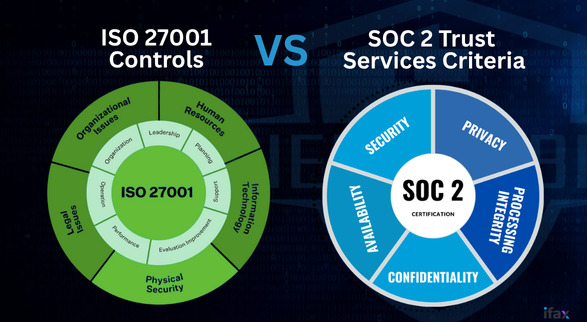
SOC 2 is a set of reporting standards developed in the US that focuses on how you protect customer data against specific Trust Services Criteria such as security, availability and confidentiality. It is especially popular with SaaS and cloud providers selling into the US and enterprise markets.
Both aim to reduce risk and build trust, but they do this in slightly different ways.
ISO 27001 vs SOC 2 differences
Here is how ISO 27001 and SOC 2 differ on the points most Australian companies care about.
1. Certification vs attestation
-
With ISO 27001, you get a formal certificate issued by an accredited certification body (in Australia, usually JAS-ANZ accredited). This certificate is valid for three years with annual surveillance audits.
-
With SOC 2, you receive an attestation report from an independent auditor (usually a CPA firm). There is no “SOC 2 certificate” as such. The report is what your customers review.
If you deal with governments, regulated industries or larger Australian enterprises, a recognised certificate like ISO 27001 can carry more weight locally.
2. Scope and focus
-
ISO 27001 looks at your whole information security management system: governance, policies, risk assessment, incident response, asset management and so on. It is designed as a governance framework you can align with other requirements such as CPS 234 and the ASD Essential Eight.
-
SOC 2 is more focused on your controls around customer data, mapped to the Trust Services Criteria. It is often tightly scoped to a particular SaaS platform or service, which works well for software companies.
If you want a single master framework for your organisation, ISO 27001 is usually the better backbone, especially as Australia continues to move in that direction.
3. Geography and customer expectations
ISO 27001 is recognised everywhere and is often a default expectation for tenders in Australia, the UK, Europe and Asia.
SOC 2 originated in the US and is now a common checklist item for venture-backed SaaS companies and tech vendors selling into North American and global enterprise markets. If you are pitching to US-based buyers or security-conscious tech companies, a request for SOC 2 appears on almost every security questionnaire.
Many Australian SaaS companies end up needing both over time: ISO 27001 to satisfy local and global standards-based buyers, SOC 2 for North American and enterprise customers.
ISO 27001 for small business in Australia: Is it worth it?
If you are a small Australian business, ISO 27001 can feel like a big step. The good news is that it is becoming more common, even in smaller organisations.
Recent guidance suggests ISO 27001 certification in Australia typically costs in the range of around $15,000 to $80,000 AUD or more, depending on size and complexity, and usually takes 6 to 18 months to implement properly.
For a small business, the ISO 27001 certification cost depends mainly on:
-
Number of staff and locations
-
How mature your current security practices are
-
Whether you do the heavy lifting internally or engage a partner like Siege Cyber
-
How ambitious your scope is (entire organisation vs a single service)
If you are already being blocked from deals because you do not have a recognised framework, the cost of missed contracts can easily outweigh the cost of implementing ISO 27001.
If you want a deeper dive into ISO 27001 for small business in Australia, Siege Cyber has a dedicated article on this topic.
SOC 2 in Australia: Who actually needs it?
SOC 2 is increasingly on the radar for Australian companies, especially in SaaS and technology.
You are more likely to need SOC 2 if:
-
You provide a cloud or SaaS platform used by overseas customers
-
You sell into US-based or global enterprises with strict vendor risk processes
-
Your customers ask specifically for SOC 2 Type 2 reports in security questionnaires
For many Australian startups, SOC 2 is now a growth milestone because without it, large prospects stall in procurement.
Siege Cyber’s SOC 2 services are designed for exactly this scenario: you know you need SOC 2, but you do not want to guess your way through a years-long process.
If you are not sure whether ISO 27001 or SOC 2 is the better move, a short discovery session or gap analysis can save you months of effort in the wrong direction. Siege Cyber offers these as standalone services so you can get clear on your priorities before you commit.
ISO 27001 vs SOC 2: A comparison
Purpose
-
ISO 27001: Build and maintain an ISMS that supports ongoing risk management and continuous improvement.
-
SOC 2: Provide assurance, via an independent report, that your controls meet the SOC 2 Trust Services Criteria.
Typical use cases in Australia
-
ISO 27001
-
Government and regulated sectors needing structured information security governance
-
Businesses aligning with APRA CPS 234, Privacy Act obligations and ASD Essential Eight maturity uplift
-
Service providers wanting a globally recognised security standard
-
-
SOC 2
-
SaaS providers and cloud platforms selling into US and global enterprise markets
-
Startups preparing for funding or expansion into North America
-
Vendors facing repeated requests for SOC 2 Type 2 reports
-
Evidence you provide
-
ISO 27001: Accredited certificate, Statement of Applicability, policies and risk treatment plans.
-
SOC 2: Independent attestation report (Type 1 or Type 2) that customers review in detail.
Alignment with Australian regulations
Neither ISO 27001 nor SOC 2 is legally mandatory in Australia, but both align well with local expectations.
-
ISO 27001 maps neatly to:
-
Privacy Act obligations for protecting personal information
-
APRA CPS 234 expectations for information security capability and controls in regulated entities
-
ASD Essential Eight as a practical control set for technical uplift.
-
-
SOC 2 supports similar goals, but uses the SOC 2 Trust Services Criteria rather than Australian-specific language.
For many boards and executives, ISO 27001 becomes the master framework, with SOC 2 layered on for specific markets and customers.
How Siege Cyber helps you implement ISO 27001 or SOC 2
Frameworks are only useful if they are implemented in a way that fits how your organisation actually works. That is where Siege Cyber comes in.
Siege Cyber supports Australian businesses with:
-
ISO 27001 certification consulting and ISMS implementation
-
SOC 2 readiness, control design and audit preparation
-
Essential Eight assessments and uplift to support your broader security posture
We are also an official partner of both Vanta and Drata, two leading compliance automation platforms. These platforms are powerful accelerators, but they do not replace the need to make smart decisions about scope, risk and evidence. Siege Cyber bridges that gap by configuring Vanta or Drata properly, mapping controls to your real-world environment, and guiding you through what still requires human judgement.
If you are not sure where your organisation stands today, a focused gap analysis against ISO 27001, SOC 2 or the Essential Eight is often the most efficient starting point. It gives you a clear roadmap and realistic timeframes, instead of a long wish list.
ISO 27001 vs SOC 2: How to choose your first step
So, which one should you do first? A simple way to decide is to look at where your growth will come from over the next 12 to 24 months.
Choose ISO 27001 first if:
-
You primarily sell to Australian or Asia-Pacific customers
-
You work with government, critical infrastructure or regulated industries
-
You want a single, structured framework that supports multiple obligations (Privacy Act, CPS 234, Essential Eight and vendor questionnaires)
Choose SOC 2 first if:
-
You are a SaaS or cloud service provider targeting US or global enterprise clients
-
Prospects are explicitly asking for SOC 2 Type 2 reports
-
You already have reasonable security maturity and want to convert stalled deals
In many cases the best long-term approach is ISO 27001 as your governance backbone, then SOC 2 for key services and international markets. Siege Cyber helps you design that roadmap so each step builds on the last, rather than starting from scratch each time.
If you want practical numbers for budgeting, Siege Cyber’s pricing page sets out different package levels for ISO 27001, SOC 2 and related services, tailored to small and mid-sized Australian businesses.
TURN INTENT INTO trusted assurance
If security questionnaires are getting harder, deals are slowing down or your board is asking more pointed questions about risk, now is the time to move. ISO 27001 and SOC 2 are not just badges, they are structured ways to prove you are managing information security properly.
Siege Cyber works with Australian companies every week on ISO 27001, SOC 2, Essential Eight and broader information security compliance frameworks. If you are weighing up ISO 27001 vs SOC 2, or trying to work out realistic timelines and costs, we can walk you through the trade-offs and give you a clear plan.
Visit siegecyber.com.au, explore our ISO 27001 and SOC 2 service pages, then get in touch to book a consultation. A short conversation now can save you months of uncertainty and help you turn security and compliance into a business advantage instead of a blocker.
Siege Cyber’s CERTIFY ISO 27001 package takes Australian businesses from gap analysis to certification with a fixed scope and a fixed price. Get a Fixed-Price Quote.