How DISP Relates to ISO 27001 and Other Frameworks
If you work with the Australian Department of Defence, you have probably heard that DISP and ISO 27001 are aligned, or that DISP builds on other frameworks. That sounds tidy, but it does not help much when you are staring at a questionnaire or contract and trying to work out what needs to happen next.
This article breaks down how the Defence Industry Security Programme (DISP) relates to ISO 27001, the ASD Essential Eight and SOC 2, and what this means in practice for defence suppliers.
Quick recap: what DISP covers
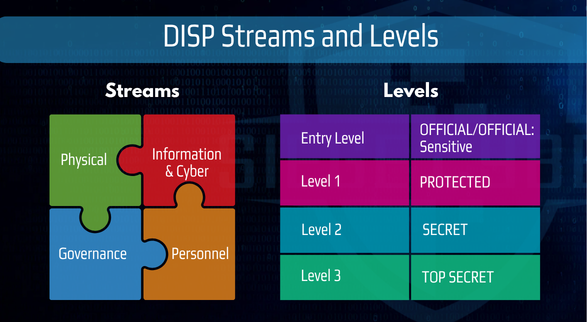
DISP is the Defence Industry Security Programme run by the Department of Defence. It is designed to make sure companies that work with Defence manage security across four main streams:
-
Governance
-
Personnel
-
Physical
-
Information and cyber
Each DISP membership level (Entry, Level 1, 2 and 3) adds more expectations around how you manage people, facilities, information and systems.
From an information and cyber perspective, DISP leans heavily on existing security frameworks and Australian guidance such as ISO 27001, the ASD Information Security Manual, the ASD Essential Eight and, for regulated entities, things like APRA CPS 234 and the Privacy Act.
How DISP and ISO 27001 fit together
Think of ISO 27001 as a structured way to run an Information Security Management System, and DISP as a specific set of expectations Defence has for that system when you handle Defence information.
ISO 27001 gives you:
-
A formal ISMS, with scope, risk assessment and risk treatment
-
A control set (Annex A) that covers governance, technical, physical and people controls
-
Requirements for internal audit, management review and continual improvement
DISP expects that, for higher levels especially, you can show:
-
Governance over information and cyber risks
-
Documented policies and procedures
-
Risk based controls for handling Defence information
-
Evidence that controls operate in practice, not only on paper
If you already run ISO 27001, you are most of the way there on the information and cyber stream. The work is in tightening the scope and controls, so they explicitly cover Defence data, environments and contractual requirements.
Typical ISO 27001 artefacts that map neatly to DISP include:
-
ISMS scope and Statement of Applicability
-
Risk register and risk treatment plans
-
Information security, access control and asset management policies
-
Incident response procedures and records
-
Supplier security and cloud service policies
This is why many defence suppliers either pursue ISO 27001 certification or at least align strongly with it. It gives them a recognised baseline when Defence, primes or auditors ask how information security is managed.
If you want help lining up DISP with ISO 27001, Siege Cyber’s DISP membership support is a good starting point.
DISP and the ASD Essential Eight
The Essential Eight is the Australian Signals Directorate’s recommended set of mitigation strategies for cyber security. It is not a law, but it is now the default language for cyber uplift across Commonwealth government and many large organisations.
For DISP, Essential Eight comes into play in two main ways:
-
Defence guidance consistently references ASD material, including the Essential Eight maturity model, as the baseline for managing cyber risk
-
Prime contractors and Defence customers increasingly expect suppliers to reach a defined Essential Eight maturity level, especially where they connect to Defence systems or handle sensitive information
In practice, this means defence suppliers should be able to answer basic questions such as:
-
What is your target Essential Eight maturity level, and where are you currently?
-
How do you manage application whitelisting, patching, admin privileges, backups and multi factor authentication in line with the Essential Eight?
-
How do these controls apply in environments that handle Defence data?
An ISO 27001 aligned ISMS provides the governance and documentation, while an Essential Eight assessment gives you a concrete, technical view of how strong your controls are.
If you are not sure where your organisation sits against the Essential Eight, a formal assessment is a very practical way to start. Siege Cyber runs Essential Eight assessments and DISP gap analyses as standalone services, so you can get a clear view before you commit to a full uplift.
Where SOC 2 fits for Australian defence suppliers
SOC 2 is a US originated attestation standard, but it is increasingly common in Australia, especially for SaaS providers and managed services. For defence work, SOC 2 reports can be helpful where:
-
You provide cloud or managed services that Defence or primes rely on
-
Overseas or multinational customers expect SOC 2 as their default assurance mechanism
-
You want to show that your controls are independently tested on an annual basis
SOC 2 does not replace DISP or ISO 27001. Instead:
-
ISO 27001 gives you a management system and an international security benchmark
-
SOC 2 provides recurring assurance over how your controls operate in practice
-
DISP layers Defence specific governance, personnel, physical and information security expectations over the top
For organisations that already use Vanta or Drata to support ISO 27001 and SOC 2 readiness, Siege Cyber often steps in to bridge the gap between what the platform automates and what DISP still expects from a governance point of view. Automated evidence collection is helpful, but someone still needs to tune controls for Defence requirements, interpret results and prepare for audits.
Do you need all three: DISP, ISO 27001 and SOC 2?
Not every defence supplier needs the full set of frameworksFram. Roughly:
-
If you hold or access Defence information or facilities, DISP will be required by contract
-
If you want a globally recognised security certification, ISO 27001 is usually the best fit
-
If you sell services to North American or multinational customers, SOC 2 may be expected
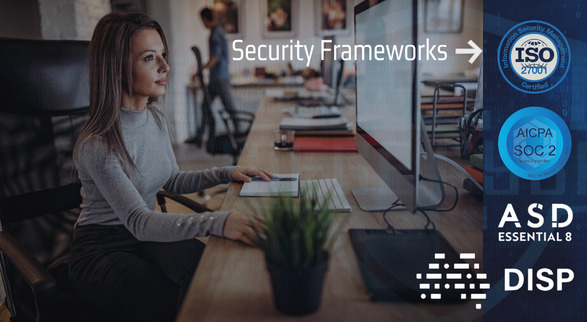
What matters is that your frameworks line up. A messy mix of overlapping controls and ad hoc processes makes it harder to satisfy Defence, primes and auditors. A single, well designed control set reused across DISP, ISO 27001, Essential Eight and SOC 2 simplifies life considerably.
Siege Cyber often starts by mapping your current controls against these frameworks, then designs a unified control set and evidence model. That way, one policy or process can serve multiple obligations, instead of you maintaining separate versions for every standard.
If you prefer transparent pricing before you talk to someone, Siege Cyber publishes indicative compliance packages ISO 27001 and SOC 2 certification cost.
Practical next steps for defence suppliers
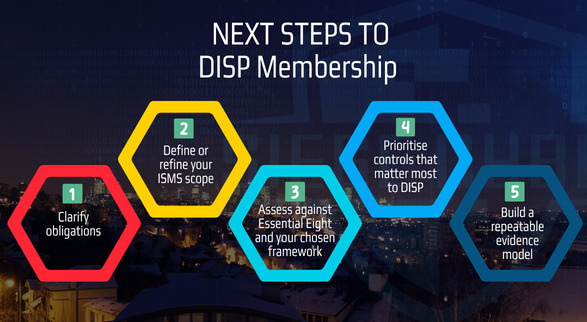
If you are looking at DISP and wondering what to do first, a sensible order usually looks like this:
-
Clarify obligations
Confirm which DISP level applies, whether ISO 27001 or SOC 2 are contractual requirements, and what your Defence and prime customers actually expect. -
Define or refine your ISMS scope
Make sure your ISMS clearly includes the environments, systems and services that handle Defence information. -
Assess against Essential Eight and your chosen framework
Run a structured assessment against Essential Eight and ISO 27001 or SOC 2, so you can see where the real gaps are. -
Prioritise controls that matter most to DISP
Focus early effort on governance, personnel security, incident response, access control, secure configuration and supplier security as they relate to Defence work. -
Build a repeatable evidence model
Decide how you will show auditors and customers that controls operate consistently over time, not just at a point in time.
Throughout this process, it helps to have someone who has been through DISP, ISO 27001 and SOC 2 before, and who understands how Australian Defence thinks about risk.
How Siege Cyber can help
Siege Cyber works with Australian defence suppliers of all sizes, from small specialist consultancies through to larger managed service providers. Typical support includes:
-
DISP readiness assessments and uplift plans
-
ISO 27001 aligned ISMS design and implementation
-
Essential Eight assessments and remediation guidance
-
SOC 2 readiness and control mapping
-
vCISO support for organisations that need ongoing guidance rather than a full time CISO
If you already have Vanta or Drata, Siege Cyber can help you configure the platform, map it to your DISP and ISO 27001 scope, and close the human‑driven gaps such as risk treatment, supplier reviews and management reporting.
If you would like to talk through your situation, visit siegecyber.com.au, review the DISP accreditation support, or contact the team at contact@siegecyber.com.au to arrange a consultation. A short conversation often saves months of trial and error.
Why DISP Cares About Essential Eight Maturity Level 2
The ICT and cyber domain of DISP is assessed against the Information Security Manual, and Maturity Level 2 of the ASD Essential Eight is the practical benchmark most suppliers are asked to reach. It is not an arbitrary bar. Level 2 is roughly the point at which an organisation is resistant to an attacker using commodity tooling and willing to spend a little effort, which describes most of what actually targets the defence supply chain.
If you are already at Maturity Level 2 and can prove it, a large part of the DISP cyber requirement is done.
Mapping the Essential Eight Into an ISO 27001 ISMS
If you hold ISO 27001, you already have the structure DISP wants for governance: a scope, a risk assessment, a Statement of Applicability, internal audit and management review. The Essential Eight then sits inside that structure as a set of technical controls rather than as a separate programme.
The mapping is straightforward in practice. Application control, patching applications, patching operating systems and restricting administrative privileges map to the Annex A controls covering configuration, vulnerability and access management. Multi-factor authentication and daily backups map to authentication and continuity. The value of doing it this way is that one internal audit cycle produces evidence for both, and one risk assessment drives both.
Running them separately is the expensive mistake. We see suppliers maintaining two sets of documents, two evidence trails and two review cycles for what is substantially the same set of controls.
What This Means for Smaller Defence Suppliers
If you are starting from nothing and need DISP, go after Essential Eight Maturity Level 2 first and treat ISO 27001 as optional unless a customer is asking for it. If you already hold ISO 27001, you are closer to DISP than you probably think, and the work is mostly personnel and physical security rather than cyber.
Either way, the order matters more than the effort. Doing these in the wrong sequence is how twelve months of work turns into eighteen.
Lining these up? Our DISP membership support covers all four domains, and we deliver ISO 27001 and Essential Eight as one programme rather than three.
Siege Cyber’s CERTIFY ISO 27001 package takes Australian businesses from gap analysis to certification with a fixed scope and a fixed price. Get a Fixed-Price Quote.