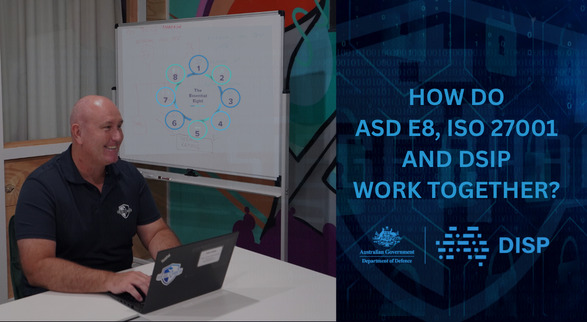
How ASD Essential Eight, ISO 27001 and DISP work together for Defence Suppliers
If you’re dealing with DISP (the Defence Industry Security Program), you are likely to have heard about ASD Essential Eight and ISO 27001. These are not three unrelated tick‑lists, but three different ways of describing and checking the same core job, which is keeping Defence information and systems safe.
In this article, we will look at how these frameworks fit together, why Essential Eight Maturity Level 2 is now the cyber baseline for DISP, and how ISO 27001 can help you meet Australian government cyber security requirements in a structured, repeatable way.
Why DISP cares about Essential Eight Maturity Level 2
DISP is the Department of Defence’s way of making sure its suppliers manage security to an acceptable standard across four domains, being governance, personnel, physical and cyber security. Over the last couple of years, Defence has lifted the cyber bar significantly.
Recent guidance and industry summaries show that:
-
DISP cyber requirements have moved from expecting suppliers to implement the ‘Top 4’ controls, to the full ASD Essential Eight.
-
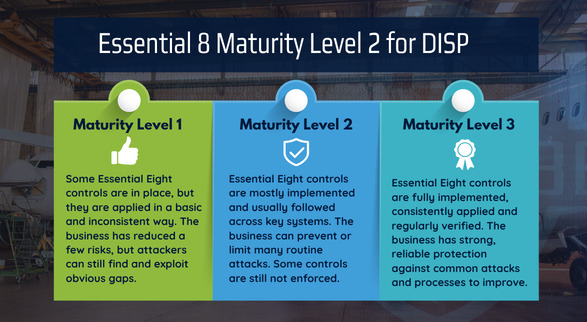
To achieve DISP membership, suppliers are now expected to implement all eight strategies at Essential Eight Maturity Level 2 for the systems they use to interact with Defence.
In practice, this means DISP is using Essential Eight as the concrete measure of defence cyber security compliance. If your Essential Eight implementation is weak, your DISP application or renewal is at risk, no matter how good the rest of your paperwork looks.
A quick refresher on the ASD Essential Eight
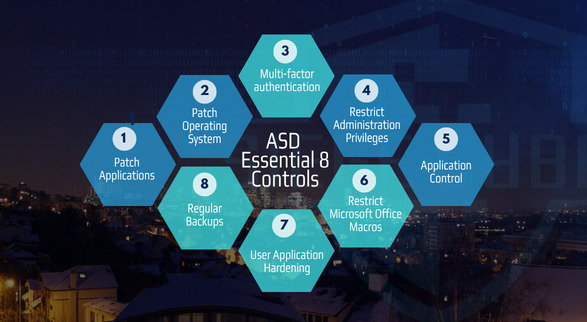
The Essential Eight are a set of technical and process controls recommended by the Australian Cyber Security Centre to prevent and limit common attacks. They cover:
-
Controlling which applications can run
-
Patching applications and operating systems
-
Hardening applications, including Office and browsers
-
Restricting administrative privileges
-
Enforcing multi‑factor authentication
-
Managing Office macros
-
Maintaining regular, tested backups
The maturity model runs from Level 0 to Level 3. At Maturity Level 2, Defence expects you to have moved beyond ad‑hoc controls and into consistent, enforced practice across your environment, not just a few critical servers.
For many small and mid‑sized defence suppliers, the biggest challenge is not understanding what these controls are, but implementing them in a way that fits their size, budget and existing systems. That is where ISO 27001 can make life easier.
How ISO 27001 supports DISP membership requirements
ISO 27001 is an international standard for information security management systems. Rather than listing only technical controls, it sets out how to build a consistent, auditable security management approach across the organisation, from risk assessment and policies through to monitoring and continual improvement.
This aligns very closely with DISP’s expectations that suppliers will:
-
Understand and manage security risks in a structured way
-
Document and enforce policies, procedures and responsibilities
-
Monitor compliance and regularly improve their security posture
For cyber, Essential Eight becomes the specific control set, while ISO 27001 gives you the framework to manage those controls over time. If you already have, or are working towards, ISO 27001 certification, you are in a much stronger position to show Defence that you meet DISP membership requirements in Australia, rather than just scrambling to answer an annual questionnaire.
If you are not sure how your current controls stack up, a structured gap analysis against ISO 27001 and Essential Eight ML2 is often the most efficient starting point. Siege Cyber offers ISO 27001 consulting services and Essential Eight assessments to give you that clear picture and a realistic roadmap, without drowning you in jargon.
Mapping ASD Essential Eight into your ISO 27001 ISMS
One practical way to think about this is to treat Essential Eight controls as part of your ISO 27001 Annex A control set and risk treatment plan.
For example:
-
Application control, patching and hardening map neatly into change management, asset management and supplier management controls in ISO 27001.
-
Admin privilege restrictions align with access control, user provisioning and monitoring requirements.
-
MFA and macro controls support your identity, authentication and secure configuration policies.
-
Backups and recovery procedures fit under business continuity and backup controls.
By handling Essential Eight inside your ISMS rather than as a standalone project, you can reuse governance, risk and policy processes across DISP, ISO 27001 and other obligations like the Privacy Act or sector regulations such as APRA CPS 234.
Where DISP, ISO 27001 and Essential Eight overlap
From a practical perspective, most of the questions you will see in the DISP cyber security domain line up with ISO 27001 control areas and Essential Eight strategies.
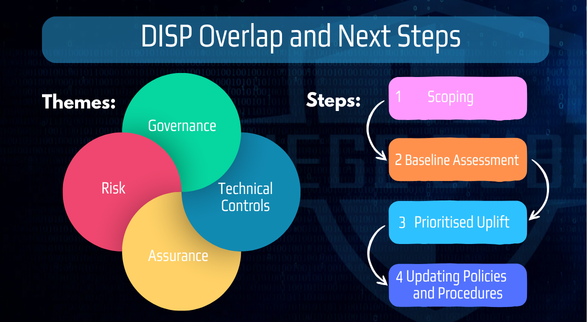
Common themes include:
-
Governance: who is accountable for cyber security and how decisions are made
-
Risk: how you identify, assess and treat information and cyber risks
-
Technical controls: how you configure, patch, harden and monitor systems
-
Assurance: how you test, audit and report on security, including incident management
This is good news. You can build one set of processes and evidence that speak to all three rather than juggling separate, conflicting frameworks. An ISO 27001‑aligned ISMS, backed by Essential Eight ML2‑level technical controls, becomes your single source of truth for defence cyber security compliance.
If you are using compliance automation platforms like Vanta or Drata to help with ISO 27001 or SOC 2, a partner such as Siege Cyber can help tune those platforms to capture the specific controls and evidence that DISP and Essential Eight expect. The platforms handle a lot of the data collection, while human experts ensure the configuration and narratives actually satisfy Defence assessors.
What this means for smaller Defence suppliers
Many smaller Defence subcontractors worry that frameworks like ISO 27001 and Essential Eight are “only for big primes”. In reality, the Department of Defence has made it clear that all DISP members are expected to reach Essential Eight Maturity Level 2, and that this is now a condition of doing business, not a nice‑to‑have.
The good news is that you do not have to implement everything overnight.
Realistic steps include:
-
Scoping: agreeing which systems are in scope for DISP and Essential Eight
-
Baseline assessment: understanding where you sit today against ML2
-
Prioritised uplift: focusing on high‑impact controls like patching, MFA and admin rights first
-
Governance: putting simple, fit‑for‑purpose policies and processes around those controls
If you would like an example of how this could look for your organisation, Siege Cyber’s ISO 27001 services page outlines how we structure engagements for Australian businesses, including Defence suppliers: https://siegecyber.com.au/services/iso-27001/
How Siege Cyber can help you line everything up
Siege Cyber works with Australian organisations that need to meet DISP membership requirements, implement ASD Essential Eight and either build or refine their ISO 27001‑aligned ISMS.
Typical support includes:
-
Essential Eight assessments and maturity uplift plans aligned with DISP expectations
-
ISO 27001 implementation and certification support, including policies, risk assessments and internal audits
-
Penetration testing, security reviews and ongoing vCISO advisory for Defence‑facing environments
For organisations already using platforms like Vanta or Drata, Siege Cyber acts as the local expert who understands both the Australian regulatory environment and the technical reality of your environment. The result is a compliance programme that does more than tick boxes, it reduces risk and supports Defence work.
If you are weighing up the investment side, Siege Cyber’s compliance pricing page gives transparent tiers for ISO 27001, Essential Eight and DISP‑related services.

turning security intentions into results
If Defence work is part of your growth strategy, DISP, ASD Essential Eight and ISO 27001 are now part of the cost of doing business. Done well, they do more than satisfy Australian government cyber security requirements; they give you a consistent way to manage risk and demonstrate trust to prime contractors and Defence alike.
If you want a clear, practical view of where you stand and what it will take to reach Essential Eight Maturity Level 2 for defence, get in touch with Siege Cyber via [email protected]. A short conversation can save months of guesswork and put you on a path that suits your size, systems and contracts.