
DISP Cyber Security Compliance: A Practical Guide for Australian Defence Contractors
If you want to bid into the Australian defence supply chain, DISP cyber security compliance is no longer optional. Defence expects suppliers to manage cyber risk properly and to prove it through the Defence Industry Security Programme and related cyber security requirements.
This guide steps through DISP cyber security requirements in practice, how they line up with frameworks like the ASD Essential Eight, and what to expect from a DISP cyber security assessment as an Australian defence contractor.
What DISP expects from your cyber security
The Defence Industry Security Program sets minimum standards across governance, personnel, physical, and information & cyber security for entities that work with Defence. Once you move beyond very low‑risk work, Defence will expect you to show that you understand cyber threats, have controls in place, and can sustain them over time.
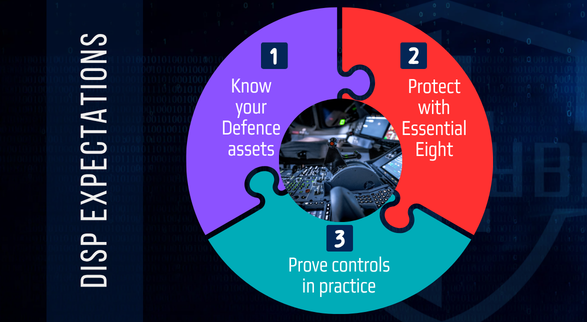
In cyber terms, DISP is looking for three things:
-
You know what sensitive information and systems you have that relate to Defence work.
-
You have fit‑for‑purpose controls to protect them, often aligned to the ASD Essential Eight.
-
You can show evidence that these controls are actually operating and not just written in a policy.
Many organisations already aim to align with the Essential Eight, and a recent Australian survey found that around 90% have committed to that framework, even if maturity is still a work in progress. DISP simply makes that alignment more formal and more visible to Defence.
Key DISP cyber security requirements in practice
The DISP information and cyber security element can feel abstract until you translate it into day‑to‑day activities. In practice, Australian defence contractors are expected to:
-
Maintain an asset register of systems that store, process, or transmit Defence information, including cloud services and SaaS tools.
-
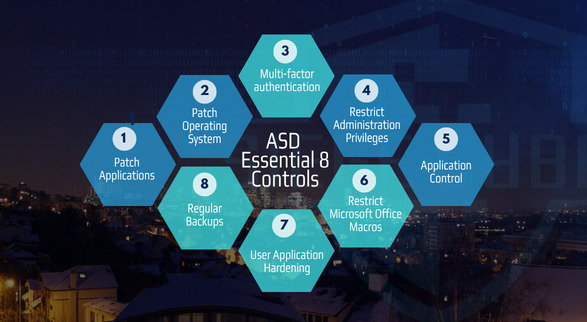
Apply Essential Eight style hardening such as patching, application control, multi‑factor authentication, and restricted admin access, targeted at an appropriate maturity level.
-
Implement structured backup and recovery so ransomware or data corruption does not take you offline for days.
-
Control who has access to Defence information, with joiner‑mover‑leaver processes and regular access reviews.
-
Monitor for suspicious activity and respond quickly when something looks wrong.
-
Manage third‑party risk, especially managed service providers or offshore processing that might touch Defence data.
Australian threat reports show that ransomware, credential theft and targeted extortion are still hammering local organisations in 2026, with threat actors increasingly using generative AI to speed up intrusions. DISP cyber security requirements are designed to raise the bar enough that you are a harder target than the next supplier in the chain.
Linking DISP to the ASD Essential Eight
DISP does not replace the Essential Eight, but rather it leans on it. Defence explicitly references the Essential Eight as a baseline set of mitigation strategies and expects DISP members to work towards appropriate maturity levels.
If you are early in your DISP journey, a practical approach is:
-
Map your current controls to the Essential Eight maturity model and identify gaps.
-
Prioritise uplift of patching, application control, restricted admin, and multi‑factor authentication, as these materially reduce the risk of common intrusions.
-
Embed these controls into policies, procedures, and tooling so you can demonstrate consistent operation, not just one‑off fixes.
The upside is that progress towards Essential Eight maturity helps with other Australian obligations such as the Privacy Act’s reasonable security expectations and, for regulated entities, APRA CPS 234.
If you are not sure where your organisation sits against DISP cyber security requirements and Essential Eight maturity, a focused gap assessment is often the fastest way to get a clear picture and a prioritised roadmap. Siege Cyber provides these assessments for defence suppliers across Australia.
What a DISP cyber security assessment looks like
A DISP cyber security assessment is essentially a structured review of how well your organisation meets the information and cyber security expectations for your desired DISP membership level. There is no single rigid template, but most assessments cover common building blocks.
Governance and risk
Defence wants to see that cyber security is governed. Expect questions around:
-
Who is accountable for information and cyber security and how often it is discussed at leadership level.
-
How you identify, assess, and treat cyber risks that relate to Defence work.
-
How policies and procedures are maintained and communicated to staff.
Auditors globally are becoming less tolerant of paper only security frameworks, and 2026 ISO 27001 guidance highlights the need for evidence that controls operate in practice, not just exist in a manual.
Controls and implementation
The assessment will look at technical and procedural controls, often mapped to the Essential Eight:
-
Patch management and vulnerability remediation, including how quickly you respond when critical flaws are announced.
-
Access control, MFA coverage, and how you protect privileged accounts from adversary‑in‑the‑middle attacks that are now common against MFA.
-
Logging and monitoring of critical systems that hold Defence data.
-
Backup strategies and restoration testing.
Where you use cloud platforms or managed services, expect scrutiny on how you manage shared responsibility and third‑party access, which has become a major focus area in recent SOC 2 and ISO 27001 audits.
Evidence and ongoing assurance
Finally, a DISP cyber security assessment looks for repeatability:
-
Regular security awareness and phishing training for staff who handle Defence information.
-
Periodic internal reviews or independent audits of security controls.
-
Documented incident response processes and lessons learned from previous events.
Defence expects you to be able to show how you are managing cyber risk and how you know that your controls continue to work.
Practical steps to get DISP cyber security ready
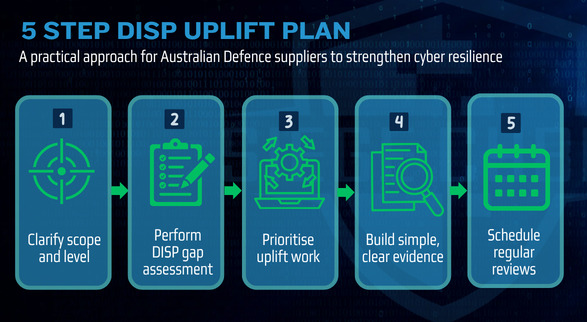
For many small to mid‑sized defence suppliers, the real challenge is turning awareness of DISP membership requirements into a manageable work plan. A practical DISP cyber readiness path usually looks like this:
-
Clarify scope and level
Confirm which DISP level you are targeting and what types of Defence information and systems fall into scope. -
Perform a DISP cyber gap assessment
Compare your current controls against DISP information and cyber security expectations and the Essential Eight maturity model, then rank gaps by risk and effort. -
Prioritise uplift work
Address high‑impact items first such as MFA and identity controls, patching processes, admin access, and backups. -
Build simple, clear evidence
Create lightweight but reliable ways to show that controls operate over time, such as quarterly access reviews, change records, and test restore reports. -
Schedule regular review
Set a cadence, at least annually, to review DISP cyber security compliance and adjust controls as threats and Defence expectations evolve.
Working through these steps alongside your DISP application means you are not just ticking a box for membership, you’re also improving your overall security posture in a way that helps with insurance, customer due diligence and other audits.
How Siege Cyber helps Australian defence contractors
Siege Cyber works with defence suppliers across Australia to prepare for DISP membership and strengthen information and cyber security in a way that will stand up to assessment. Typical support includes:
-
DISP‑aligned cyber security gap assessments, mapped to the Essential Eight and relevant Australian regulations.
-
Practical remediation roadmaps that balance Defence expectations with your budget and delivery commitments.
-
Implementation support across policies, technical controls, and evidence collection, leveraging experience with ISO 27001, SOC 2, and other frameworks.
Siege Cyber also provides clear, transparent pricing for DISP and broader compliance services through its compliance pricing section, which helps you plan uplift work as part of your broader cyber and compliance strategy.
If your DISP journey will eventually intersect with ISO 27001 or SOC 2, Siege Cyber can also act as an expert partner on compliance automation platforms such as Vanta and Drata, bridging the gap between what the platform automates and the deeper, human work of risk assessment, control design and audit preparation.
If you are preparing for a DISP membership assessment or need to lift DISP cyber security compliance, the next step is straightforward. Visit siegecyber.com.au, review the Defence Industry Security Programme service page and compliance pricing, then get in touch via contact@siegecyber.com.au to schedule a short discussion about your current posture and timelines. Siege Cyber can help you turn DISP information and cyber security requirements into a clear plan and give you the confidence to engage with Defence as a trusted supplier.
From Controls to Evidence: What Defence Assessors Look For
Having a control is not the same as being able to prove it. This is the single biggest gap we see in first-time applications. A supplier will say patching is managed, and it genuinely is, but there is no record showing what was patched, when, by whom, and what happened to the exceptions.
Assessors are looking for evidence that is dated, repeatable and attributable. A screenshot taken the week before the assessment proves very little. A monthly report produced the same way for the last six months proves a lot.
Designing a DISP Evidence Framework That Works
The approach that holds up is to decide, for every control, what artefact proves it and where that artefact lives, before you start collecting anything. Then collect it on a cycle rather than in a panic.
In practice that means a small number of recurring outputs: a monthly patch and vulnerability report, an access review with sign-off, training completion records, incident register entries including the ones that turned out to be nothing, and minutes from whatever forum governs security decisions. Five or six artefacts produced reliably beat fifty produced once.
The test we apply is simple. If an assessor asks how you know a control worked in March, can you answer without doing new work?
Doing This Without an Enterprise Security Team
Most Australian defence suppliers are not large businesses, and nobody has a spare full-time person for this. What works at that size is narrowing scope honestly, automating the collection that can be automated, and accepting that a few controls will be manual with a named owner and a calendar reminder.
Compliance platforms help, but they are not the answer on their own. They are good at gathering technical evidence and poor at governance, personnel and physical security, which are three of the four domains DISP assesses. Use them for what they are good at and keep ownership of the rest.
Need help building the evidence? Our DISP membership support covers the four domains and the Annual Security Report. Pricing is on our compliance pricing page.
Siege Cyber runs Essential Eight gap analysis and maturity uplift for Australian organisations, so you can see where each of the eight strategies actually sits. Get a Fixed-Price Quote.
New to DISP? Start with our complete guide to DISP levels and requirements, which covers Entry Level, Level 1 and Level 2, what Defence expects at each, and how the DISP CERTIFY package gets you there.